All species › Cranes, rails and allies › Cranes › Common Crane
Common Crane | Grus grus
Kraanvogel | Grulla común
Common Crane is the grey crane of Eurasia, and it reaches North America only as a rare stray. Almost every bird is found among migrating Sandhill Cranes, where it stands out by its black-and-white head. Nebraska accounts for about two thirds of all records on the continent.
Voice
The call is a loud, rolling bugle, krooh, carrying for kilometres over open country and produced by the same long windpipe coiled in the breastbone as in the other cranes. A pair calls in duet, the female answering higher and faster than the male. In North America the voice is of little help in finding one: on the Platte tens of thousands of Sandhill Cranes call at once, and the notes of the two species cannot be picked apart in that noise. A stray is therefore nearly always found by eye, not by ear.
Recording: Lars Edenius — CC BY-NC-SA 4.0 · Degernäs, Umeå, Västerbottens län, Sweden · xeno-canto
Identification
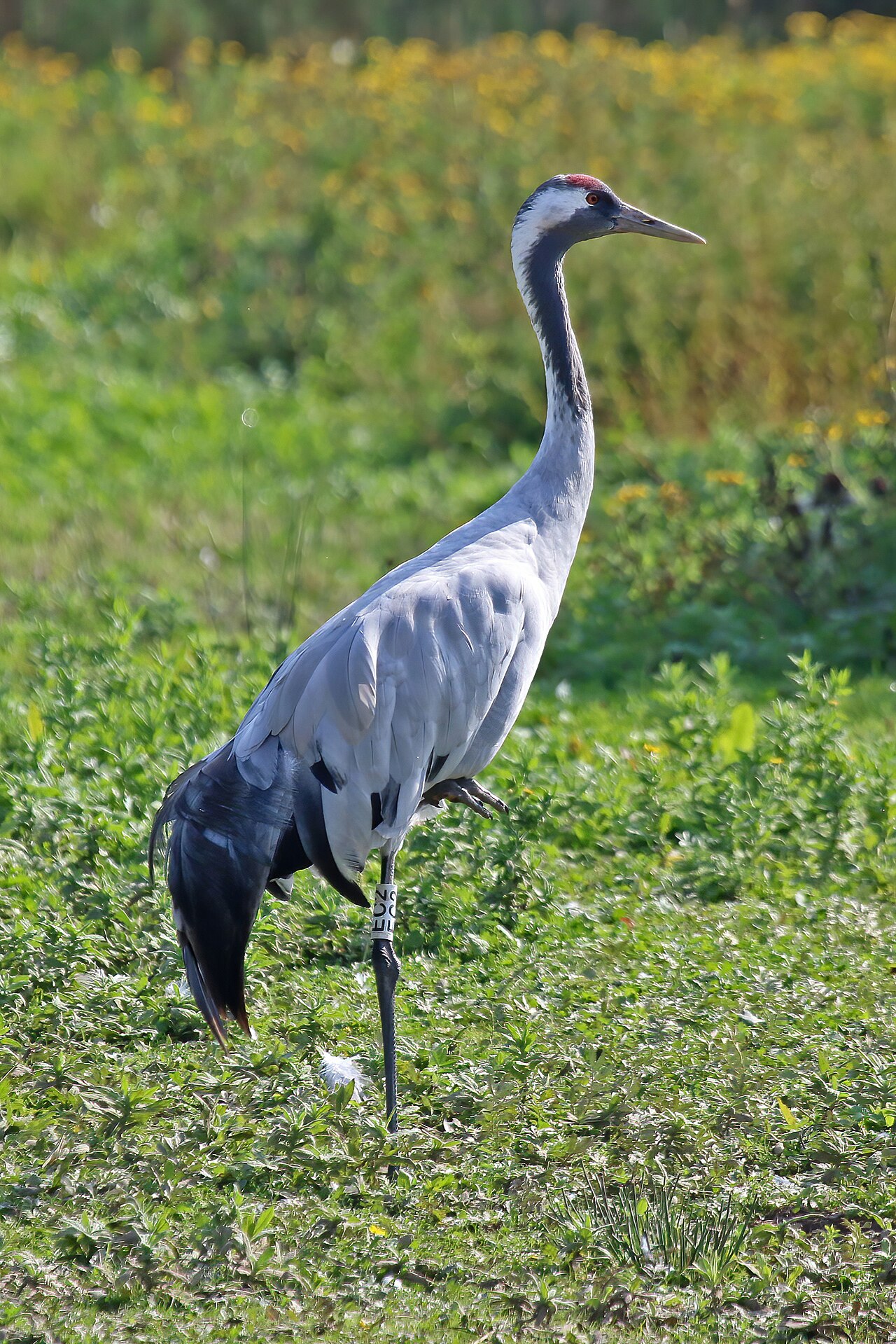
A large crane of about a metre to a metre twenty, slate grey in the body, with the usual crane shape: long neck, long legs and a bustle of elongated secondaries hanging over the tail. The head is black with a broad white stripe that begins behind the eye and runs down the side of the neck, and a small bare red patch sits on the crown. The bill is short and greyish, the legs dark. Male and female look alike, the male slightly larger. Juveniles have a brown head and neck with no white and no red. In flight the neck is extended and the black primaries and secondaries stand out sharply against the grey coverts.
Confusion species
Sandhill Crane is the species it almost always stands among: that bird is washed brownish grey, lacks the black-and-white head stripe and shows red on the forehead only. Whooping Crane, which uses the same flyway, is white with black wingtips and cannot be confused. Watch for hybrids between Common and Sandhill Crane: these have been recorded in North America and show a half-drawn head stripe. A bird with an incomplete or vague pattern is therefore not proof, but a reason to take photographs.
Habitat
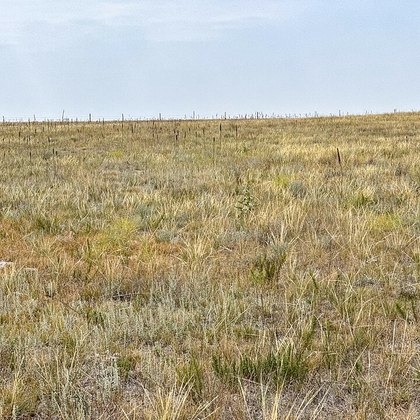
In North America it has no habitat of its own: it uses whatever the flock it travels with uses. That means maize stubble and wet meadows to feed on by day, and shallow sandbars in the middle of a wide river to roost on at night. Forest and deep water are avoided, as by the other cranes. Outside the migration season the species is not present here.
Where the bird is most often found, arranged by the USNVC — the vegetation classification of the United States and Canada — and CMECS for sea and coast.



Range and movements
The species breeds across northern Eurasia and winters from Spain and North Africa to India and eastern Asia; in North America it is a rare stray. Most records come from the Great Plains in spring, above all from the Platte valley in Nebraska, where about twenty-five occurrences have been documented since the first bird in 1972, nearly all between early March and early April. The birds are thought to join Sandhill Cranes in eastern Siberia and to cross the Bering Strait with those flocks. Further east, birds of uncertain origin have also turned up; one escaped bird bred with Sandhill Cranes in New York, Vermont and New Jersey between 1991 and 1996.
Where and when to look
The chance lies in the Platte valley in Nebraska between early March and early April, when Sandhill Cranes are there in hundreds of thousands. Work through the fields flock by flock with a telescope by day and look for one head with a white stripe among thousands of plain grey ones. Photograph the head and neck of any suspect bird, because the hybrids can only be judged on that pattern.
Conservation
Worldwide the species is listed as Least Concern (LC); the world population is large and the number of breeding birds in Europe has risen over recent decades. In North America there is nothing to conserve: not a single pair breeds and there is no population. How often it appears here depends on Eurasian numbers and on the Sandhill Crane flocks it travels with.
Scientific name
Grus grus | (Linnaeus, 1758)
Linnaeus described the species in 1758 as Ardea grus, among the herons; Brisson set up the genus Grus in 1760 with this bird as its name-bearer, which is why author and year stand in parentheses. Genus name and species name being identical is allowed in zoology and is called a tautonym. Grus is the Latin word for a crane and echoes the call. Linnaeus gave Europe and Africa as the type locality; it was later restricted to Sweden.