All species › Cranes, rails and allies › Cranes › Whooping Crane
Whooping Crane | Grus americana
Trompetkraanvogel | Grulla Trompetera
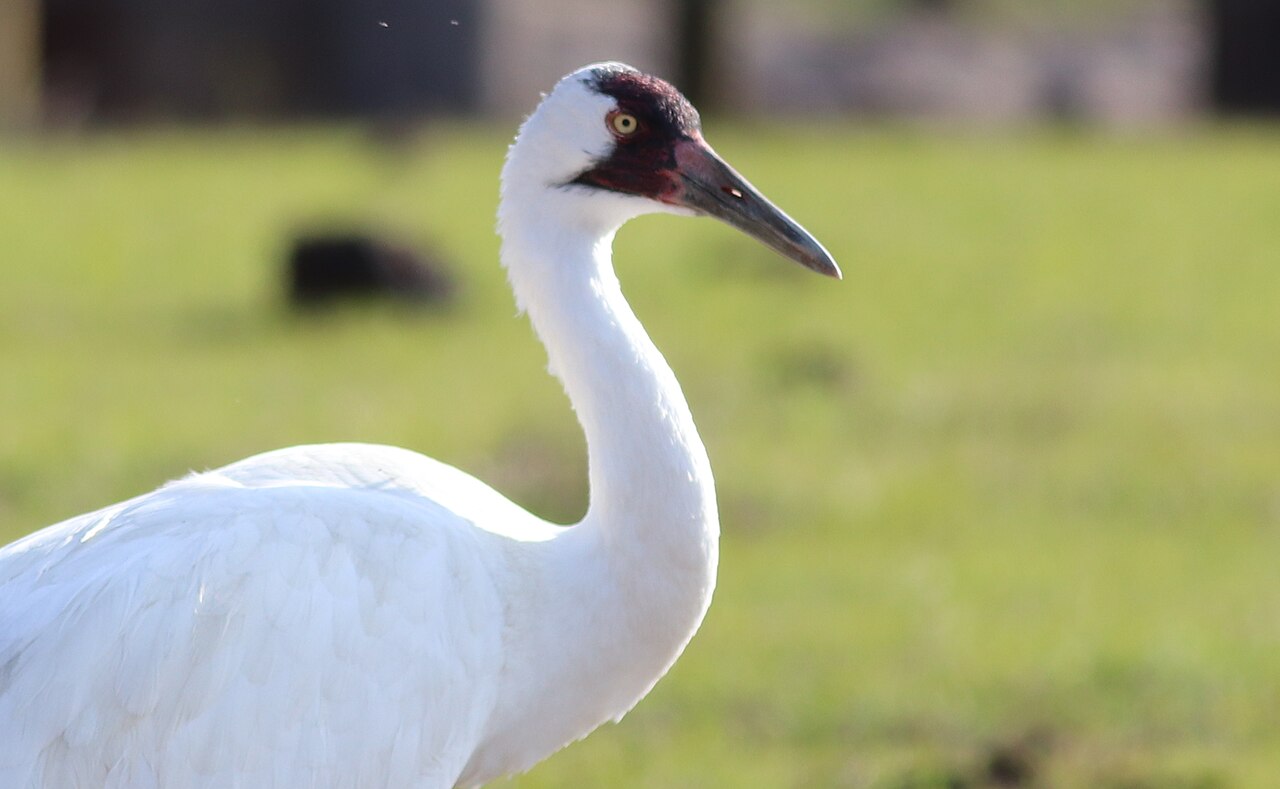
Whooping Crane is the tallest bird in North America: snow white, with black wingtips and a bare red crown, and a call that carries for kilometres across the marsh. In 1941 twenty-one birds were left. After eighty years of counting, protecting and captive breeding there are again more than eight hundred.
Voice
The call is a loud, far-carrying single-note bugle, ker-loo, audible for kilometres over open marsh. The sound is made in an unusually long windpipe that lies coiled in the breastbone and works as a sounding box. A pair gives a unison call in which the female answers each lower note of the male with two or three higher, faster notes, both birds with bills tilted up. Young birds beg with a thin, high peeping that can still be heard well into the first year.
Recording: Sue Riffe — CC BY-NC-SA 4.0 · Backbone Rd, Polk Cty, Florida, United States · xeno-canto
Identification
A bird of about a metre and a half, with a wingspan of over two metres and a weight approaching eight kilograms. The adult is entirely white, with a bare red crown, a dark red streak across the cheek, a long dark pointed bill and black legs. The black primaries show only in flight; on the ground the elongated inner secondaries hang over the tail as a bustle. Male and female are alike, the male a little larger. Juveniles are white blotched with rusty brown on head, neck and back, which wears away through the first year. In flight the neck is fully extended and the legs trail well beyond the tail, with slow, deep wingbeats.
Confusion species
Sandhill Crane has the same shape and carriage but is grey, smaller, and carries a red bare patch on the forehead only. American White Pelican is also white with black wingtips, but has a short neck drawn back in flight, short legs and a large bill. Snow Goose is white with black wingtips and flies with the neck extended, but is far smaller, short-legged and short pink-billed. Great Egret flies with the neck folded, and Wood Stork has a bare dark head and black along the whole trailing edge of the wing.
Habitat
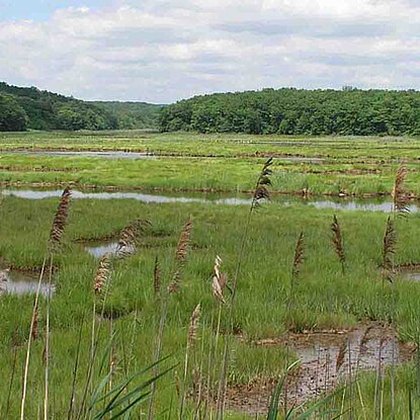
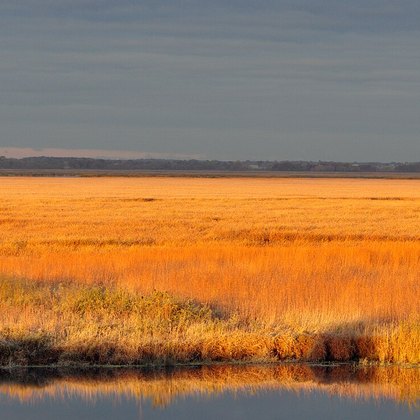
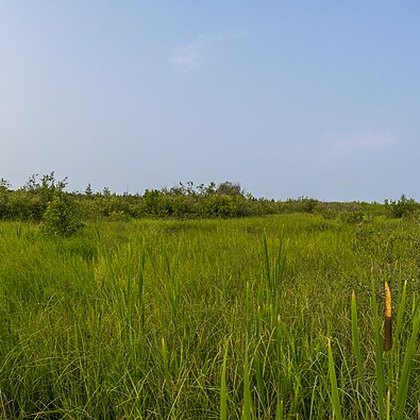
On the breeding grounds it uses shallow marshes of bulrush, cattail and sedge among spruce and tamarack, where a pair holds a large territory. In winter it is a bird of salt marsh, shallow bays and tidal flats on the Texas coast, with saltgrass and cordgrass; there it lives mainly on blue crabs, clams and wolfberry. On migration it uses shallow wetlands, river sandbars and grain stubble to rest and feed. Closed forest and deep water are of no use to it.
Where the bird is most often found, arranged by the USNVC — the vegetation classification of the United States and Canada — and CMECS for sea and coast.


Range and movements
The only self-sustaining population breeds in Wood Buffalo National Park, on the border of Alberta and the Northwest Territories, and winters around Aransas on the Texas coast. The migration route is a narrow band, averaging some three hundred kilometres wide, running across Saskatchewan, both Dakotas, Nebraska, Kansas and Oklahoma. The species once bred across the northern prairies as far as Illinois and wintered from the Gulf Coast into Mexico. Two reintroduced groups have been added: since 2011 a non-migratory group in southwestern Louisiana, and a migratory eastern group that breeds in Wisconsin and winters mainly in Indiana and Alabama.
- Resident
- Breeding (summer)
- Winter
- Passage
- dark = core range, pale = thinly spread
Where and when to look
Aransas National Wildlife Refuge is the surest place from November to March: from the observation tower or from a boat in the bay, pairs with their young of the year can be seen out on the marsh. On migration in Nebraska and Kansas, scan flocks of Sandhill Cranes for a white bird; the black wingtips only show once it takes off. Report any sighting away from the known range, since the birds are tracked individually.
Conservation
The species is listed as Endangered (EN). From the twenty-one birds of 1941 the wild Aransas and Wood Buffalo population grew to an estimated 540 birds in the winter of 2025 to 2026, with average growth of 4.24 per cent a year since 1938. Counting the reintroduced groups and the captive birds, the total is above eight hundred. The main threats are collisions with power lines, shooting through confusion with Sandhill Crane, storms and pollution on the Texas coast, and the narrow genetic base of all the birds together.
Scientific name
Grus americana | (Linnaeus, 1758)
Linnaeus described the species in 1758 as Ardea americana, among the herons; it was later placed in the genus Grus, which is why author and year stand in parentheses. Grus is the Latin word for a crane, and americana refers to the continent. Linnaeus worked from a plate by George Edwards. The type locality is given as North America, later narrowed to Hudson Bay.