All species › Cranes, rails and allies › Rails, gallinules and coots › Ridgway's Rail
Ridgway's Rail | Rallus obsoletus
Californische ral | Rascón de Ridgway
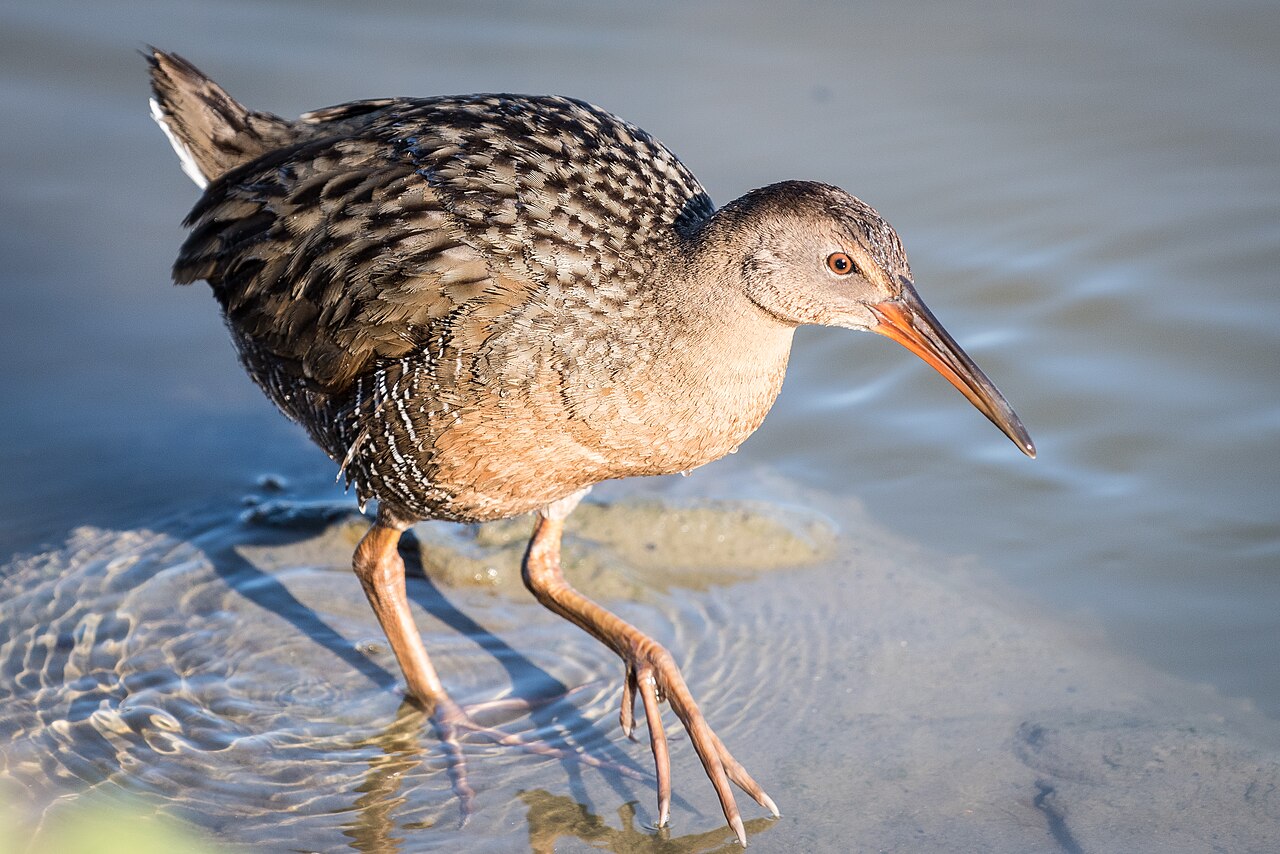
Ridgway's Rail is the large rail of Pacific salt marsh: cinnamon on neck and breast, with a long, slightly drooping bill and a short, cocked tail. It rarely flies and would rather walk through dense marsh, where it is heard from far off and seldom seen. Since 2014 it has counted as a species of its own, separate from the Clapper Rail of the east coast.
Voice
The male's advertising call is a run of hard, clattering kek notes that first speeds up and then slows again, sometimes dozens of notes long. Pairs call together in a grunting duet, to which the female adds a descending kek-burr. Most calling comes in spring at first light and in the last hour of the day, and often around high tide as well. One calling bird usually sets off the neighbours, so the sound travels across the marsh like a wave.
Recording: Paul Marvin — CC BY-NC-SA 4.0 · Tijuana Slough National Wildlife Refuge visitor center, Imperial Beach, San Diego County, California, United States · xeno-canto
Identification
A large, long-legged rail with a small head, a long, slightly drooping bill and a short tail that is often held up. Neck and breast are warm cinnamon, the flanks barred black and white, the back a mixture of black and greyish brown; the cheeks are grey and there is a white patch under the tail. The bill is orange at the base and dark towards the tip, the legs orange-brown. The sexes look alike; the male is slightly larger and heavier billed. Young birds are darker and greyer with less cinnamon on the breast, and downy chicks are entirely black. Seen head-on, the bird is narrow enough to squeeze between the stems, from the side it looks full-bodied; in flight the legs dangle and it goes only a short way.
Confusion species
Clapper Rail is all but identical, but lives on the Atlantic and Gulf coasts and does not occur in the west; until 2014 the two were counted as one species. King Rail (Rallus elegans) is larger, rusty on the breast and a bird of fresh water in the east. In the west the only real confusion is Virginia Rail, which at twenty to twenty-seven centimetres is barely half as long and has a thin red bill. Sora is smaller again, with a short yellow bill and a black face.
Habitat
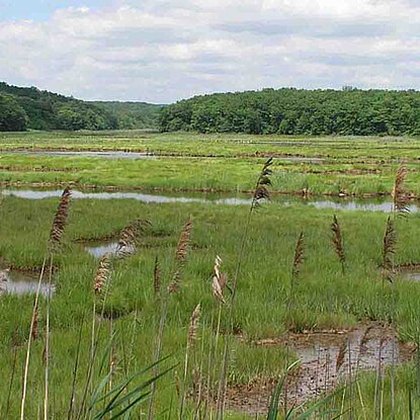
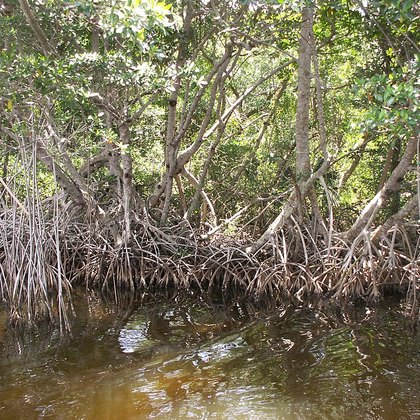
Tidal salt marsh with cordgrass and pickleweed is its core: dense growth to hide and nest in, with muddy creeks alongside to feed in. Along the Mexican coast it also enters mangrove, and along the lower Colorado River it lives in freshwater marsh of cattail and bulrush. It needs the daily tide; at high water it withdraws into the tallest vegetation or onto stranded wrack. Open water without cover, and dried-out marsh grown solid with vegetation, offer it nothing.
Where the bird is most often found, arranged by the USNVC — the vegetation classification of the United States and Canada — and CMECS for sea and coast.



Range and movements
Resident, all year in the same marsh; it does not migrate and rarely moves more than a few kilometres. The range runs from San Francisco Bay along the lagoons of southern California into Baja California, with a second core along the lower Colorado River in California, Arizona and southern Nevada, and on along the coasts of Sonora, Sinaloa and Nayarit. Until 2014 it was counted with Clapper Rail; since then the western birds stand as a species of their own, with the Mangrove Rail of the tropics as a third. In San Francisco Bay more than ninety per cent of the original tidal marsh has gone, and with it the range shrank to a series of separate pieces.
- Resident
- Breeding (summer)
- Winter
- Passage
- dark = core range, pale = thinly spread
Where and when to look
Walk a boardwalk through salt marsh at sunrise in March or April and wait for the clattering duet; in those weeks it calls most. A spring tide helps: at extreme high water the bird is pushed out of the vegetation, walks along the edge or swims a stretch of open water. Watch then for the white patch under the tail, which flashes at every step.
Conservation
The species is Near Threatened (NT) on the Red List and is declining through the loss and fragmentation of tidal marsh. The birds of San Francisco Bay number about eleven hundred; the forms of southern California and of the Colorado River are listed as endangered in the United States. Introduced cordgrasses, introduced red fox and rats, and a rising sea that presses the marsh against dykes and roads are the heaviest threats.
Scientific name
Rallus obsoletus | Ridgway, 1874
Robert Ridgway described the bird in 1874 as Rallus elegans var. obsoletus, that is as a variety of King Rail; because the name has stayed within Rallus, author and year carry no parentheses. obsoletus is Latin for 'worn' or 'faded', after the dull plumage of the birds from the bay. The description appeared in The American Naturalist 8, page 111, with San Francisco, California as the type locality. The English name honours the same ornithologist.