All species › Cranes, rails and allies › Rails, gallinules and coots › King Rail
King Rail | Rallus elegans
Koningsral | Rascón Elegante
King Rail is the largest rail in North America, a bird of freshwater marsh with a rusty breast and a long, slightly curved bill. It walks through dense reed and cattail and is heard mainly at dusk. Since 1966 numbers have fallen by about eighty-five per cent, above all in the interior.
Voice
The male's call is a run of hard, wooden kek notes, slower and deeper than the Clapper Rail's and with clear gaps between them. There is also a grunting series of jupe-jupe-jupe notes that fades away in strength, with which pairs answer each other. Most calling comes in April and May at sunrise and after sunset, and sometimes right through the night. A sudden bang or a passing train can set a whole marsh edge calling.
Recording: John A. Middleton Jr. — CC BY-NC-SA 4.0 · Mallory Swamp, Lafayette County, Florida, United States · xeno-canto
Identification
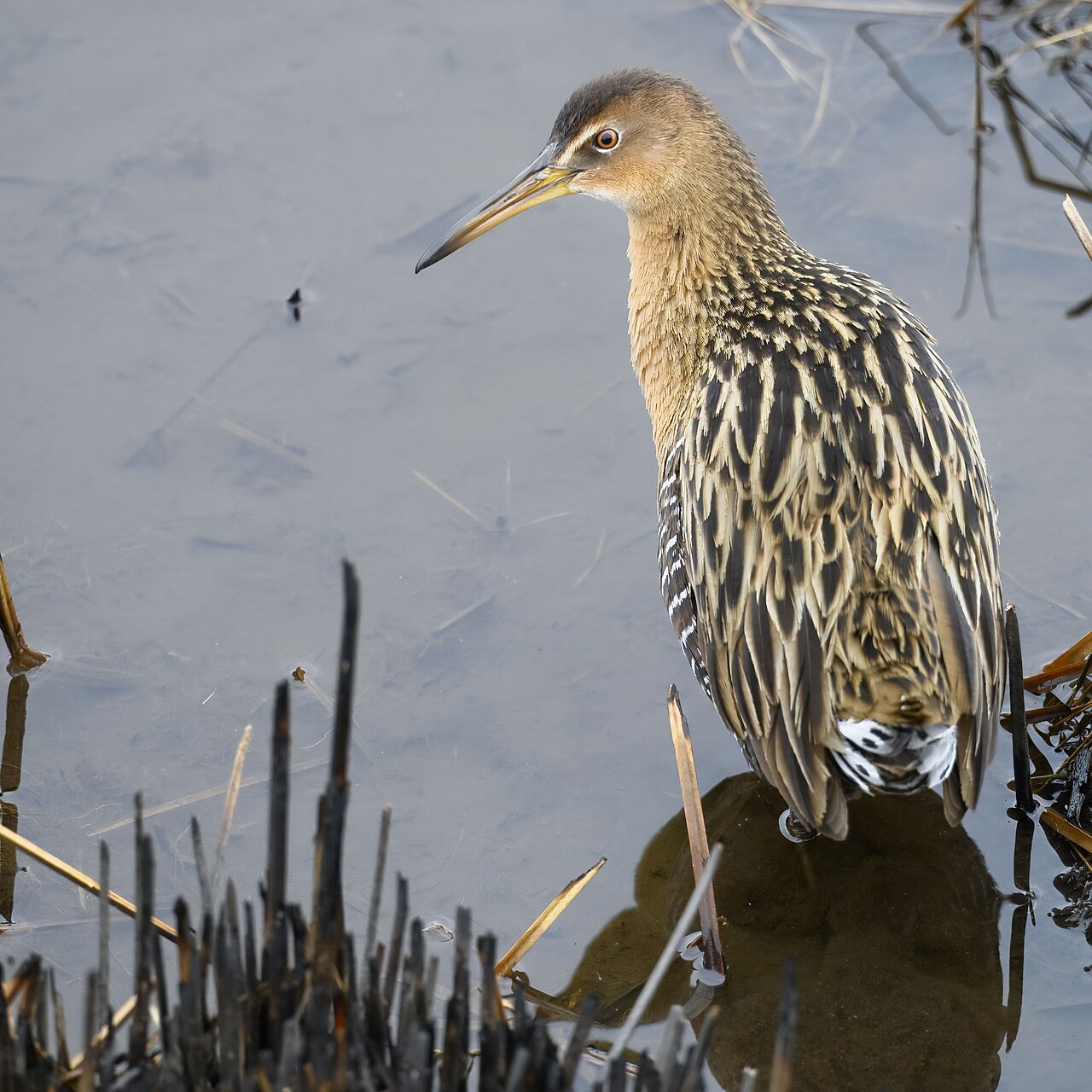
A large, long-legged rail with a small head, a long and slightly drooping bill and a short tail. The breast and foreneck are warm rusty, the cheeks grey and the throat whitish; the back is blackish brown with olive feather edges and the flanks are sharply barred black and white. The bill is orange at the base with a dark tip and the legs are long and orange-brown. The sexes are alike in colour; the male is larger. Young birds are darker and duller with a drab breast, and downy chicks are entirely black. In flight the legs dangle and it beats low over the reed, usually only for a few tens of metres.
Confusion species
Clapper Rail is smaller, greyer and duller, with an olive-brown rather than rusty breast, and keeps to salt tidal marsh; where fresh and salt water grade into each other intermediate birds occur, because the two species interbreed there. Ridgway's Rail of the west coast closely resembles Clapper Rail and does not overlap with this species. Virginia Rail has the same colour pattern but at twenty to twenty-seven centimetres is much smaller — barely more than half as long — and far finer billed. Sora is small and grey and has a short yellow bill.
Habitat
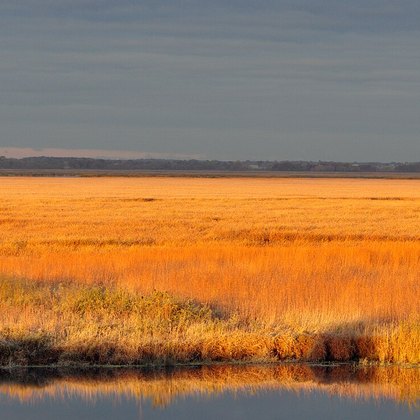
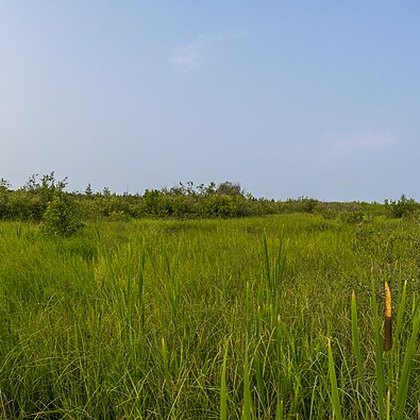
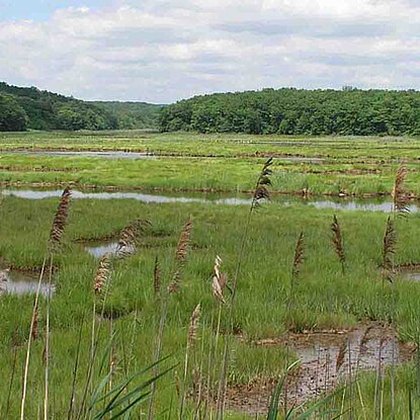
Freshwater and brackish marsh with cattail, bulrush, reed and sedge, with shallow water and muddy openings to feed in. Rice fields, wet meadows, diked marsh units and broad roadside ditches are used too, as long as there is cover and a soft bottom. It wants a mosaic of dense growth and open mud, and avoids both deep open water and fully saline tidal marsh. Where the water turns saltier, Clapper Rail takes its place.
Where the bird is most often found, arranged by the USNVC — the vegetation classification of the United States and Canada — and CMECS for sea and coast.


Range and movements
Resident on the coastal plain of the Gulf of Mexico and the southern Atlantic seaboard, from Texas to Florida and north to Delaware, with a settled population on Cuba. Inland it breeds locally north to the Great Lakes and extreme southern Ontario; those birds move south in autumn and winter on the Gulf Coast, with part of them carrying on to Tamaulipas and Veracruz. During the twentieth century the interior range contracted sharply through the draining of marshes, the straightening of creeks and the loss of wet meadow. On the coast it holds on locally.
- Resident
- Breeding (summer)
- Winter
- Passage
- dark = core range, pale = thinly spread
Where and when to look
Look for it in May at sunrise along the edge of a freshwater marsh or a diked reed unit, and listen for a quarter of an hour before moving. If no answer comes, a hard clap of the hands helps: the bird reacts to sudden noise. A rail that does step out almost always walks the line between reed and open mud, and withdraws at the first movement.
Conservation
The species is Near Threatened (NT) on the Red List; North American numbers have fallen by about eighty-five per cent since 1966. In Canada it counts as endangered and in several Midwestern states it is protected by law. Drainage, the salting up of coastal marsh and the loss of shallow floodplain are the main causes; in a number of states it is also still a game bird.
Scientific name
Rallus elegans | Audubon, 1834
John James Audubon described the species in 1834 as Rallus elegans; it still stands in that genus, so author and year carry no parentheses. The name appeared with plate 203 of The Birds of America, the text in the third volume of the Ornithological Biography. elegans is Latin for 'choice' or 'trim', after the sharply drawn barring on the flanks. Several states were first given as the type locality; it was later restricted to Charleston, South Carolina.