All species › Cranes, rails and allies › Rails, gallinules and coots › Clapper Rail
Clapper Rail | Rallus crepitans
Klapperral | Rascón Crepitante
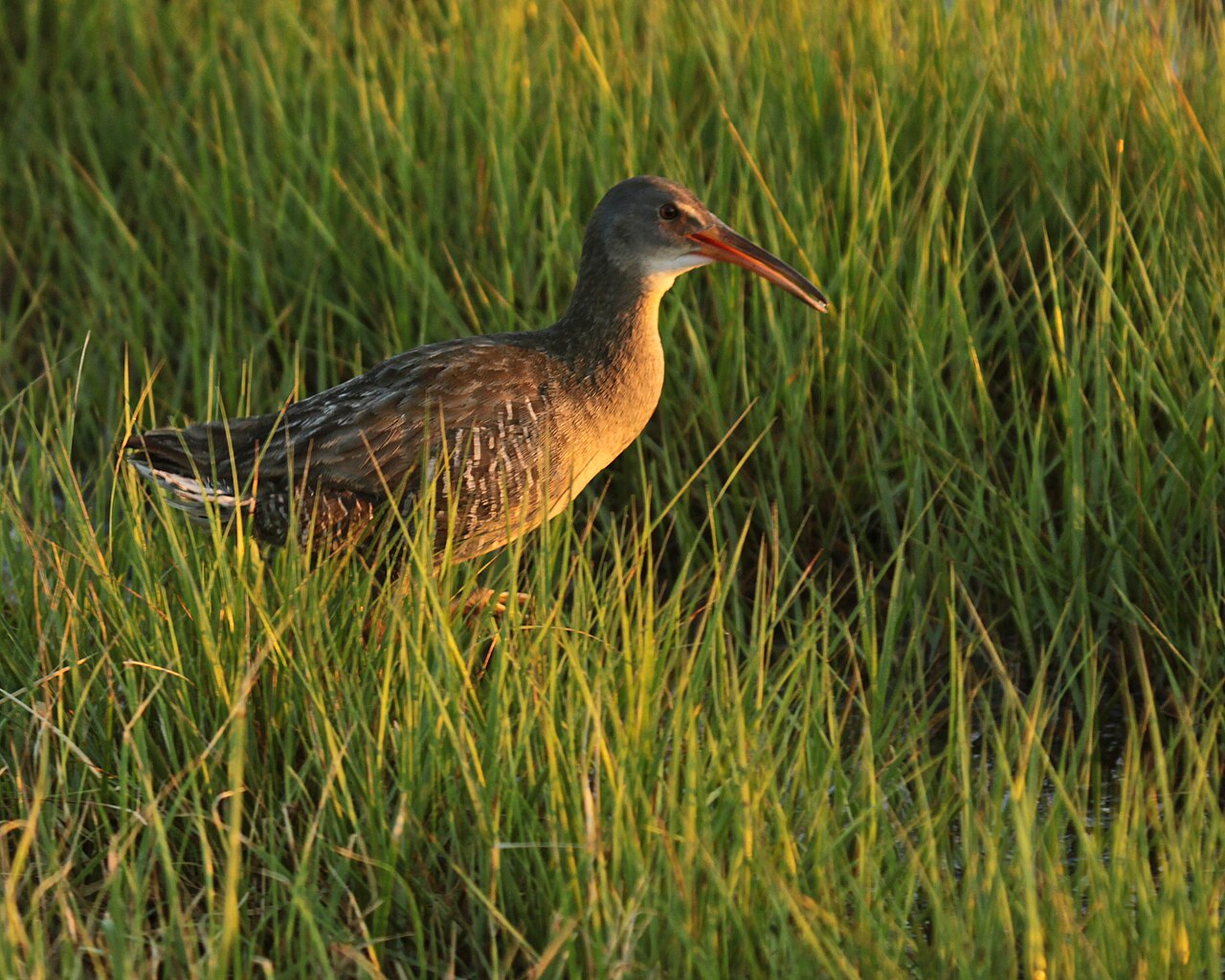
Clapper Rail is the rail of salt tidal marsh along the Atlantic and Gulf Coasts, a grey-brown bird with a long, slightly curved bill. It owes its name to the clattering run of calls that rolls through the cordgrass on the rising and falling tide. To see one you have to wait for a spring tide; hearing one is possible almost any day.
Voice
The characteristic sound is a loud, clattering series of kek-kek-kek-kek notes that starts fast, slows after a dozen notes and then dies away. Pairs add a low, grunting duet to it, and an alarmed bird gives a short, sharp kek. One calling bird infects the neighbours, so the sound travels across the marsh as a chain reaction; this happens by day as well as at night, with a peak around dusk and high tide. In autumn and winter it is quieter, but seldom wholly silent.
Recording: Scott McConnell — CC BY-NC-SA 4.0 · Sea Isle City, Cape May County, New Jersey, United States · xeno-canto
Identification
A large, slender rail with a small head, a long and slightly drooping bill and a short tail that is often held up. Head, neck and breast are pale grey-brown to dull cinnamon, with a grey cheek; the back is dark olive-brown with pale feather edges and the flanks are barred grey and white. There is a white patch under the tail, the bill is orange at the base with a dark tip, and the legs are dull yellow to pinkish, usually under mud. Breast colour varies with region: birds of the northern Atlantic coast are the drabbest, those of the Gulf Coast and the Caribbean warmer in tone. Young birds are darker and greyer, downy chicks entirely black. The body is deep from the side but narrow head on, which is what lets it walk between dense stems.
Confusion species
King Rail is larger, with a rusty breast, a tawnier back and more sharply barred black-and-white flanks, and keeps to fresh water; in brackish transition zones the two breed side by side and intermediate birds cannot be named with certainty. Ridgway's Rail closely resembles this species but lives on the Pacific, thousands of kilometres away. Virginia Rail has the same pattern in miniature: twenty to twenty-seven centimetres, with a thin red bill and a clearly grey face. Sora has a short yellow bill and a black mask and cannot be mistaken for this species.
Habitat
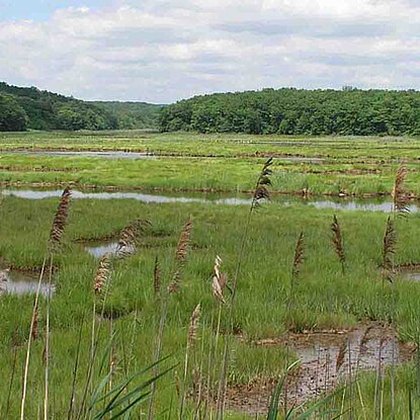
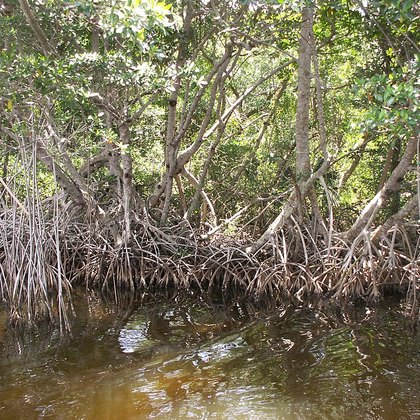
Salt tidal marsh with cordgrass and needlerush, cut by creeks with bare mud banks where it feeds at low water. In the south of the range that shifts to mangrove, and at the upper edge of the marsh to brackish reed and rush. It needs a daily tide and a band of tall vegetation or stranded wrack to shelter in at high water. It avoids fresh inland marsh and open water without shoreline growth.
Where the bird is most often found, arranged by the USNVC — the vegetation classification of the United States and Canada — and CMECS for sea and coast.



Range and movements
Resident along the Atlantic coast from southern New England to Florida and on westward along the Gulf to Texas and Tamaulipas, with populations in the Bahamas, Cuba, Hispaniola, Puerto Rico, the northern Antilles, northern Yucatán and the coast of Belize. Only the northernmost birds leave their marsh in winter and shift south; the rest stay all year. Until 2014 the species was counted together with Ridgway's Rail and Mangrove Rail as one; since then there are three. On the east coast numbers have been fairly stable in recent decades, though much salt marsh has been lost over two centuries.
- Resident
- Breeding (summer)
- Winter
- Passage
- dark = core range, pale = thinly spread
Where and when to look
Go to a salt marsh on a spring tide or after an onshore gale: at extreme high water the cordgrass is submerged and the rails walk in the open along the narrow strips that stay dry. On ordinary days the last hour before sunset is the best time, when a single call sets the whole marsh clattering. Do not walk into the marsh but stay on a dyke or boardwalk; the bird comes past along the creek edge of its own accord.
Conservation
Least Concern (LC) worldwide, with stable numbers along the coast of the United States. The loss of salt marsh to reclamation, building and salinity change is the old threat; rising sea level is the new one, because a marsh pressed against a dyke or a road cannot move inland with it. Nests are flooded out by spring tides and storms every year, and oil spills on the Gulf Coast have hit whole marshes locally.
Scientific name
Rallus crepitans | Gmelin, 1789
Johann Friedrich Gmelin described the species in 1789 as Rallus crepitans, in the thirteenth edition of Linnaeus's Systema Naturae; it still stands in that genus, so author and year carry no parentheses. crepitans is the Latin participle of crepitare, 'to rattle' or 'to clatter', after the run of calls. The original type locality read only 'in Noveboraco', in New York; it was later restricted to Long Island. The English and Dutch names both say the same thing as the species name.