All species › Cranes, rails and allies › Rails, gallinules and coots › Virginia Rail
Virginia Rail | Rallus limicola
Virginiaral | Rascón de Virginia
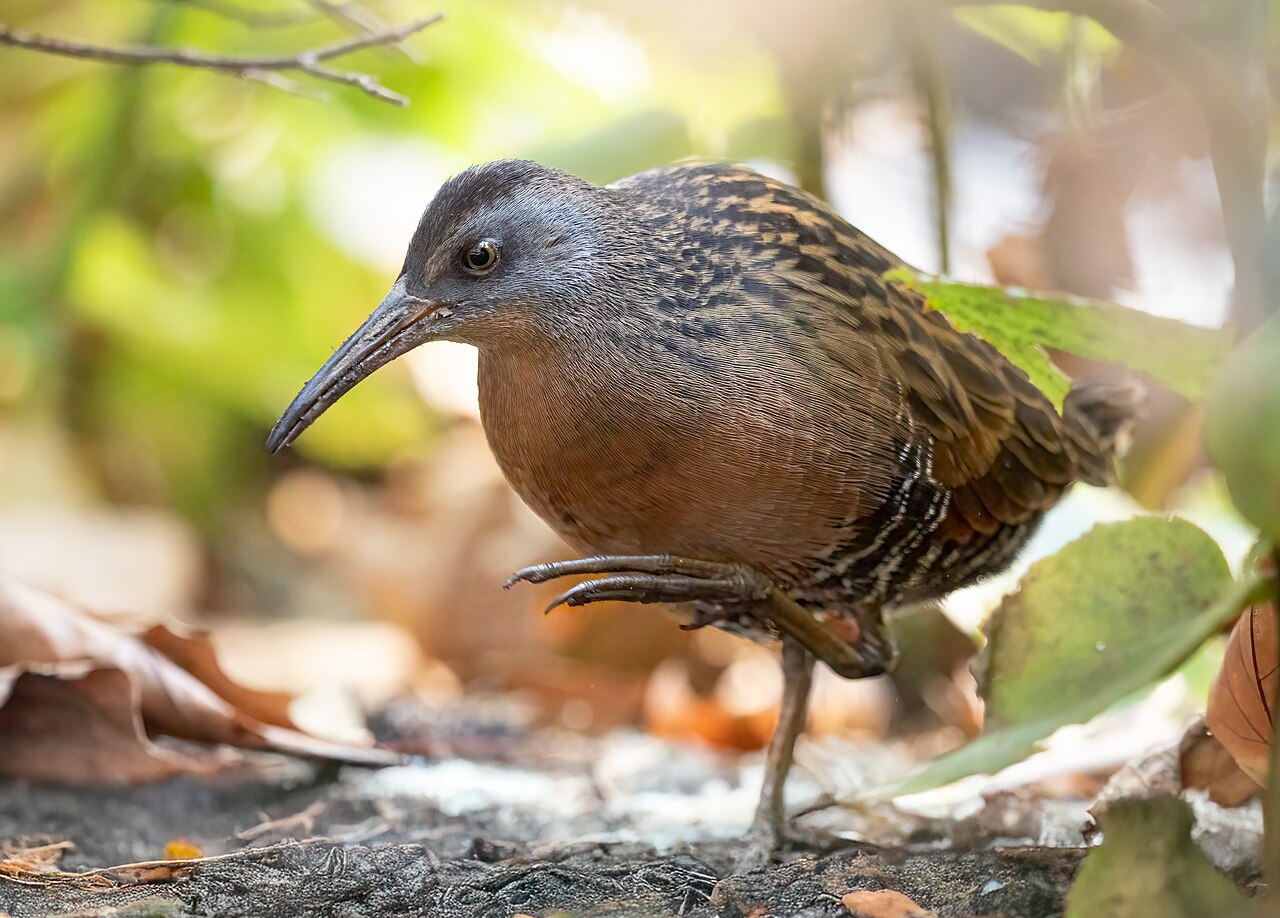
Virginia Rail is the small, rusty rail of freshwater marsh, with a long red bill and a grey face. It is found across almost the whole continent and yet most birdwatchers know it only as a voice. Of all birds it has the heaviest leg muscles relative to its flight muscles, and that shows in the way it moves through the reeds.
Voice
The best known sound is a run of metallic kid-ick kid-ick kid-ick notes, fast one after another and with the tone of two pebbles tapped together. There is also a descending series of grunting notes, falling away in pitch and strength, usually delivered by the pair together. An alarmed bird gives a short, high keep. Most calling comes in April and May at dusk and in the first hours of the night; outside the breeding season it is nearly silent.
Recording: Frank Severson — CC BY-NC-SA 4.0 · West Sacramento, Yolo County, California, United States · xeno-canto
Identification
A small rail with a long, thin and slightly drooping bill and a short tail that is often held up. The underparts are warm rusty, the cheeks grey, the back dark brown with coarse black streaking; the flanks are sharply barred black and white and it is white under the tail. Bill and legs are red to reddish brown, though the legs are usually muddy. The sexes are alike; the male has a slightly longer bill. Young birds are sooty black below with a dark bill and lack the rusty tones, which raises questions every autumn. In flight the legs dangle and it beats weakly and low, dropping back into the vegetation after a few tens of metres.
Confusion species
Sora lives in the same marsh but has a short, thick yellow bill, a black face and no rust on the breast. King Rail and Clapper Rail share the colour pattern but are nearly twice as long, with a far heavier bill; the same goes for Ridgway's Rail on the west coast. Young Virginia Rails are confused with Black Rail, which is much smaller, white-speckled on the back and red-eyed. A rail seen briefly in flight is told by the long red bill and the rusty underparts.
Habitat
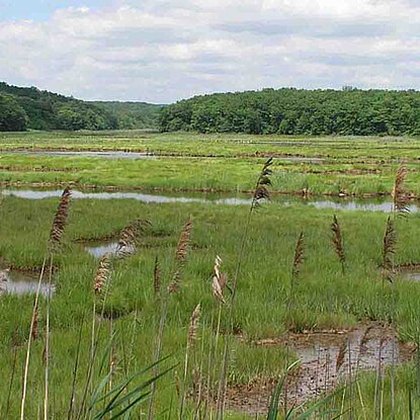
Freshwater and brackish marsh with cattail, bulrush and sedge, with shallow water, soft mud and a dense, tall stand above it. It looks above all for the boundary between cover and open mud, and also uses wet meadows, silting pond edges and old peat cuttings. In winter it turns up in coastal salt marsh and along tidal creeks as well. Deep open water, fast streams and dry reedbeds grown solid are of no use to it.
Where the bird is most often found, arranged by the USNVC — the vegetation classification of the United States and Canada — and CMECS for sea and coast.




Range and movements
A breeding bird of southern Canada and the northern half of the United States, from British Columbia and Nova Scotia south to Colorado and Pennsylvania. On the west coast, in the southwest and along the mid-Atlantic seaboard it stays all year; interior and northern birds migrate at night to the southern states and Mexico. In winter it is most numerous in the coastal marshes of the Gulf and the south Atlantic states. The range has grown smaller and patchier over the past century where freshwater marsh was drained, but the species still occurs throughout that area.
- Resident
- Breeding (summer)
- Winter
- Passage
- dark = core range, pale = thinly spread
Where and when to look
Go to the edge of a cattail marsh half an hour after sunset in April or May and stand still; the grunting duet often comes from a few metres away without the bird ever showing. In winter a creek edge at low tide is the best place: then it walks the bare mud along the vegetation. Trust the ear rather than the eye, and leave recordings of its call at home during the breeding season.
Conservation
Widespread and numerous, with no sign of a continent-wide decline; the species is listed as Least Concern (LC). The main pressure comes from the drainage and silting up of shallow freshwater marsh and from the conversion of wet meadow to arable land. In a number of states and provinces it is still a game bird, though little shot. Because it can be counted only by its call, the trend is hard to establish.
Scientific name
Rallus limicola | Vieillot, 1819
Louis Pierre Vieillot described the species in 1819 as Rallus limicola, in the twenty-eighth volume of the Nouveau dictionnaire d'histoire naturelle; it still stands in that genus, so author and year carry no parentheses. limicola is built from the Latin limus ('mud') and colere ('to inhabit'), so 'mud-dweller'. The type locality is given as the United States, later narrowed to Pennsylvania, after a plate by Edwards. The South American and Andean birds once counted with this species now stand as species of their own.