All species › Cranes, rails and allies › Rails, gallinules and coots › Sora
Sora | Porzana carolina
Soraral | Polluela Sora
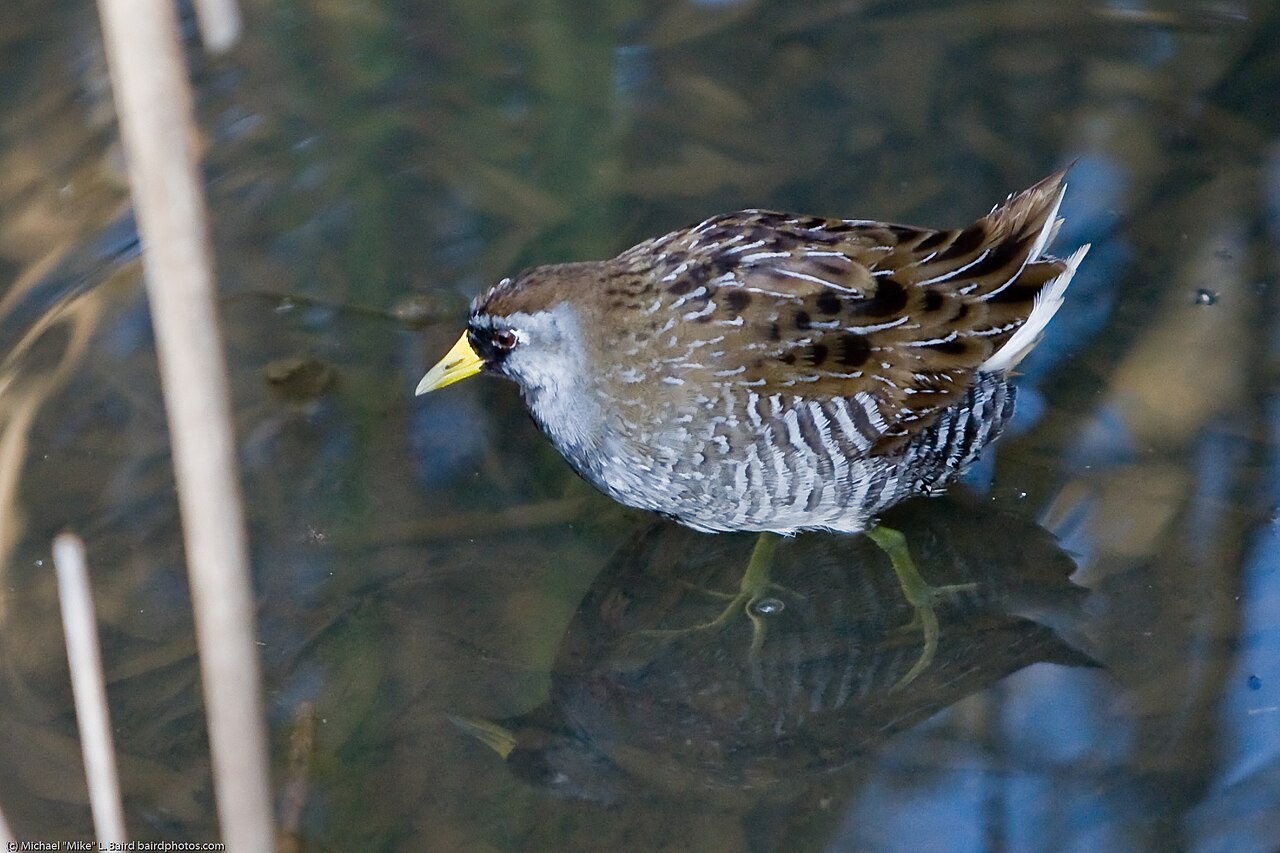
Sora is the most numerous and widespread rail in North America: a stocky marsh bird with a short, thick yellow bill and a black face. Of all the rails it is the easiest to see, because in the early morning it walks out onto open mud along the reed edge. Despite short, rounded wings it covers thousands of kilometres in autumn, as far as South America.
Voice
The best known sound is a high, descending whinny: a run of notes that drops in pitch one after another and dies away, from deep in the marsh. There is also a clear rising ker-wee, repeated for hours in the evening, and a sharp keek when startled. It reacts to sudden noise: a slammed car door or a stone thrown into the water can set a whole marsh edge calling. Most calling comes in April and May as dusk falls and through the night.
Recording: Bjørn Olav Tveit — CC BY-SA 4.0 · Grindholmen, Kurefjorden, Råde kommune, Østfold, Norway · xeno-canto
Identification
A small, stocky rail with a short, thick yellow bill, a short tail that flicks up and long toes on yellow-green legs. The plumage is mottled grey-brown with white feather edges on the back, a slate-grey neck and breast, and fine white streaks across the flanks; under the tail is a white panel. The adult male has a black face and a black throat patch; the female is duller and has less black. Young birds lack the black altogether and have a buff face and a pale bill, so in autumn they look like quite another species. Downy chicks are black with orange bristles around the throat. In flight the legs dangle and it goes low and fluttering over a short distance.
Confusion species
Virginia Rail lives in the same marsh but has a long, thin red bill and rusty underparts instead of grey. Yellow Rail is smaller and buff, with dark stripes on the back and a white wing panel that shows only in flight. Black Rail is smaller again, dark slate with white speckling and a red eye. Young Soras without the black face are most often taken for a Yellow Rail; the short yellow bill and the white flank streaks then settle it.
Habitat
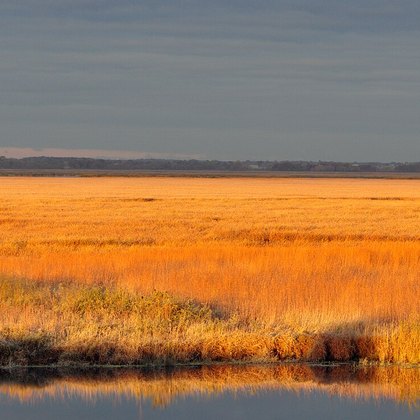
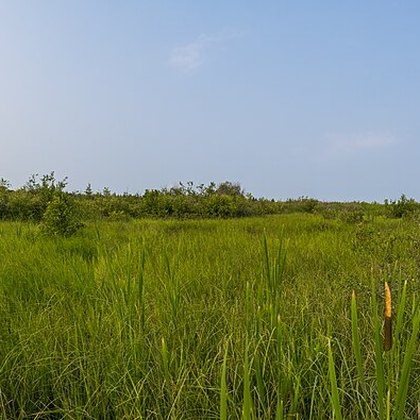
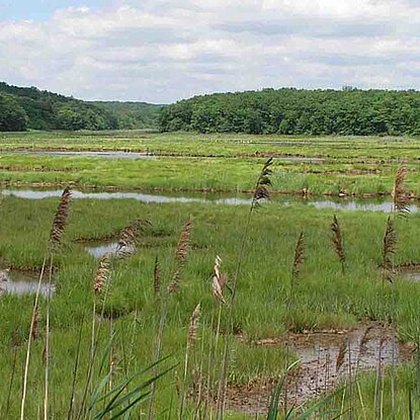
Shallow freshwater marsh with cattail, bulrush, sedge and wild rice, with patches of open mud between the stems. On migration it also uses wet meadows, flooded fields, ditches, rice fields and even small fringes of reed around ponds. In winter it turns up in brackish marsh and mangrove as well. Deep open water and dry, solidly grown vegetation with no mud beneath it are of no use to it.
Where the bird is most often found, arranged by the USNVC — the vegetation classification of the United States and Canada — and CMECS for sea and coast.

Range and movements
A breeding bird of southern Alaska, almost all of Canada and the northern half of the United States, reaching south into California, Arizona and New Mexico. From August it migrates south by night and winters in the southern states, throughout Mexico, Central America, the Antilles and northern South America. In autumn large numbers gather in wild rice marshes, where it was once heavily hunted. The breeding range has barely changed shape over the past century, although the marshes within it have grown smaller.
- Resident
- Breeding (summer)
- Winter
- Passage
- dark = core range, pale = thinly spread
Where and when to look
Look for it in September or October at the edge of a marsh whose water has been drawn down: on the exposed mud it walks in full view, in short steps with a flicking tail. In spring the ear works better than the eye — sit down at sunset and wait for the descending whinny. If in doubt look at the bill: short and yellow belongs to this species, long and red to Virginia Rail.
Conservation
Not threatened (Least Concern) and the most numerous rail on the continent, with a population spread right across the breeding range. The draining of shallow marsh and the conversion of wet meadow to arable land are the main pressures; the loss of stopover sites on migration adds to them. In many states and provinces it is a game bird, with a harvest that is small against the numbers. Because it is counted mainly by its call, the trend is less sharply known than for birds of open water.
Scientific name
Porzana carolina | (Linnaeus, 1758)
Linnaeus described the species in 1758 as Rallus carolinus, in the tenth edition of the Systema Naturae; because it was later placed in Porzana, author and year stand in parentheses. Porzana comes from an Italian name for the small crakes, and carolina refers to Carolina. The type locality reads North America and was later narrowed to Hudson Bay, after a plate by Edwards. The name Sora comes from an indigenous language of eastern North America and has been taken over into English.