All species › Cranes, rails and allies › Rails, gallinules and coots › Common Gallinule
Common Gallinule | Gallinula galeata
Amerikaans waterhoen | Gallineta Americana
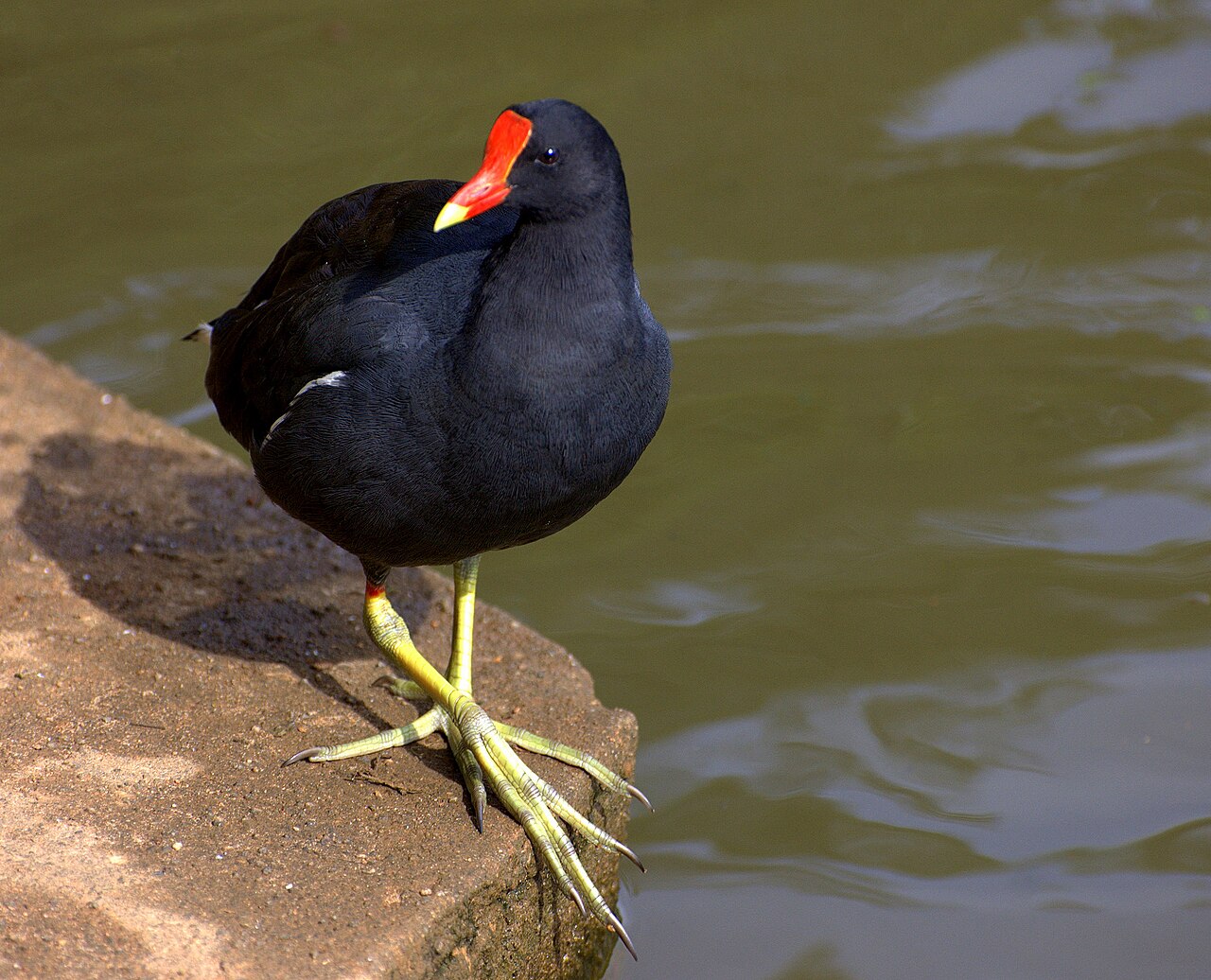
Common Gallinule is the slate-grey marsh bird with the fiery red bill and red frontal shield that swims like a duck without having webbed feet. A broken white line along the flank and a divided white undertail give it away even when the colour of the bill cannot be made out. Since 2011 it has been treated as a species separate from the Eurasian Moorhen of Europe and Asia.
Voice
Out of dense reeds comes a loud, laughing series that starts high and falls away in a cackle: kek-kek-kek-kek-kek, slower and lower with every note. There are also single hard kek and kruk notes, a nasal barking and a short scraping sound like tearing paper. Both sexes call, all year round, and most of all at dusk and in the first hours of the night. Downy chicks beg with a thin, high peeping right beside the parent.
Recording: Emily Ritter — CC0 · Stockton (near Stevens Point), Portage County, Wisconsin, United States · xeno-canto
Identification
A medium-sized marsh bird, slate-grey on head, neck and underparts and olive-brown on back and wings, with a red frontal shield and a red bill tipped in yellow. A broken white line runs along the flank, formed by the white edges of the flank feathers; under the tail are two white patches with a black stripe between them. The legs are yellow-green with a red ring above the tarsus, and the toes are long and unlobed. The sexes look alike; the female averages slightly smaller. Young birds are dull brown with a grey belly and a greenish bill without red, but they already show the white flank line. Swimming, the head pumps with every stroke and the tail is held up; it takes off with legs dangling and fluttering beats, low over the reeds.
Confusion species
American Coot swims on the same water but is rounder and evenly dark grey, with a white bill, a white shield and broad lobes along the toes; it has no white flank line. Purple Gallinule (Porphyrio martinica) has the same red bill with a yellow tip, but a pale blue shield above it, and beyond that purple-blue underparts and long yellow legs. Gray-headed Swamphen of southern Florida is far larger and heavier, with a grey-blue head, red-orange legs and no white flank line. Young gallinules are confused with Sora, which is shorter and rounder, has a yellow conical bill and shows an unmarked white patch under the tail with no black centre.
Habitat
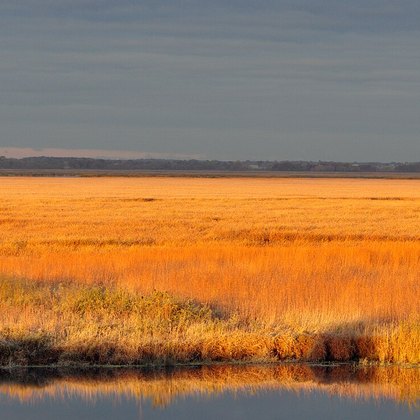
Shallow fresh and brackish marshes with cattail, reed or bulrush and open water among them; also ditches, canals, rice fields, fish ponds, retention ponds and the vegetated shores of lakes. It needs two things at once: floating and standing plants to walk over and nest in, and open water or bare mud to feed on. Deep water without plants and fast-flowing rivers are of no use to it, and it does not go out onto open salt water. In the south of its range it breeds right inside towns, in any ditch with enough cover.
Where the bird is most often found, arranged by the USNVC — the vegetation classification of the United States and Canada — and CMECS for sea and coast.




Range and movements
Present all year along the Gulf and southern Atlantic coasts, in Florida, in California and Arizona, and on through Mexico, Central America and the Caribbean; south of the area covered by this guide the range continues to Chile and Argentina. In the eastern United States it breeds north to the Great Lakes, New England and southern Ontario and Quebec; those birds move south as soon as their water freezes. The northern limit shifted during the twentieth century: it first bred in Pennsylvania in 1904, and the breeding range now reaches the Canadian Maritime Provinces. On Kauaʻi and Oʻahu lives a subspecies of its own that stays all year and is listed as endangered in the United States.
- Resident
- Breeding (summer)
- Winter
- Passage
- dark = core range, pale = thinly spread
Where and when to look
Look for it early in the morning along the reed edge of a pond or a canal, where it swims out of cover with a pumping head and creeps back at the least alarm. Sound is often the first sign: one laughing series from the reeds is enough to know it is there. On any grey swimming bird, check the flank — the white line still shows at long range, when the colour of the bill no longer carries.
Conservation
The North American population is put at about five million birds and the species counts as not threatened (LC). The loss of shallow freshwater marsh to drainage and shoreline development is the main pressure; against that stand the rice fields, fish ponds and stormwater wetlands that give it new places to live. It is a game species in a number of states, though little shot. The Hawaiian subspecies is small in number and federally protected.
Scientific name
Gallinula galeata | (Lichtenstein, 1818)
Lichtenstein described the species in 1818 as Crex galeata, in his list of mounted mammals and birds of the Berlin museum; because it was later moved to another genus, author and year stand in parentheses. Gallinula is Latin for 'little hen', a diminutive of gallina, 'hen'. galeata means 'helmeted', from galea ('helmet'), after the shield on the forehead. The type locality is given as Brazil, possibly Paraguay, after a description by Azara. Until 2011 the American birds were counted with Eurasian Gallinula chloropus; since then they have been treated as a species of their own.