All species › Loons › Loons › Common Loon
Common Loon | Gavia immer
IJsduiker | Colimbo grande
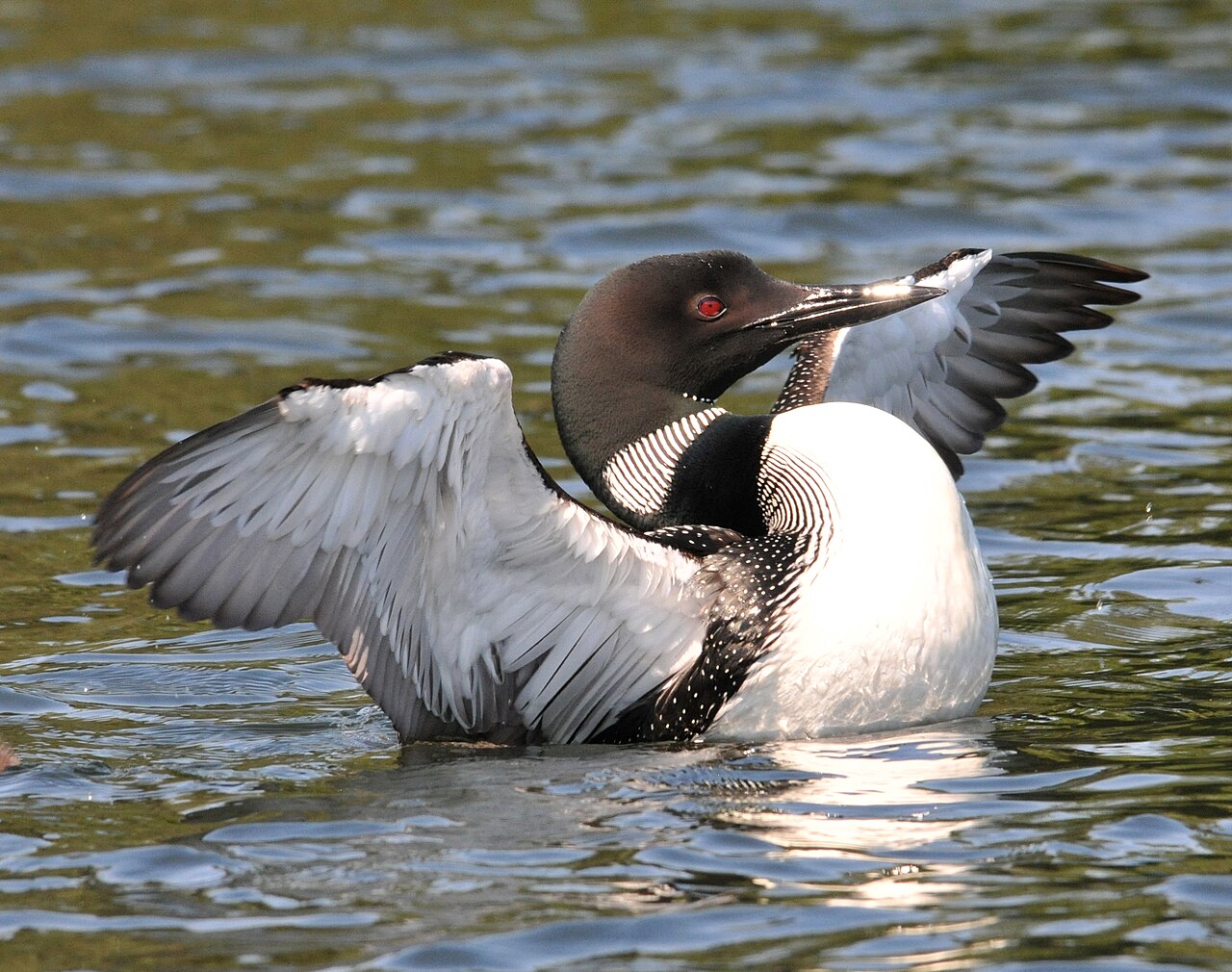
The Common Loon is the voice of the northern lake country: a long, mournful wail that carries for kilometres across still water at night. Heavy, riding low, with a dagger of a bill — a bird that can barely stand on land but runs down fish under water.
Voice
Four calls, all four unmistakable. The wail is a long, rising, mournful cry with which a pair keeps contact across the lake; the yodel is an undulating, chopping scream given by the male alone and different in every individual, so that neighbouring birds know one another by it. The tremolo is a high, quavering laugh given in alarm and in flight, and between mates and chicks at close range comes a soft hoot. Spend a night on a northern lake in June and the wail is what you hear first and longest.
Recording: Jonathon Jongsma — CC BY-SA 3.0 · Big Bay State Park, Ashland, Wisconsin, United States · xeno-canto
Identification
In breeding plumage black with a green gloss on the head, a striped neck collar and a chequered black-and-white back, with a heavy straight bill held level. The neck is thick and often shows a bulge just above the waterline; the forehead is high and steep. In winter grey-brown above and white below, with a ragged, irregular border on the neck, white around the eye and usually a dark, broken neck collar. In flight the big feet trail beyond the tail and the head is held slightly below the line of the body — a crossbow shape that identifies it at range.
Confusion species
Yellow-billed Loon is larger and paler, with an ivory bill whose upper edge runs straight so that the whole bill appears tilted upward, and in winter a paler face with a dark ear spot. Pacific and Arctic Loons are smaller, round-headed and thin-billed, and in winter show a clean, straight division between dark and light on the neck; Red-throated Loon is smaller still, holds its bill tilted up, and in winter has a pale face and a finely white-speckled back. A distant swimming Double-crested Cormorant rides higher and points its hooked bill up at an angle.
Habitat
Breeds on clear, fish-rich lakes with islands and sheltered coves, and with enough open water for take-off — below about five hectares a lake is usually too small. The nest sits right at the waterline or on a floating island, because the bird can only slide onto it. In winter on coastal waters, bays and estuaries, and on large inland lakes and reservoirs.
Where the bird is most often found, arranged by the USNVC — the vegetation classification of the United States and Canada — and CMECS for sea and coast.



Range and movements
Breeds from Alaska across the whole of Canada into the northern United States — Minnesota, Wisconsin, Michigan, New England — and beyond that in southern Greenland and Iceland. Winters along the Pacific south to Baja California and Sonora, along the Atlantic coast and in the Gulf of Mexico, and on large inland reservoirs. Birds from Greenland, Iceland and eastern Canada cross to western Europe, where several thousand spend each winter.
- Resident
- Breeding (summer)
- Winter
- Passage
- dark = core range, pale = thinly spread
Where and when to look
On migration and in winter the swimming attitude is the quickest character: low, with the back almost level and the bill held strictly horizontal. On winter-plumaged birds watch the border between dark and light on the neck — ragged and toothed in this species, ruler-straight in the Pacific and Arctic Loons. On breeding lakes, keep off the shoreline: a disturbed bird leaves the nest and often does not return for hours.
Conservation
Not globally threatened and stable across North America as a whole, but with a set of very specific threats. Lead from fishing sinkers and jigs is lethal once swallowed and is the leading cause of adult mortality in some states; mercury from coal-burning accumulates through the food chain and depresses breeding success; acidification empties lakes of fish. Boat wakes swash nests away and built-up shorelines offer no quiet — along the southern edge of the range the species disappeared from a series of states during the last century.
Scientific name
Gavia immer | (Brünnich, 1764)
Brünnich described the species in 1764 in his Ornithologia Borealis as Colymbus Immer, among Linnaeus's divers and grebes; because it was later placed in another genus, author and year stand in parentheses. The genus Gavia was introduced by Johann Reinhold Forster in 1788; gavia is the Roman authors' name for an unidentified seabird, probably a gull. immer goes back to a Norwegian folk name for the bird, related to Icelandic himbrimi; it has also been linked to Swedish immer, emmer, the grey ashes of a fire, after the charred black of the plumage, and to Latin immergo, 'to immerse'. The type material came from the Faroes.