All species › Loons › Loons › Red-throated Loon
Red-throated Loon | Gavia stellata
Roodkeelduiker | Colimbo chico
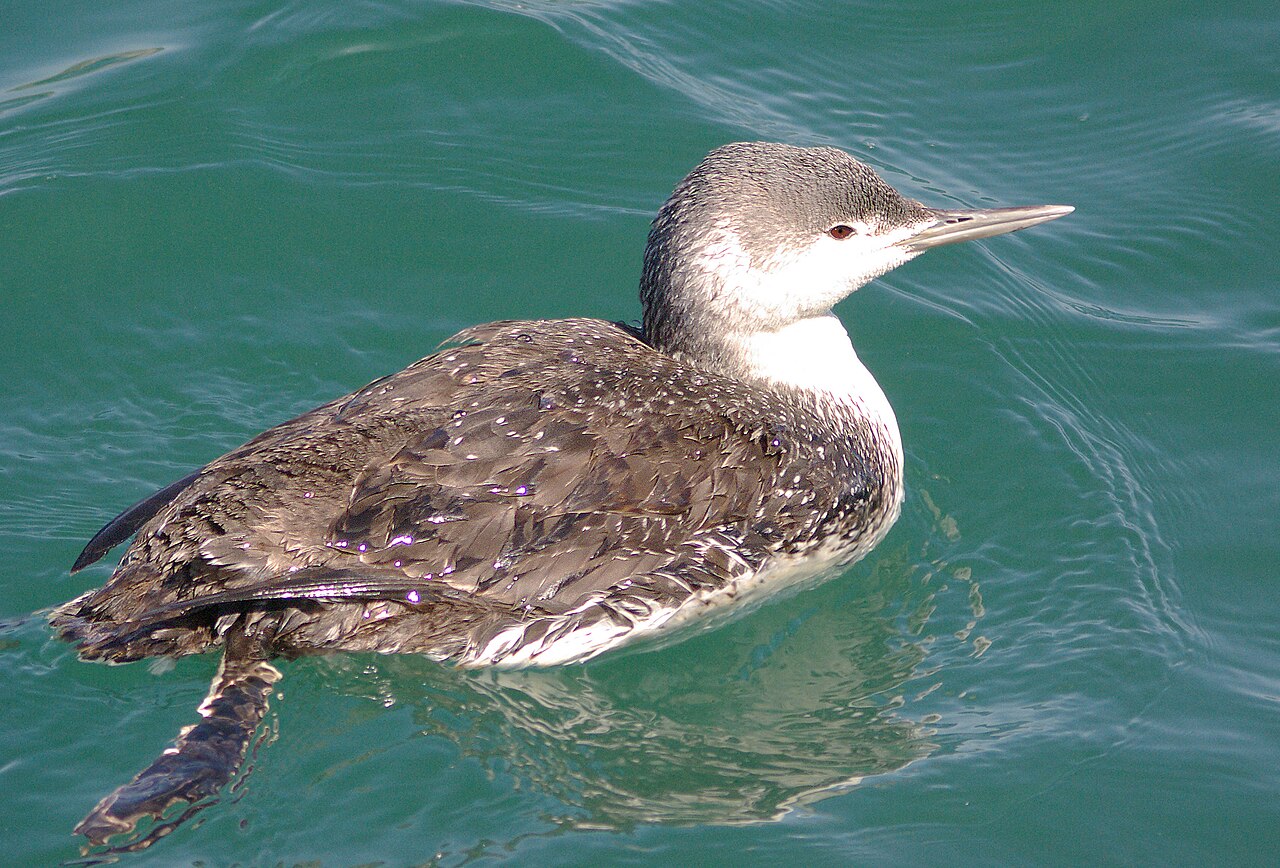
Red-throated Loon is the smallest and lightest of the loons, a family of heavy, low-swimming fish-eaters with the legs set right at the back of the body. It is the only one that can take off from land and that will make do with a pool a few tens of metres across, and the only one with a plain dark back in breeding plumage. The rusty throat patch that gives it its name is entirely gone in winter.
Voice
On the breeding grounds it is noisy: a fast, goose-like series of kaa-kaa-kaa in flight, a short barking alarm at the nest, and a low moaning contact note between mates. The typical sound is the long, mewing wail that falls in pitch and carries kilometres across the tundra; pairs sing it in duet, with a hard, pulsing cooing as the answering voice. A border dispute adds a hoarse rattle, given while both birds go across the water half running, half flying with the neck stretched out. On the wintering grounds at sea it is almost always silent.
Recording: Stanislas Wroza — CC BY-NC-SA 4.0 · Soppavann, Finland · xeno-canto
Identification
A slender loon with a thin, sharply pointed bill held characteristically tilted upwards, and a narrow head on a thin neck. In breeding plumage head and side of neck are plain grey, with a triangular rusty patch on the foreneck, black-and-white stripes down the hindneck, and a plain dark brown back with no pattern at all — in which it differs from every other loon. In winter the upperparts are dark with dense, fine white speckling, the underparts and face white, and the border between dark and light runs high and blurred across the neck, so that the face looks white. Young birds resemble the winter adult but are greyer, with a duller neck and a pale bill. In flight the head hangs lower than the body, the wingbeats are fast, and the silhouette looks narrower and lighter than in the other loons.
Confusion species
The larger loons of the genus Gavia, of which Common Loon (Gavia immer) is the best known, have a heavier bill carried straight ahead, a thicker neck and in winter a plain dark back; on them the border between the dark cap and the white throat is sharp and low, whereas on Red-throated Loon it is high and vague and leaves the face white. In breeding plumage the difference lies in the back: only Red-throated Loon has a plain back, with no white chequering. Red-necked Grebe (Podiceps grisegena) is confused with it at sea, but is smaller, has a yellow bill base, a shorter neck and a white wing patch that shows at once in flight. Cormorants swim as low, but have a hook at the tip of the bill, a long tail, and hold the head at a steeper angle.
Habitat
Breeds on small, shallow pools and lakelets in the tundra and at the edge of the conifer forest, up into the mountains; the nest lies within half a metre of the waterline, because it can barely walk. Unlike the larger loons it does not need fish in its breeding water: it flies daily to the sea or to a large lake to fish and carries the catch back to the chick in its bill. In winter it lives on shallow salt water — sheltered bays, estuaries, the zone behind the surf and the sandbanks off the beach — and rarely far offshore. Deep ocean water and fast-flowing rivers it does not use.
Where the bird is most often found, arranged by the USNVC — the vegetation classification of the United States and Canada — and CMECS for sea and coast.



Range and movements
Breeds right around the Pole, and further north than any other loon: in North America from western and northern Alaska across the Canadian arctic islands and the northern mainland to Labrador, along the coasts of Hudson Bay, and across the whole of Greenland to its northernmost shore. Beyond this continent it breeds in Iceland, northern Scotland, Scandinavia and northern Siberia, so that it appears on the European map as well. In winter it lies along both coasts: on the Pacific from southern Alaska to Baja California, on the Atlantic from Newfoundland to Florida and on into the northern Gulf of Mexico. On the Great Lakes it occurs mainly on passage, at times in considerable numbers; elsewhere inland it is scarce.
- Resident
- Breeding (summer)
- Winter
- Passage
- dark = core range, pale = thinly spread
Where and when to look
On the Atlantic coast November to March is the season: from a pier or a groyne look for birds lying just behind the surf, and watch for the uptilted bill and the white face. On passage, in October and November, it goes low over the sea in loose parties with the head held lower than the body — a silhouette separable from any other seabird at long range. To see it in breeding plumage you must go to the tundra of Alaska or northern Canada, where in June it may be lying on almost any pool. There, look for the bird flying back and forth to the coast: that is nearly always this species.
Conservation
Partners in Flight puts the North American breeding population at about two hundred and sixty thousand birds; worldwide the total is put at two to six hundred thousand birds, on a falling trend; the IUCN lists the species as Least Concern (LC). In Alaska numbers dropped by more than half between 1977 and 1993; that decline has since come to a halt without the old level returning. The dangers lie mainly at sea: oil on the water in the wintering areas, drowning in set nets, and disturbance of the shallow coastal waters where it spends the winter. On the breeding pools it is sensitive to disturbance, because a bird driven off has trouble getting back onto the nest.
Scientific name
Gavia stellata | (Pontoppidan, 1763)
The Danish bishop and naturalist Erik Pontoppidan described the species in 1763 as Colymbus stellatus, in the genus that then held the grebes as well; because it was later moved to Gavia, author and year stand in parentheses. Gavia is a Latin word used by Pliny for an unspecified seabird. stellata means 'set with stars', after the dense white speckling on the back of the winter bird — the plumage in which it was most often seen in western Europe. The type locality is the river Tame in Warwickshire, England, fixed on the strength of the description Francis Willughby had given a century earlier.