All species › Tropicbirds › Tropicbirds › White-tailed Tropicbird
White-tailed Tropicbird | Phaethon lepturus
Witstaartkeerkringvogel | Rabijunco coliblanco
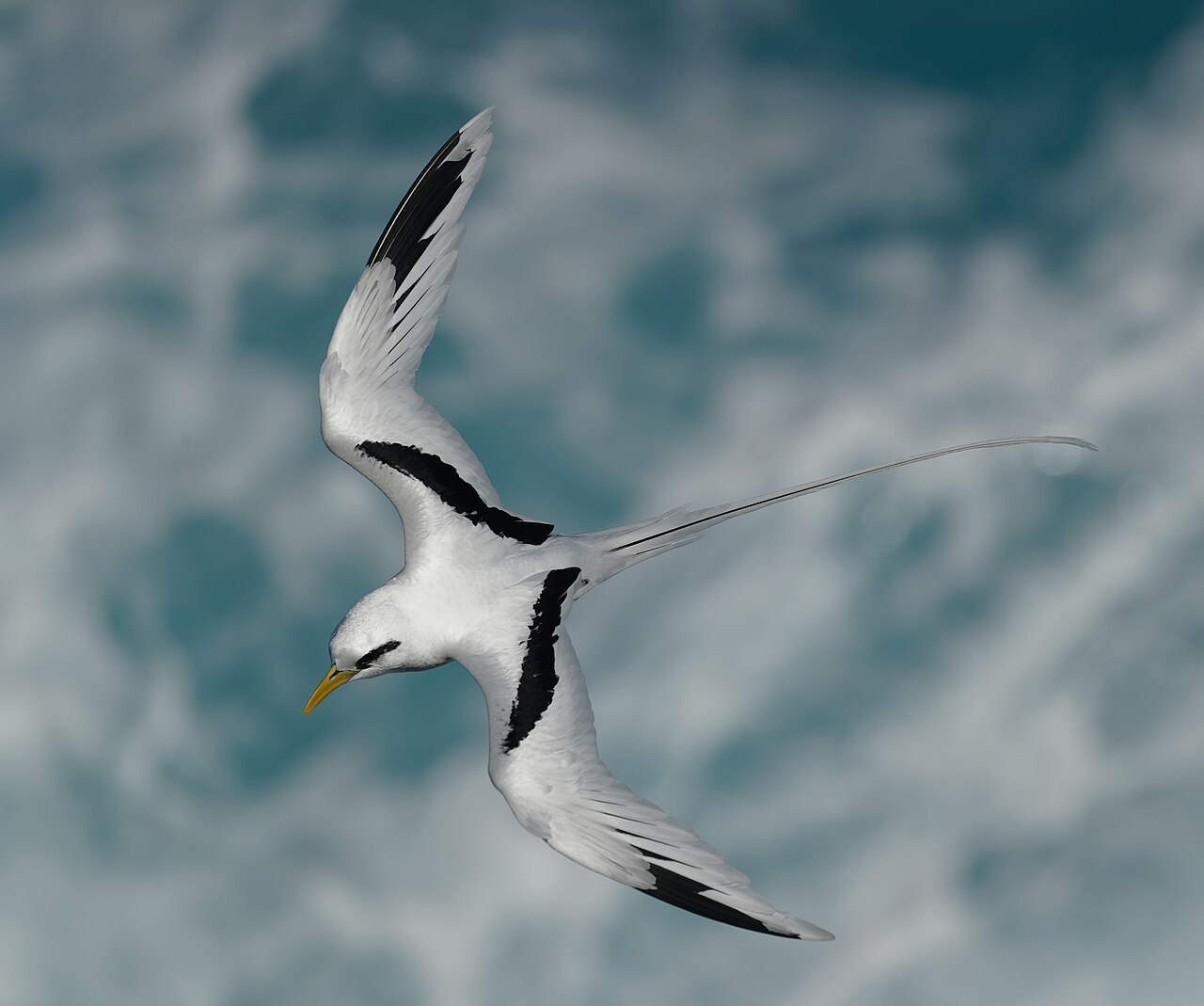
A brilliant white seabird with a black eye-mask, a black diagonal across the upperwing and two ribbon-like tail streamers that roughly double its length. It nests in crevices in sea cliffs and crater walls and spends the rest of the year alone over the open ocean. In Bermuda it is the longtail and a national emblem; in Hawaii it is the koaʻe kea.
Voice
Over the colony a shrill screaming kee-kee-krrt-krrt-krrt, usually given in flight and in chases, with a dry rattle as two birds shoot past one another. Displaying pairs circle together calling without pause, so that a cliff face with only a few pairs produces continuous sound. At sea it is all but silent. The calls carry far over water and often betray a bird hanging high above a crater or a headland.
Recording: Ross Gallardy — CC BY-NC-SA 4.0 · Grand Anse Praslin, Seychelles · xeno-canto
Identification
Adults are glossy white, sometimes with a soft peach bloom, with a black mask through the eye, a broad black bar running diagonally across the upperwing and black in the outer primaries. The bill is yellow to orange and the legs are small and weak. The two central tail feathers grow into white ribbons that reach half a metre in old birds; males average longer streamers than females. Juveniles lack the streamers, have a yellow-green bill with a dark tip and a back finely barred with black. The flight is high and fast on stiff pigeon-like beats broken by short glides; the bird hovers over the water and then drops in with half-folded wings.
Confusion species
Red-billed Tropicbird (Phaethon aethereus) is larger, has a red bill, finely barred upperparts throughout and more black in the primaries, but no black bar across the upperwing. Red-tailed Tropicbird, the commonest of the three in Hawaii, is heavier, looks all white with a stout red bill and has thin red streamers that are invisible at a distance. Streamerless juveniles are taken for terns, which have forked tails, slimmer bodies and a far looser, bouncing flight. In doubt, look for the black diagonal across the wing: only White-tailed Tropicbird has it.
Habitat
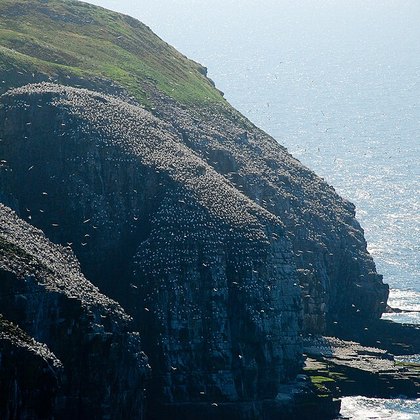
Warm open ocean far from land, where it wanders alone over deep water. To breed it needs an inaccessible cavity: a crevice or ledge in a sea cliff, a hole in a lava wall, a cave or a hollow tree, always one it can drop into from the air and slide out of again. It avoids flat open ground, where it has no defence against rats and cats. In Hawaii it nests far inland, in the walls of craters and canyons.
Where the bird is most often found, arranged by the USNVC — the vegetation classification of the United States and Canada — and CMECS for sea and coast.


Range and movements
The species occupies every tropical ocean. In this region it breeds in Bermuda, which holds two to three thousand birds, in the Bahamas and the Greater Antilles — Cuba, Jamaica, Hispaniola and Puerto Rico — and in the Cayman Islands, where it is a summer visitor to the cliffs of Grand Cayman and the Bluff of Cayman Brac. In Hawaii it breeds from March to October in Waimea Canyon and along the Na Pali coast on Kauaʻi, on Molokaʻi and Lanaʻi, and in the crater of Kilauea on the island of Hawaii. Outside the breeding season it leaves land altogether and lives at sea, where its whereabouts are poorly known. Off the United States it is a regular spring and summer bird around the Dry Tortugas and in the Gulf Stream; hurricanes can carry it far inland.
- Resident
Where and when to look
Stand at a breeding cliff on a sunny morning with onshore wind: the birds hang in the updraught in front of the rock and the streamers light up against the dark stone. On the island of Hawaii the overlook into Kilauea crater lets you look down on the birds instead of up at them. At sea look high rather than low: this is a bird that flies well above the waves.
Conservation
It is listed as Least Concern (LC) worldwide, though the trend is unknown because the birds are untraceable outside the season. At the colonies introduced rats and cats are the main threat, together with building and erosion of the cliffs it nests in; on Cayman Brac the colony fell from about eight hundred birds in 1985 to some two hundred in 2003. In Bermuda artificial nest cavities, called igloos for their shape, are added to the cliffs and are readily taken up.
Scientific name
Phaethon lepturus | Daudin, 1802
Daudin described the species in 1802 as Phaëton lepturus, using the old spelling of the genus, in his edition of Buffon's natural history; author and year stand without parentheses, because the species is still in the same genus. Phaethon, coined by Linnaeus in 1758, is the son of the sun god who drove the sun chariot across the sky. lepturus is built from Greek leptos, 'slender', and oura, 'tail', after the two thread-like feathers. The described specimen came from Mauritius, on the other side of the world from the birds of this region.