All species › Tropicbirds › Tropicbirds › Red-tailed Tropicbird
Red-tailed Tropicbird | Phaethon rubricauda
Roodstaartkeerkringvogel | Rabijunco Colirrojo
The largest and heaviest of the tropicbirds: a snow-white seabird with a coral-red bill and two narrow, blood-red tail streamers that trail behind it as a single thin thread. In fresh plumage the white carries a soft pink bloom, which fades away in the course of the year. In North America it belongs to Hawaii, where it breeds on the cliffs and atolls of the whole island chain.

Voice
In ordinary flight it is silent. At the nest it greets its mate with a short, hoarse squawk on arriving and leaving, and anyone approaching the scrape too closely gets a low, growling snarl. The display is the loud part: males circle in wide rings above the cliffs, glide, then beat the wings briefly and fast and skim low over the water, giving sharp cackling series as they go. The chick begs with a rattling chatter that carries out of a crevice in the rock.
Recording: AUDEVARD Aurélien — CC BY-NC-SA 4.0 · Tuamotus Islands, The Tuamotu and Gambier Islands, France · xeno-canto
Identification
Large and heavily built, with broad wings and a thick, pigeon-like body; the plumage is almost entirely white, with no more than a short black line through the eye, some black at the bend of the wing and black shafts in the primaries. The bill is bright coral red, the legs black. The two central tail feathers are red, thin and up to thirty-five centimetres long; at a distance they read as one thread, and against the sun often show only as a thin line. Young birds have a black bill, no streamers, and heavy black barring above that gives a coarsely scaled look. Full adult plumage comes only in the third year.
Confusion species
Red-billed Tropicbird (Phaethon aethereus) is as large but has white streamers, clear black barring across the back and black in the wingtip; in Hawaii it is a great rarity, but it does turn up at the colonies. White-tailed Tropicbird (Phaethon lepturus) is far smaller and lighter built, with a yellow bill and a broad black diagonal band across the upperwing. At long range it is taken for a large tern or a white booby; the difference lies in the stiff, fast wingbeats with no sailing, in the all-white head with only an eye-stripe, and in the habit of dropping vertically into the sea from a great height rather than hovering low over the water. A bird that has lost its streamers is still known by the heavy build and the red bill.
Habitat
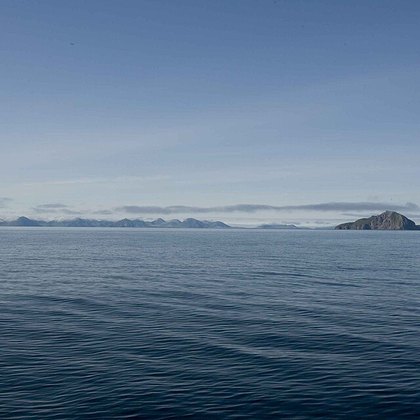
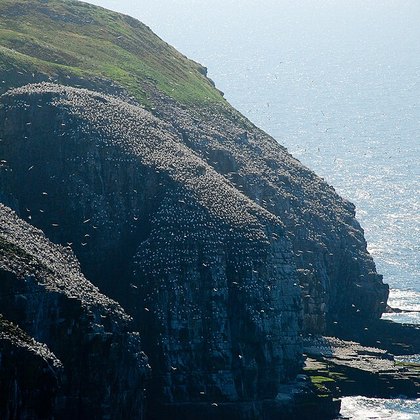
Outside the breeding season it lives only on the open ocean, often thousands of kilometres from land and over water too deep and too poor for most other seabirds. It breeds on oceanic islands and atolls: a shallow scrape in the shade, under a shrub such as naupaka or beach heliotrope, or in a crevice in a rock face. It needs a place from which it can drop straight into the air, because taking off from flat ground is almost beyond it. Islands reached by rats, cats or mongooses it loses.
Where the bird is most often found, arranged by the USNVC — the vegetation classification of the United States and Canada — and CMECS for sea and coast.


Range and movements
Breeds on islands throughout the Indian Ocean and the western, central and southern Pacific. In North America that means the Hawaiian archipelago: the largest colonies are on the northwestern islands, with Midway and Laysan foremost, and on the main islands it nests scattered on cliffs and offshore islets — among them Kilauea Point on Kauaʻi, where it can be watched at close range. Outside the breeding season the birds spread widely over the Pacific; off the west coast of North America it is a great rarity. World-wide seventeen to twenty-one thousand pairs breed, of which nine to twelve thousand in Hawaii; the largest single colony is on Johnston Atoll.
- Resident
Where and when to look
Kilauea Point on Kauaʻi is the surest site in the guide area: between February and June birds circle along the cliff front by the lighthouse every day, low enough to show the red streamers without binoculars. Watch for the display flight, in which a bird appears to beat backwards above its mate — a sight no other seabird gives. At sea it is a matter of luck: look high, because it usually passes tens of metres above the water.
Conservation
World-wide the species is listed as Least Concern (LC), but in Australia it is listed as sensitive after unexpected declines in some colonies. On the main Hawaiian islands rats, feral cats and the mongoose are the chief cause of failed nests; the northwestern islands are largely free of predators and for that reason carry most of the population. On Johnston Atoll the yellow crazy ant appeared in 2010, which can blind chicks with its acid. Low atolls also lose nest sites to washover in storms and to rising sea level.
Scientific name
Phaethon rubricauda | Boddaert, 1783
Pieter Boddaert gave the species its scientific name Phaeton rubricauda in 1783, on the basis of a plate and description by Buffon; it still stands in the same genus, so author and year carry no parentheses. Boddaert wrote the genus with a single h; the valid spelling is Phaethon, from Greek phaethon, 'the shining one', the son of the sun god. rubricauda is built from Latin ruber, 'red', and cauda, 'tail' — the two red threads that set the species apart from all the others. The type locality is Mauritius, then called Isle de France.