All species › Tropicbirds › Tropicbirds › Red-billed Tropicbird
Red-billed Tropicbird | Phaethon aethereus
Roodsnavelkeerkringvogel | Rabijunco etéreo
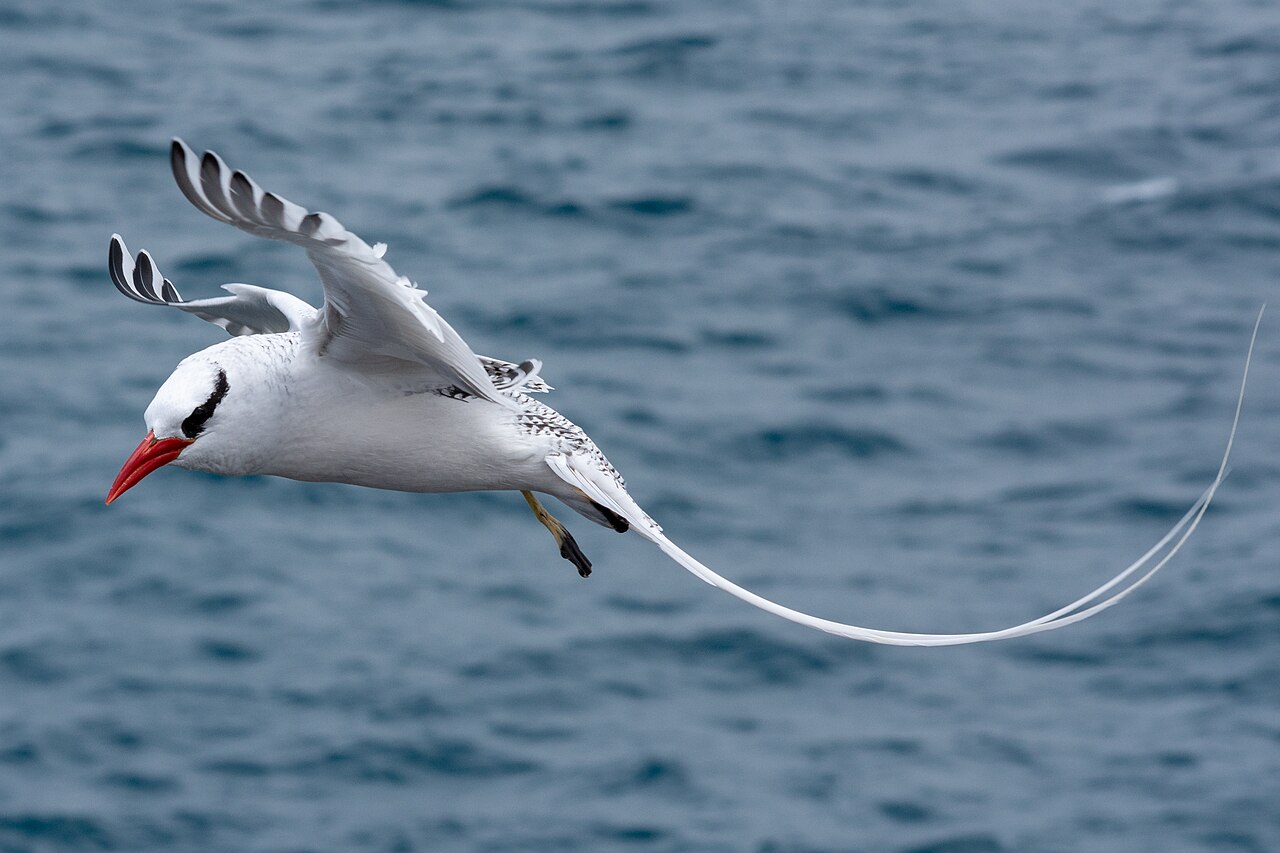
A snow-white seabird with a coral-red bill, fine black barring across the back and two thread-thin white tail streamers longer than its whole body. It belongs to the tropicbirds, a small and self-contained group of the tropical oceans that is not classed with the terns, however strong the resemblance in colour. In North America it breeds on rock islands off the Pacific coast of Mexico and on the cliffs of the Caribbean.
Voice
At sea it is almost always silent; the noise belongs to the colony. There, parties of two to twenty birds circle above the cliff and the water screaming a hard, rattling kreeee-kreeee-kri-kri-kri that carries far out to sea. The sound is sharp and grating, more a scream than a call, and is loudest in the display flights at the start of the season. At the nest it is reduced to low growling notes, and the chick begs with a continuous chattering from the rock crevice.
Recording: Jesse Fagan — CC BY-NC-SA 4.0 · Isla Genovesa, Galapagos, Ecuador · xeno-canto
Identification
Adults are white, at close range with fine black barring across mantle, shoulders and wing coverts, a black line running through and behind the eye, black on the outer primaries and a deep red bill. The two central tail feathers are white, thin as a thread and up to half a metre long; they break off easily, so a bird without them is nothing unusual. In flight the silhouette is distinctive: a heavy, pigeon-like body, pointed wings beaten fast and stiffly, and the two threads behind the short tail. The legs are set so far back that it cannot stand on land and shuffles across the rock instead. Young birds lack the streamers, have a yellow to orange bill, are more coarsely barred above and carry a black band across the nape.
Confusion species
Red-tailed Tropicbird (Phaethon rubricauda) is as large but has no barring on the back, almost no black in the wingtip and red rather than white streamers. White-tailed Tropicbird (Phaethon lepturus) is smaller and lighter built, with a yellow bill and a broad black diagonal band across the upperwing instead of fine barring. At a distance it is most often taken for a large tern — Caspian Tern (Hydroprogne caspia) and Royal Tern (Thalasseus maximus) also carry a big red or orange bill — but terns have a black cap, a forked tail and dive just below the surface after a brief hover. The tropicbird has a white head with no more than an eye-stripe, flies with stiff, fast beats and never sails on the wind, and drops vertically into the sea from tens of metres up.
Habitat
Outside the breeding season it lives on the open sea, far from land and over deep, clear water; only at the colony does it come within sight of the coast. It breeds on steep, uninhabited rock islands and sea cliffs, in a bare scrape under an overhanging stone, in a crevice or under low scrub, always at a place from which it can drop straight into the air. It feeds over deep water, often above schools of tuna or above dolphins driving flying fish to the surface. Islands reached by rats or cats it loses; shallow, turbid coastal water it does not use.
Where the bird is most often found, arranged by the USNVC — the vegetation classification of the United States and Canada — and CMECS for sea and coast.



Range and movements
Breeds in three separate areas: the tropical Atlantic, the Caribbean Sea, and the eastern Pacific from the Gulf of California to Ecuador and the Galápagos. In North America the colonies lie on the rock islands of the Gulf of California — Isla San Pedro Mártir and the islets off Baja California — and further south to the coast of Colima, and in the east on the cays and stacks around Puerto Rico. Outside the breeding season it wanders far over the open ocean: in late summer it appears annually in small numbers off southern California, and exceptionally as far as Hawaii, the Gulf of Mexico and the Atlantic coast of the United States. A figure of around fifteen thousand birds was given for the Pacific population in 1995, and four to five thousand pairs for the western Atlantic around 2000.
- Resident
- Breeding (summer)
- Winter
- Passage
- dark = core range, pale = thinly spread
Where and when to look
It is nearly always a find made from a boat: on a trip in the Gulf of California, or off southern California in August and September, look up rather than at the water, because it passes high and straight. The streamers are barely visible at range; what stands out is a short, thickset white bird with fast, stiff wingbeats that never for a moment sails on the wind as a tern or a gannet does. At the Puerto Rican colonies March to June is the season: stand at a cliff front and wait for the circling, screaming parties over the sea.
Conservation
The species is listed as Least Concern (LC), but numbers are falling and the estimates differ widely, because the colonies are small and scattered over many remote islands. The chief threat is introduced rats and feral cats, which take eggs and chicks on the breeding islands; where these have been eradicated the birds return. In Mexico it stands on the national list of species under protected status. Around Puerto Rico the breeding population is put at about eighteen hundred pairs, after a heavy decline over the past centuries.
Scientific name
Phaethon aethereus | Linnaeus, 1758
Linnaeus described the species in 1758 as Phaëthon aethereus, and it still stands in that same genus, so author and year carry no parentheses. Phaethon is Greek phaethon, 'the shining one': the son of the sun god who drove the sun chariot too close to the earth. aethereus is Latin for 'of the upper air' or 'heavenly' — a fitting name for a bird that spends almost its whole life high above the open sea. The type locality is Ascension, in the middle of the Atlantic.