All species › Waders, gulls and terns › Auks, puffins and murres › Common Murre
Common Murre | Uria aalge
Zeekoet | Arao común
The Common Murre is the most numerous auk of the northern hemisphere and the last auk in this guide: an upright black-and-white seabird that breeds without a nest on narrow cliff ledges, shoulder to shoulder in ranks of thousands. It breeds on both oceans and occurs in Europe as well; what follows is the North American part of that range. In Alaska about half of all murres died between 2014 and 2016 during a prolonged marine heatwave.
Voice
Noisy in the colony, all but silent at sea. The ground note is a low, rolling, throaty arrrr, delivered with the bill raised; from thousands of throats at once it becomes a sustained hum that carries for kilometres over the water. When birds jostle on the ledge it turns into a hoarse, complaining ah-ah-arrr, bill open and neck stretched. The chick that leaps from the cliff at dusk calls a high, piercing wee-lee wee-lee, answered by the male on the water below; weeks later, far out at sea, father and chick still find each other by those two voices.
Recording: Sven Normant — CC BY-NC-SA 4.0 · Hornoya, Vardø kommune, Finnmark, Norway · xeno-canto
Identification
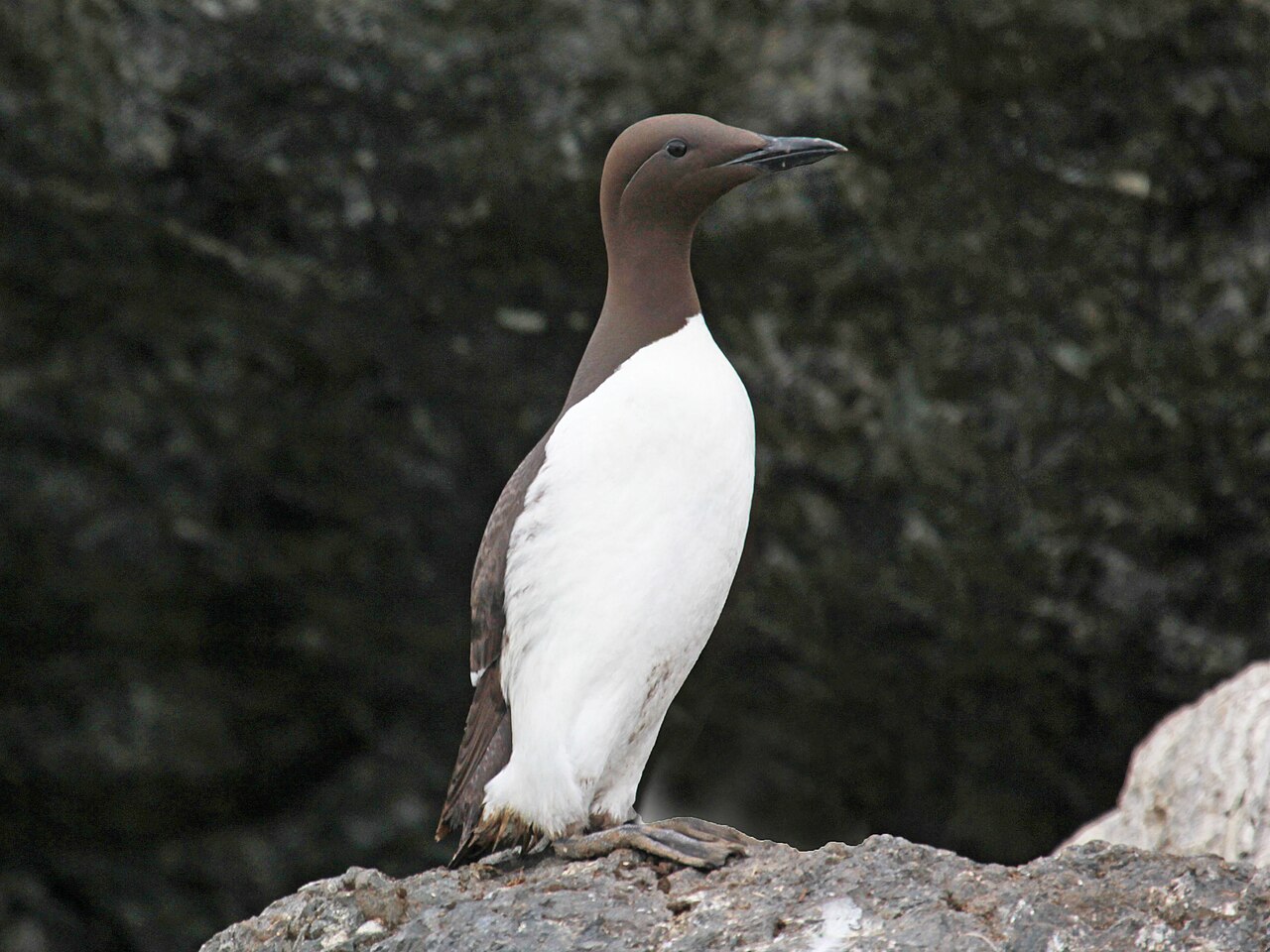
Large and heavy for an auk, with a long, pointed, straight bill, a short tail and narrow, tapering wings. In breeding plumage head, neck and upperparts are sooty black to dark chocolate brown and the underparts white, with a sharp border low on the breast. In winter plumage throat and cheek turn white and a single clear black line remains, running back from the eye across that white cheek. Some Atlantic birds are 'bridled': a thin white eye-ring with a white line behind it, shown by roughly one bird in ten in Newfoundland and by more further north. Male and female look alike; juveniles resemble winter adults but have a shorter, finer bill. The flight is low and fast on whirring beats with no gliding; on the water it rides high, bill tilted slightly up.
Confusion species
Thick-billed Murre (Uria lomvia) has a shorter, deeper bill with a pale line along the cutting edge of the upper mandible, a sharper black point on the breast, and in winter plumage lacks the black line across the white cheek. Razorbill (Alca torda) has a deep, laterally flattened black bill crossed by a white line and a long pointed tail that cocks up on the water. On the Pacific, Pigeon Guillemot (Cepphus columba) is far smaller, with bright red feet and large white wing patches. At a distance at sea a swimming murre with its chick is taken for a Dovekie; the long dagger of a bill settles it, for no small auk has one.
Habitat
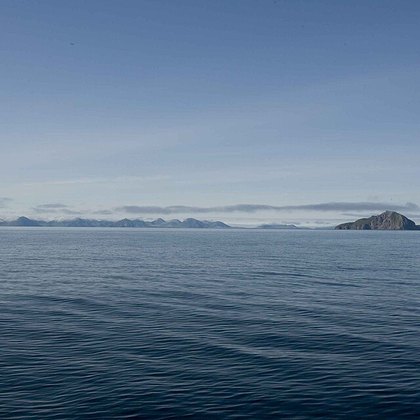
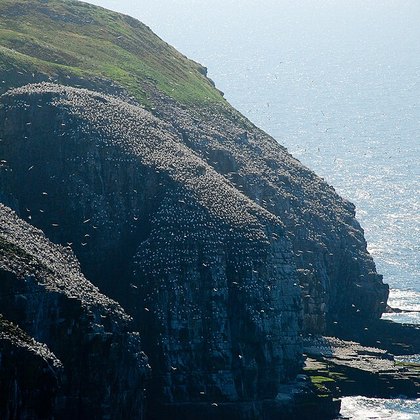
It breeds on narrow ledges of steep sea cliffs, on the flat tops of rock islands and on sea stacks, always where fox, rat or man cannot reach. It builds no nest: the single egg lies on bare stone, and its pear shape makes it swing in an arc when knocked rather than roll off the ledge. For the rest of the year it lives at sea, usually over the continental shelf, where cold, nutrient-rich water gathers small schooling fish. It makes no use of sheltered inner bays, sandy beaches or fresh water.
Where the bird is most often found, arranged by the USNVC — the vegetation classification of the United States and Canada — and CMECS for sea and coast.

Range and movements
On the Pacific it breeds from the Bering Sea and the Aleutians along the coast of Alaska south through British Columbia, Washington and Oregon to central California; the colonies of the Oregon coast and the Farallon Islands are the largest south of Alaska. On the Atlantic side it is in Newfoundland and Labrador — Funk Island alone holds hundreds of thousands of pairs — in the Gulf of St. Lawrence, and in small numbers in southwest Greenland; a few pairs have lately returned to Matinicus Rock in Maine, where the species had been absent for a century. Beyond North America it breeds all round the northern Atlantic, from Iceland and Britain to Norway, and in northeast Asia. It hardly migrates: birds leave the cliff and spread by swimming and flying over the shelf, staying wherever the water remains open.
- Resident
- Breeding (summer)
- Winter
- Passage
- dark = core range, pale = thinly spread
Where and when to look
From late April into July a colony is the surest place: Cape St. Mary's in Newfoundland, where you stand at eye level with the stack from the mainland, the boat trip to the Farallon Islands off San Francisco, or the cliffs at Yaquina Head in Oregon, where a car park overlooks thousands of birds. Come early in the morning, when birds return from sea with a single fish held crosswise in the bill. After mid-August the ledges are empty and the bird is one for a boat, or for a headland in an onshore wind.
Conservation
Worldwide the species runs to several million pairs and is listed as Least Concern (LC), but the North American picture is bleak. In the marine heatwave of 2014 to 2016 an estimated four million murres starved in Alaska, about half of the birds there; ten years on there is still no sign of recovery. Oil at sea and drowning in gill nets take birds every year, and in Newfoundland and Labrador murres are still legally hunted — the only organised seabird hunt in North America.
Scientific name
Uria aalge | (Pontoppidan, 1763)
The Danish bishop Erik Pontoppidan described the species in 1763 as Colymbus aalge, among the divers; because it was later placed in Uria, author and year stand in parentheses. The genus Uria was introduced by Brisson in 1760 and goes back to Ancient Greek ouria, the name of a waterbird in Athenaeus. aalge is not Latin at all but an old Danish word for an auk, which Pontoppidan took over unchanged. He gave Iceland as the type locality.