All species › Waders, gulls and terns › Auks, puffins and murres › Thick-billed Murre
Thick-billed Murre | Uria lomvia
Kortbekzeekoet | Arao de Brünnich
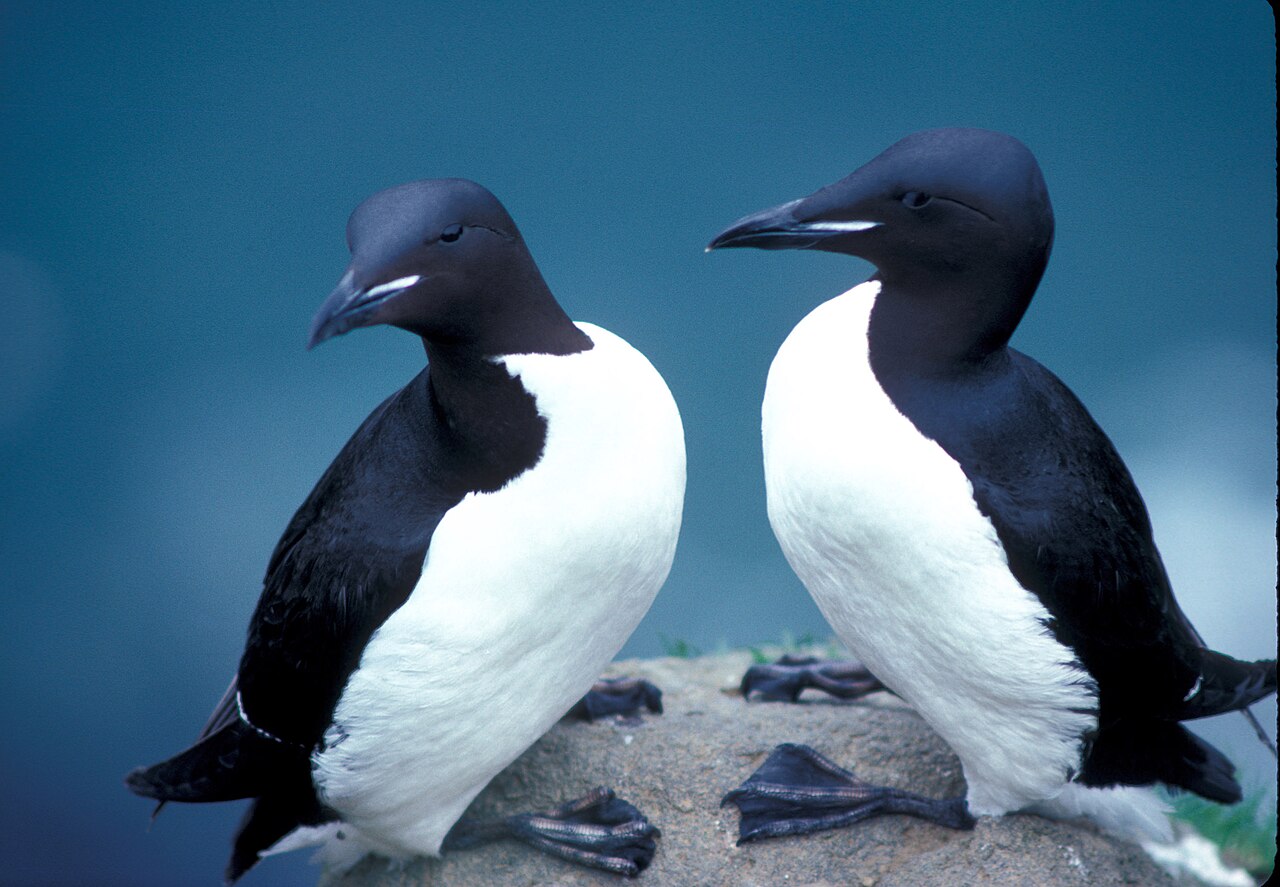
The Thick-billed Murre is the murre of the pack ice: heavier, shorter-billed and darker than its southern counterpart, and one of the most numerous breeding birds of the Bering Sea and the Canadian Arctic Archipelago. It breeds shoulder to shoulder on narrow cliff ledges, with less space per bird than any other bird species, and dives from there to well over a hundred metres. A single cliff can carry more than a million birds.
Voice
In the colony you hear a sustained, low, harsh calling spread over the whole cliff face: a growling, throaty arrrrr and a-oorrr, head thrust forward and bill wide open. Thousands of birds together turn this into a deep, unbroken hum audible far out over the water; it sounds heavier and more grunting than the higher moaning of the Common Murre. To the chick there is a short low growl, and the chick answers with a thin peep. At sea it is silent.
Recording: Stanislas Wroza — CC BY-NC-SA 4.0 · Westfjords Region, Iceland · xeno-canto
Identification
A large, heavy auk standing upright on the ledge, with a thick neck, a tapering head and a short, powerful bill with a straight lower mandible and a slightly curved upper one. It is black above with a blue gloss and pure white below; the black of the throat runs down into the white breast in a sharp point — one of the most reliable marks. Along the cutting edge of the upper mandible runs a thin pale blue to white stripe from the gape forward. In winter plumage throat and lower cheek turn white, but the black cap still runs down below the eye, with no line across the white. Juveniles have a shorter, finer bill on which the pale stripe is barely visible. Male and female look alike; the flight is fast and direct, low over the water, on short narrow wings that also serve as paddles below the surface.
Confusion species
Common Murre (Uria aalge) is the hard one: it is browner black, slimmer, with a longer and thinner bill without a pale stripe, and the border between black and white on the breast runs straight instead of in a point. In winter plumage the difference is clearest: the Common Murre has a white face with a dark line running back across it behind the eye, the Thick-billed Murre an entirely dark cap with no line. Razorbill (Alca torda) is the same size but has a deep, laterally flattened bill with a white cross-line and a long pointed tail. Dovekie (Alle alle) is far smaller and has no neck. In the North Pacific the Thick-billed Murre is usually the heavier and darker of the two murres, and its bill there is stouter still than on the Atlantic side.
Habitat
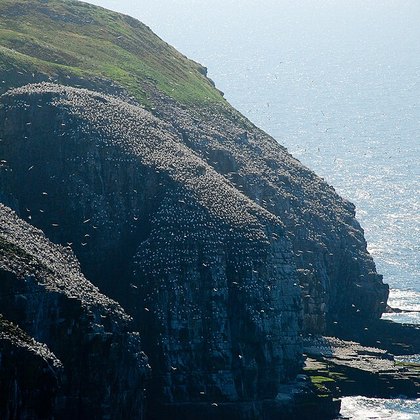
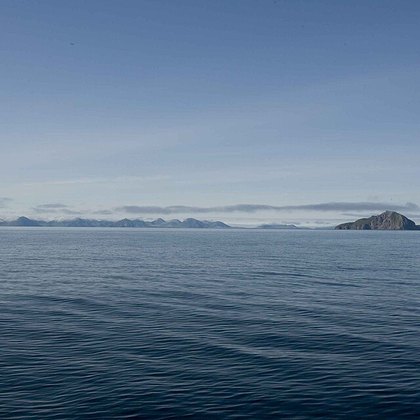
It breeds on narrow ledges of steep sea cliffs and on rocky islands, where the single egg lies on bare rock without a nest and the ledge may be so narrow that the bird barely fits. Outside the breeding season it lives at sea over the continental shelf and its edge, and in the north by preference along the ice edge and at leads, where Arctic cod stand under the ice. It fishes in deep water: dives of twenty to forty metres are routine, and over a hundred metres has been measured. It makes no use of shallow sheltered bays or of fresh inland waters.
Where the bird is most often found, arranged by the USNVC — the vegetation classification of the United States and Canada — and CMECS for sea and coast.


Range and movements
It breeds right around the pole. In North America, on the Pacific side on the islands of the Bering Sea — St. Lawrence, St. Matthew, the Pribilofs, the Diomedes — and along the Chukchi coast of Alaska; on the Atlantic side in Greenland and across the Canadian Arctic Archipelago, from Prince Leopold Island to Coats, Digges and Akpatok in Hudson Strait, with southern colonies in Labrador, Newfoundland and on the Rochers-aux-Oiseaux in the Gulf of St. Lawrence. In winter the birds move to ice-free water: on the Atlantic side to off Newfoundland, Nova Scotia and the Gulf of Maine, in smaller numbers to Massachusetts, and on the Pacific side to the Aleutians and the Gulf of Alaska. Off southwest Greenland and off Newfoundland millions of birds from the whole north gather in winter.
- Resident
- Breeding (summer)
- Winter
- Passage
- dark = core range, pale = thinly spread
Where and when to look
From June to early August the colonies are the target: a boat trip along the cliffs of St. Paul in the Pribilofs, where the birds sit at eye level on the ledges, or along the Gannet Islands in Labrador and Akpatok in Hudson Strait. On the ledge look at the bill first — short, heavy, with a pale stripe along the cutting edge — and only then at the colour. On the United States east coast it is above all a winter bird: in January and February scan from a headland in Maine or Massachusetts for heavily built auks with an entirely dark cap.
Conservation
With fifteen to twenty million birds this is one of the most numerous seabirds of the northern hemisphere, and the species is listed as Least Concern (LC). Colonies are disappearing all the same: in West Greenland shooting, for years without a limit, has emptied whole cliff faces, and in Newfoundland the winter hunt took a heavy toll for generations. On top of that come oil, drowning in gill nets and the shrinking sea ice, which takes with it the Arctic cod that has to raise the chicks. In the Bering Sea tens of thousands of murres starved in 2018 after the sea water had turned unusually warm.
Scientific name
Uria lomvia | (Linnaeus, 1758)
Linnaeus described the species in 1758 as Alca lomvia, among the auks; because it was later placed in Uria, author and year stand in parentheses. The genus Uria was introduced by Brisson in 1760 and goes back to Greek ouria, the name of a waterbird in Athenaeus. lomvia is a Swedish word for an auk or diver, taken from common speech by Linnaeus just as torda was. He gave boreal Europe as the type locality; Hartert restricted it to Greenland in 1921. In Spanish (arao de Brünnich) and in British English (Brünnich's Guillemot) the bird is named after the Danish zoologist Morten Thrane Brünnich, who described the birds of the far north in the eighteenth century.