All species › Waders, gulls and terns › Auks, puffins and murres › Dovekie
Dovekie | Alle alle
Kleine alk | Mérgulo atlántico
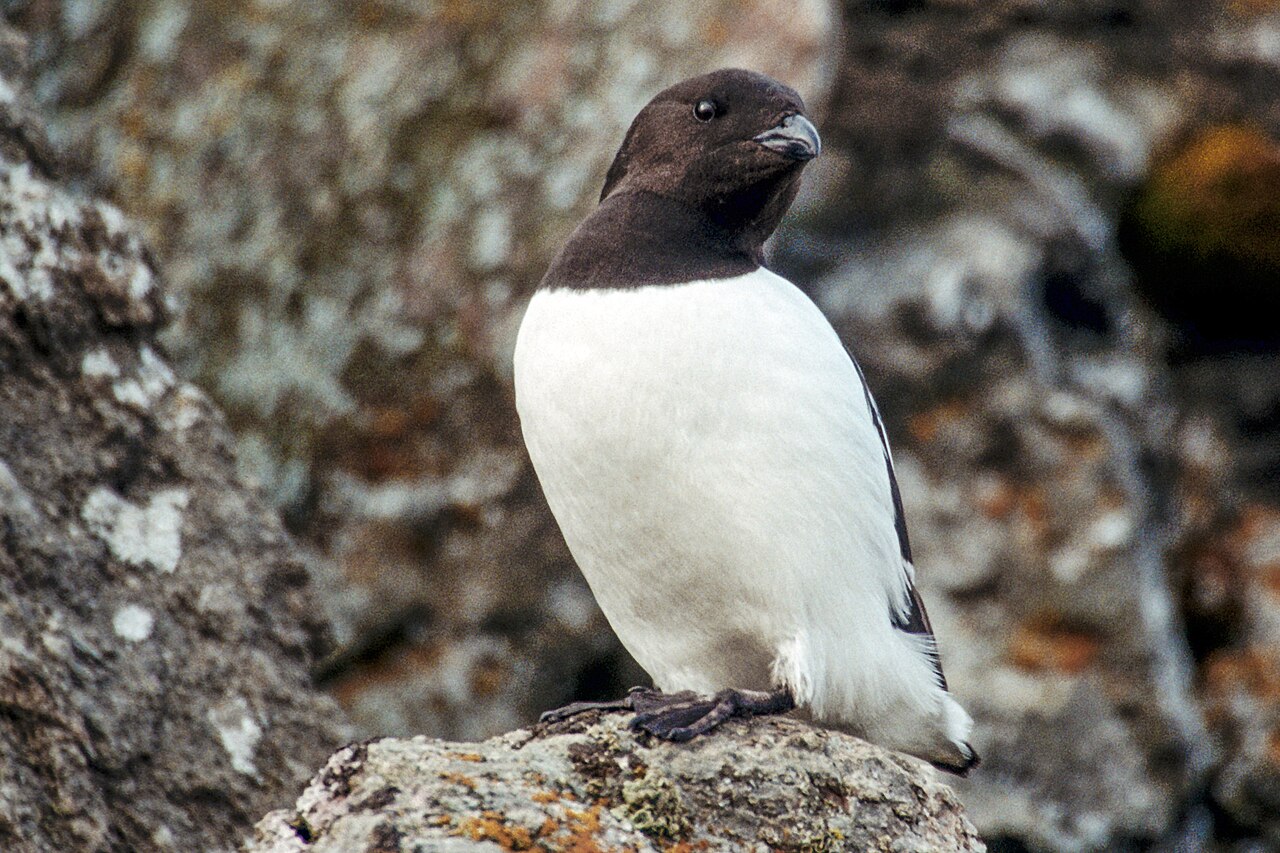
The Dovekie is barely bigger than a starling and probably the most numerous seabird in the North Atlantic: a black-and-white bundle with no neck and a short stubby bill, living on swarms of tiny crustaceans. It breeds in millions in the scree slopes of northwest Greenland and winters on the open sea, where most observers see it only as a whirring dot. After an autumn storm it can suddenly turn up inshore, in ponds and on car parks.
Voice
In the colony it is deafening: from the scree rises a sustained, high chattering laughter, an undulating chirrr-chirrr-i-i-i-i kept up by thousands of birds at once and sounding at a distance like running water. Flying swarms over the slope give a fast, giggling rattle that swells and falls with every turn. At the nest crevice the sound is shorter and more growling. At sea, outside the breeding season, it is almost always silent.
Recording: Stein Ø. Nilsen — CC BY-NC-SA 4.0 · Bjørndalen, Longyearbyen, Norway · xeno-canto
Identification
A small, squat auk with no visible neck, a short tail, short narrow wings and a short, blunt, almost conical bill. In breeding plumage head, neck, breast and upperparts are deep black and the belly white, with a sharp border across the breast, a small white spot above the eye and fine white streaks on the scapulars. In winter the throat turns white and the white runs up as a half-collar behind the ear-coverts, while crown and back stay black. Juveniles resemble winter adults but are browner in tone. In flight the silhouette is distinctive: an almost round little body on fast-vibrating wings, whirring low over the waves almost like an insect.
Confusion species
Confusion with other Atlantic auks is a matter of scale: Atlantic Puffin (Fratercula arctica), Razorbill (Alca torda) and the murres are all two to four times as big, longer-necked and longer-billed. On a distant dot at sea the flight helps most — the Dovekie whirrs, the other auks beat more heavily and slowly. In the Bering Sea, where it breeds at only one or two spots, Least Auklet (Aethia pusilla) comes closest in shape and size, but that bird has a red bill with a white bristly plume above the eye and is spotted below rather than clean white. On the water a Dovekie is also taken for a young murre; the absence of a neck and the blunt little bill settle that at once.
Habitat
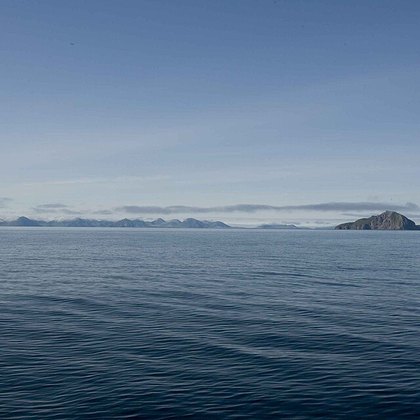
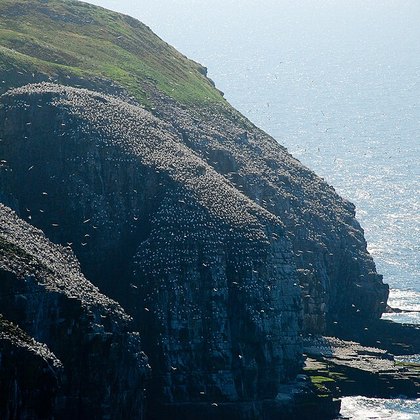
It breeds in scree slopes and talus fans at the foot of cliffs, where the egg lies deep between the blocks out of reach of foxes and gulls; colonies often sit hundreds of metres above the sea and sometimes kilometres inland. It feeds at sea where cold water meets warm and the copepod Calanus hangs in dense swarms near the surface: along the ice edge, over the shelf break, and in current fronts and upwellings. It makes no use of shallow sheltered coastal waters or of the open warm ocean.
Where the bird is most often found, arranged by the USNVC — the vegetation classification of the United States and Canada — and CMECS for sea and coast.


Range and movements
By far the most Dovekies breed in northwest Greenland, with smaller colonies on Svalbard, Novaya Zemlya, Franz Josef Land and Iceland; on the Canadian side scattered colonies lie on Baffin Island and in Hudson Strait. On the Pacific side it breeds only on Little Diomede and a few other points in the Bering Strait, in a handful of pairs. In winter it leaves the high Arctic and spreads over the Labrador Sea and the Grand Banks; from there numbers reach south to off Nova Scotia and New England, in smaller numbers to New York and New Jersey. Where the sea does not freeze it stays all year, and off southwest Greenland the winter numbers are large.
- Resident
- Breeding (summer)
- Winter
- Passage
- dark = core range, pale = thinly spread
Where and when to look
From November to March an onshore northeasterly gale is the best ally: afterwards, stand on a headland in Massachusetts, Rhode Island or Long Island and scan low over the waves for small black-and-white bundles shooting past on vibrating wings. A pelagic trip over the shelf break gives the best chance and the shortest range. If a storm-wrecked Dovekie is found on land, leave it be: it cannot take off from flat ground and belongs back in open water, not in a bathtub.
Conservation
Estimates of the world population differ widely, but it runs to tens of millions of birds, the great majority of them breeding in northwest Greenland; the species is listed as Least Concern (LC). At the colonies Arctic foxes, Glaucous Gulls and introduced rats are the standing enemies, and in Greenland hunting birds for food has long been part of life. The great unknown is warming Arctic water: the large, fat copepod it depends on is being replaced in the south of its range by smaller, leaner southern species, and it is not clear how long it can make do with those.
Scientific name
Alle alle | (Linnaeus, 1758)
Linnaeus described the species in 1758 as Alca alle, among the auks; because it was later placed in Alle, author and year stand in parentheses. The genus Alle was introduced by Link in 1806, and since genus and species name are identical this is one of the few bird names that carry the same word twice. That word is not Latin but a northern European local name for the Long-tailed Duck; Linnaeus confused the two birds, and the name stuck to the Dovekie. He gave the seas of Arctic Europe and America as the type locality; this was later restricted to Scotland.