All species › Waders, gulls and terns › Auks, puffins and murres › Razorbill
Razorbill | Alca torda
Alk | Alca común
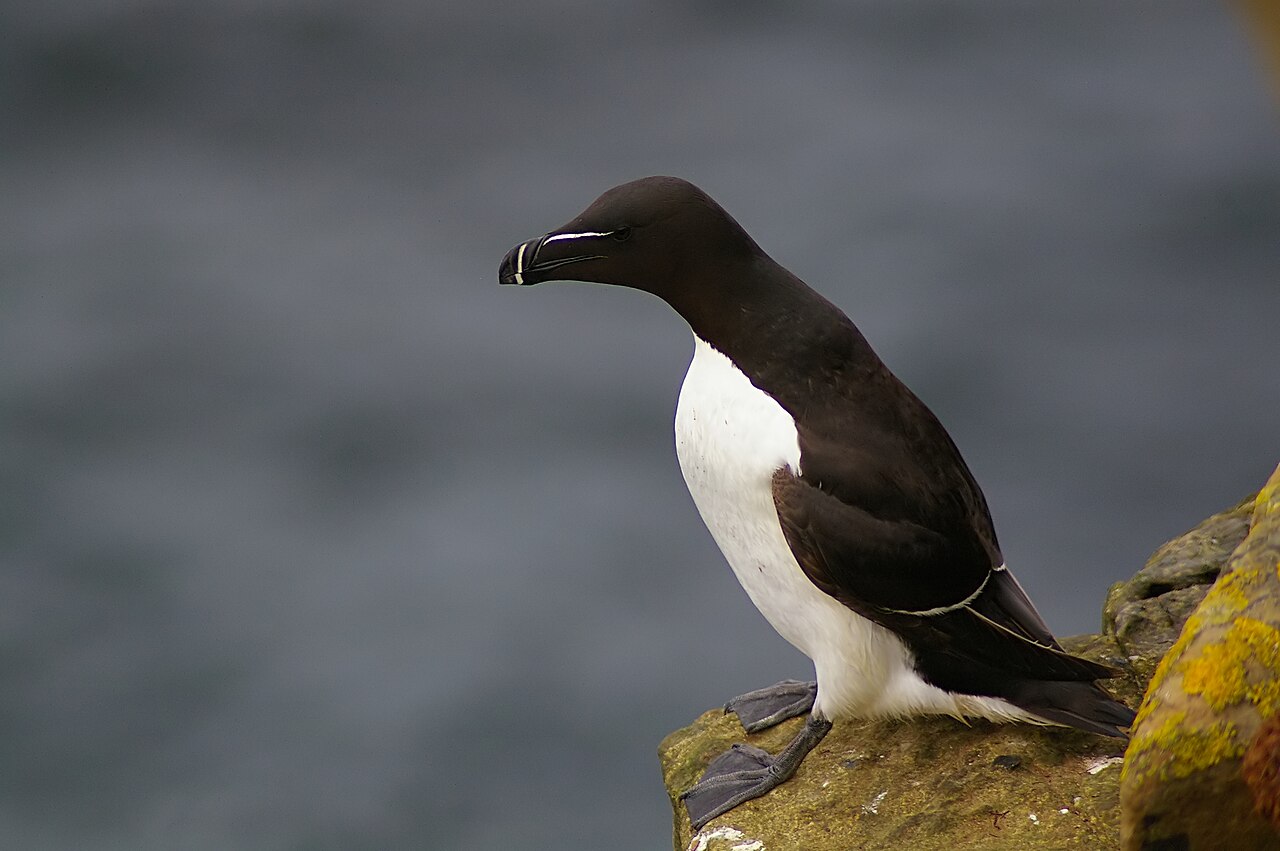
The Razorbill is the heaviest auk left in the Atlantic and the only living species of its genus: jet black above, snow white below, with a deep, laterally flattened bill crossed by a thin white line. It breeds from Newfoundland to the Gulf of Maine in crevices and under boulders, leaving the open ledges to the murres. Outside the breeding season it is a bird of the open sea, and along the American east coast above all a winter visitor.
Voice
At sea it is silent. In the colony it produces a low, harsh, grating sound, more a growl than a call: a drawn-out orrrr or arr-arr, coming out of the crevice and delivered with the bill wide open so that the bright yellow mouth shows. In display there is also a trilling rattle while the partners tap their bills together. At sea young birds call to their father with a thin, high peep, and that sound — often in the dark, out of sight of land — is the only auk voice many observers hear in autumn.
Recording: Roland Arnison — CC BY-NC-SA 4.0 · Mull (near Gometra House), Argyll and Bute Council, Scotland, United Kingdom · xeno-canto
Identification
A big, elongated auk with a large head, a thick neck and a long pointed tail, held cocked up on the water. The plumage is sharply two-toned: deep black from crown to tail, white from the line of the throat down. The bill is the mark: black, deep and narrow as a razor in profile, with transverse grooves and a vertical white line near the tip, and in breeding plumage a thin white line running from the eye to the base of the bill. In winter that line disappears and throat and ear-coverts turn white, opening up the face. Juveniles have a distinctly smaller, shallower bill without grooves and without the white line. In flight it is heavy and direct, with fast beats and the feet tucked away under the long tail.
Confusion species
Common Murre (Uria aalge) and Thick-billed Murre (Uria lomvia) are about the same size but browner or slate-black, short-tailed and thin-billed; on the water the Razorbill rides high at the rear with the tail cocked, the murres lie flat. Atlantic Puffin (Fratercula arctica) is smaller and stockier, with a triangular bill and a pale grey face. In juvenile Razorbills the bill is small and ungrooved, and what is left are the head shape, the long tail and the abrupt end of the black on the throat. In winter plumage the Razorbill's white face is more cleanly bounded than the murre's, which has a dark line running back across the white behind the eye.
Habitat
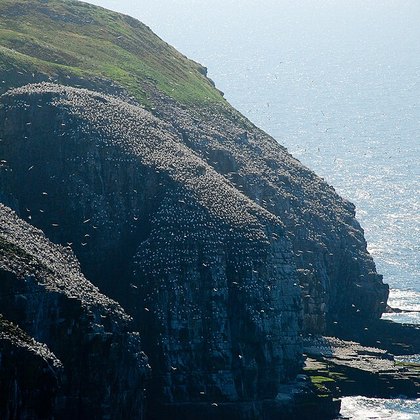
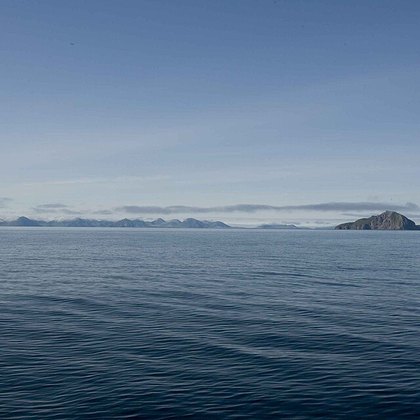
It breeds on rocky islands and cliffs, but not on the open ledges: it seeks a crevice, a cavity under a boulder or a niche in a scree slope where the egg lies out of sight. What makes a site suitable is an island without ground predators and a sea with shoals of small fish within a short flight. Outside the breeding season it lives at sea, further out than the Black Guillemot but closer in than the Atlantic Puffin: over the continental shelf and its edge, and in winter also in deep bays and sounds. It makes no use of sandy coasts or inland waters.
Where the bird is most often found, arranged by the USNVC — the vegetation classification of the United States and Canada — and CMECS for sea and coast.


Range and movements
In the western Atlantic it breeds from southwest Greenland and Hudson Strait south along Labrador and Newfoundland to the Gulf of St. Lawrence, Nova Scotia, New Brunswick and the islands off Maine, where its range ends. By far the largest part of the world population breeds on the other side of the ocean, in Iceland, Britain and Norway. After breeding the birds move out to sea: the winter concentrations lie from the Labrador Sea and the Grand Banks into the Gulf of Maine, with smaller numbers south along New England and the mid-Atlantic states to Virginia. Hard winters push them further south; in the winter of 2012-13 an unprecedented number appeared as far as Florida and the Gulf of Mexico.
- Resident
- Breeding (summer)
- Winter
- Passage
- dark = core range, pale = thinly spread
Where and when to look
In summer a boat trip to a colony is the surest way: Machias Seal Island or Matinicus Rock off Maine and New Brunswick, Witless Bay in Newfoundland, the Mingan Islands in Quebec. From land, winter is the season: from December to March stand on a headland or pier in an offshore wind and scan low over the water for black-and-white birds with a heavy head beating past. Watch for that heavy-headed look and the cocked tail on the water; the white bill line only shows at close range.
Conservation
The world population is put at roughly a million mature birds and the species is listed as Least Concern (LC); Iceland alone holds a majority of them, and the western Atlantic only a small minority. In the Gulf of Maine and the Canadian Maritimes numbers have recovered since the breeding islands were protected, after centuries of hunting for eggs and meat. The main dangers now are oil, drowning in gill nets and a shifting food supply: warmer sea water moves sand lance and capelin, and where the fish leave, the chicks fail.
Scientific name
Alca torda | Linnaeus, 1758
Linnaeus described the species in 1758 as Alca torda; because it has never been moved out of that genus, author and year stand without parentheses and the name has been unchanged since the original description. Alca is Norwegian alke for auk, which Linnaeus took over into Latin. torda goes back to tordmule, the Swedish name for the bird, which comes from Gotland. Linnaeus gave the 'northern European ocean' as the type locality; this was later restricted to southern Sweden.