All species › Waders, gulls and terns › Sandpipers and allies › Common Snipe
Common Snipe | Gallinago gallinago
Watersnip | Agachadiza común
A snipe of Eurasia that in North America turns up only along the far western edge: on the outer Aleutians and the islands of the Bering Sea, in small numbers but in almost every year. Until 2002 it was counted as one species with Wilson's Snipe, and to pin it down here you have to look at the underwing, the trailing edge of the wing and the number of tail feathers. Further east on the continent it has hardly been recorded at all.
Voice
On the breeding grounds the male gives at dusk a low, full humming woo-woo-woo-woo that arises as air streams past the spread outer tail feathers during a dive; it sounds fuller and lower than in Wilson's Snipe, whose outer feathers are narrower. From a post or a fence comes a hard repeated chip-per chip-per. On take-off it gives a short, harsh scaap, all but identical to that of Wilson's Snipe and therefore of no help. On the islands off Alaska you usually see it come up silently out of a wet meadow.
Recording: Stanislas Wroza — CC BY-NC-SA 4.0 · Kaamanen, Finland · xeno-canto
Identification
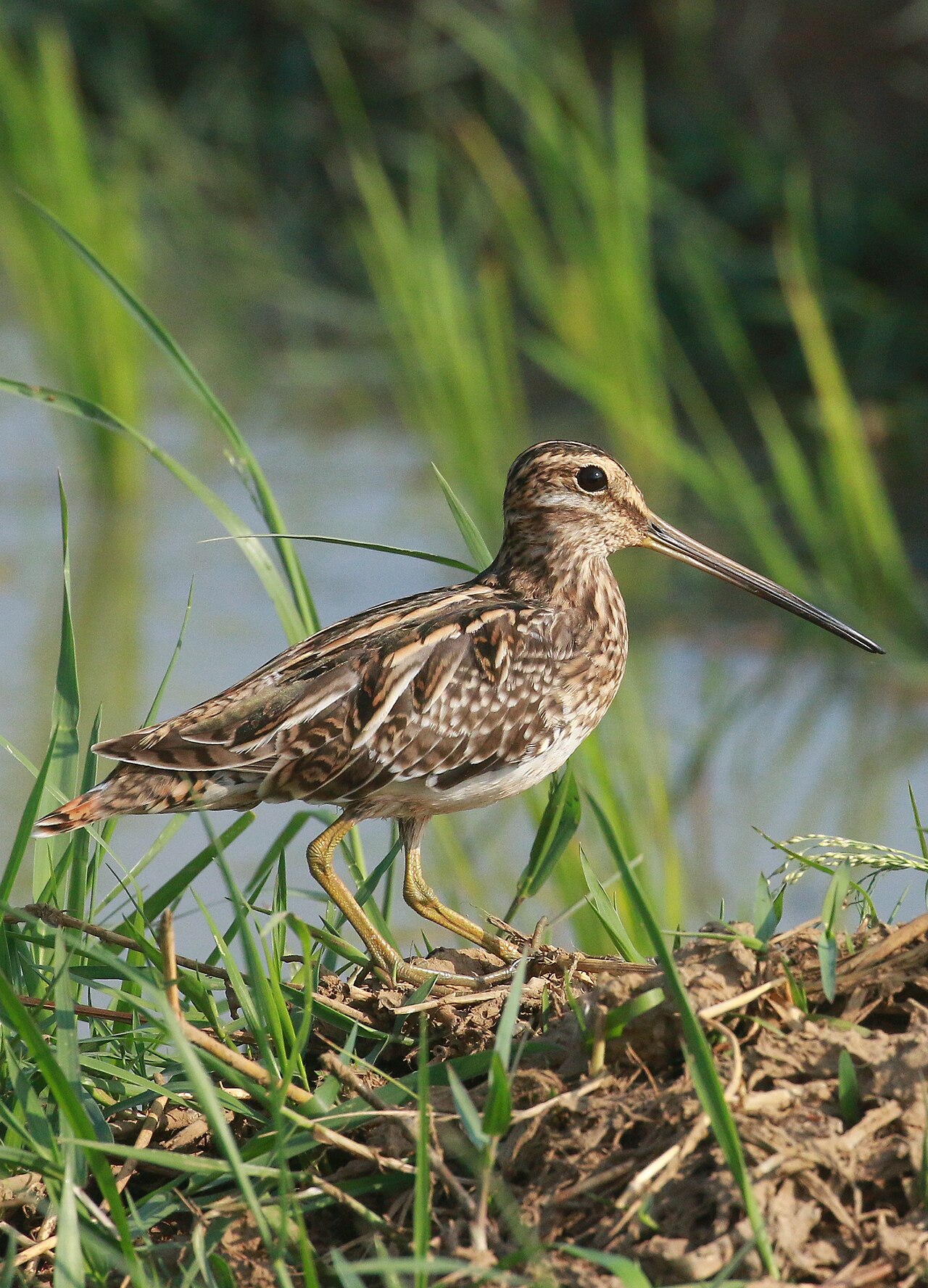
As large and nearly as patterned as Wilson's Snipe: the same cream braces down the back, the same pale central stripe over the dark crown and the same long straight bill. The difference lies in the wing and the tail: the white edge along the trailing edge of the inner wing is broad, the underwing is largely white with thin bars, and the tail carries seven pairs of feathers of which the outer ones are fairly broad. The flanks are less heavily barred, so that the underside reads as whiter. In flight the silhouette is the same: pointed dark wings, a short orange tail with a black band, and an angular zigzag on take-off. Male and female look alike, and after a few weeks juveniles can no longer be told from adults.
Confusion species
Everything turns on Wilson's Snipe (Gallinago delicata), which occurs in western Alaska too: that one has eight pairs of tail feathers against seven in this species, and its outer feathers are so narrow that the display flight sounds higher and thinner. In flight the white trailing edge of the wing is narrower in Wilson's Snipe and the underwing densely dark-barred, while here it is largely white; the flanks are more heavily striped black there as well. The call on take-off is a short rasping note in both and settles nothing. At a distance Long-billed Dowitcher (Limnodromus scolopaceus) can look snipe-like, but it has longer legs, a white wedge up the back and feeds in flocks in open water. A photograph of the spread tail is usually the only evidence for this species that stands up.
Habitat
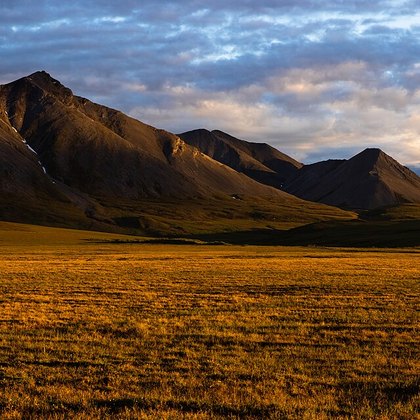
On the Bering Sea islands and the Aleutians it sits in wet sedge meadows, along ditches and at the soggy edges of pools and small streams, usually under the cover of low grass. It seeks the same soft, sodden ground as its American counterpart and probes it with the long bill for worms and insect larvae. Open mud without cover and dry tundra it avoids. On the breeding grounds in Eurasia it is a bird of wet meadows, peatland, marsh edges and soggy grassland along ditches.
Where the bird is most often found, arranged by the USNVC — the vegetation classification of the United States and Canada — and CMECS for sea and coast.




Range and movements
It breeds from Iceland and Ireland eastward through Europe and Siberia to the Bering Sea, and winters from western Europe and Africa to southern and Southeast Asia. On the American side it appears in almost every year in small numbers on the outer Aleutians — Attu, Shemya and Buldir — and on the Pribilofs and St. Lawrence Island, chiefly from mid-May into June and to a lesser degree in late summer. A few birds stay through the summer on those islands. Away from Alaska there are only a handful of continental records, and those almost always call for photographs of the spread tail. How many reach here depends on how many Siberian birds overshoot to the east in spring.
Where and when to look
Anyone on Attu, Shemya or St. Paul in the last week of May or the first of June should look at every snipe that comes up out of a wet meadow. Put the bird up and check first for the broad white trailing edge of the wing and the almost white underwing. Then get as low as you can and try to photograph it as it lands with the tail spread; without that image the report usually stays undecided.
Conservation
The Red List holds the species as Least Concern (LC); the world population is large and its centre of gravity lies in Russia and northern Europe. In western Europe numbers fell sharply through the twentieth century with the draining and heavier use of wet meadows. For North America there is nothing to manage: how many birds end up here depends on numbers in Siberia and on the weather in May.
Scientific name
Gallinago gallinago | (Linnaeus, 1758)
Linnaeus described the species in 1758 as Scolopax Gallinago; because it was later moved to another genus, author and year stand in parentheses. The genus Gallinago was introduced by Brisson in 1760 and is a Latin word for a snipe, formed on gallina, 'hen'. The humming of the display flight, by contrast, has been likened in many languages to a goat or a ram: 'sky goat' and 'thunder ram' are old names for this bird. The species name repeats the genus name, which happens often enough in Linnaeus. The type locality is Europe, later restricted to Sweden.