All species › Waders, gulls and terns › Sandpipers and allies › Terek Sandpiper
Terek Sandpiper | Xenus cinereus
Terekruiter | Andarríos del Terek
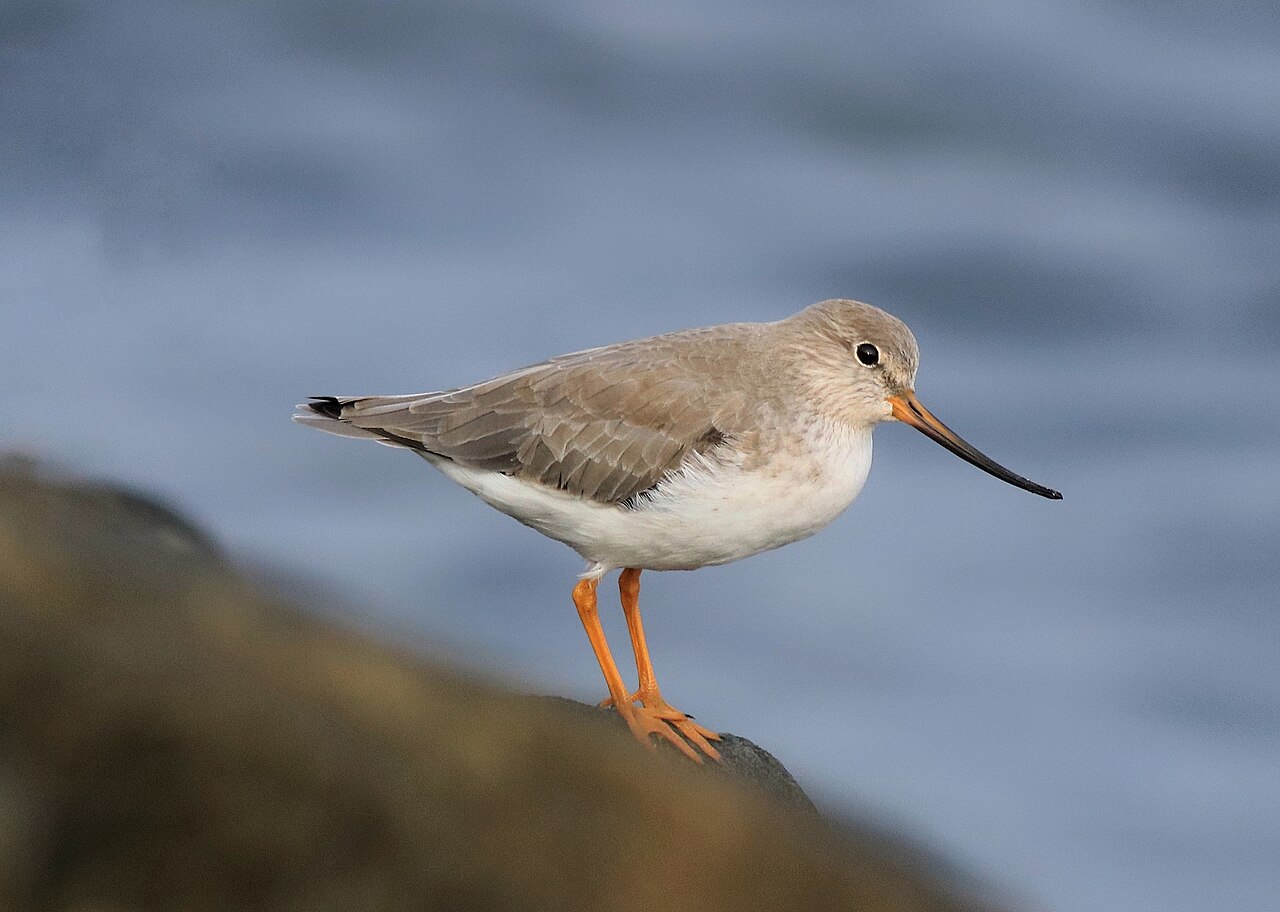
A grey wader with short orange-yellow legs and a long, clearly upcurved bill, which runs over the mud rather than walking across it. In North America it is a guest from Siberia: in almost every year a few turn up along the western edge of Alaska, with a peak in the first days of June and again in late August. Its name comes from the Terek, the river that flows into the Caspian Sea and from which the first described specimen came.
Voice
The call is a fast series of clear whistled notes, wit-wit-wit-wit, rising slightly in pitch and usually given as the bird takes off. There is also a rolling, trilling sound like a small whistle, heard among feeding birds as well. On the breeding grounds the male delivers a rattling little song during a low flight over the riverbank, with short glides on stiff wings. On the islands off Alaska you generally hear only the flight call, and often not until the bird is already up.
Recording: Ray Tsu 诸仁 — CC BY-NC-SA 4.0 · Jiuduansha Wetland National Nature Reserve, Shanghai, China · xeno-canto
Identification
Plain grey on head, back and breast, white on belly and undertail, with a short pale supercilium that is not always visible. The bill is long and visibly upcurved, black with a yellow or orange-tinged base; the legs are short and bright orange-yellow, which lights up at a distance on an otherwise grey bird. In breeding plumage two black lines run over the shoulders, formed by dark shafts in the scapulars. In flight there is no white wing bar but a broad white trailing edge along the inner wing, and the bird looks short-tailed and long-winged. It runs hunched and fast, with sudden dashes after crabs and worms, and does not teeter as it goes. Male and female look alike; juveniles have pale fringes to the wing coverts and lack the black shoulder lines.
Confusion species
Spotted Sandpiper (Actitis macularius) and Common Sandpiper (Actitis hypoleucos) are about the same size and equally grey-brown, but have a straight bill, teeter constantly, and show a white stripe across the wing in flight rather than a white trailing edge. Lesser Yellowlegs (Tringa flavipes) has much longer yellow legs, a straight bill and a white rump patch. Dunlin (Calidris alpina) has a bill that curves the other way, downward, and black legs. If a grey wader's bill curves up and its legs glow orange, nothing else is left.
Habitat
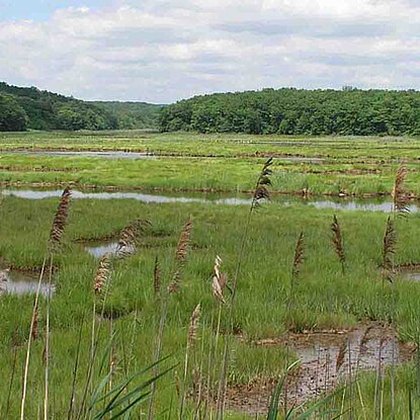
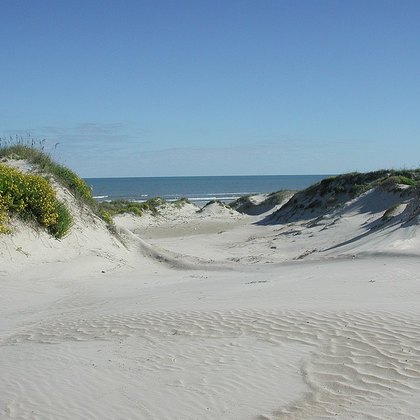
In North America it stands on sandy beaches, along the edges of lagoons and salt pools and on the mud of stream and river mouths; on the Pribilofs it is nearly always the shore or the lagoon edge. In the wintering range it takes to broad tidal flats and mangrove fringes, running among other waders. The breeding grounds look quite different: sand and gravel bars along rivers in the taiga and on the southern tundra, with willow growth alongside. Dry open ground and steep rocky coast it does not use.
Where the bird is most often found, arranged by the USNVC — the vegetation classification of the United States and Canada — and CMECS for sea and coast.



Range and movements
It breeds along the rivers of northern Eurasia, from Finland east to the Kolyma and Chukotka, and winters along tropical coasts from East Africa and southern Asia to Taiwan and northern Australia. In North America it appears in almost every year in small numbers on the Pribilofs, the western Aleutians and the Bering Sea islands. The records fall in two windows: late May and the first week of June, and the last week of August, when juveniles move out; birds in July are usually adults that have already left the breeding grounds. From mainland North America only a handful of records are known. The number of Alaskan records has risen over recent decades, partly because more people are watching on those islands.
Where and when to look
The best chance is St. Paul or Attu in the first days of June, after a spell of westerly wind. Walk the edges of the lagoons and the beaches and look for a grey bird that runs between the other waders instead of stepping among them; the upcurved bill can be seen at long range. If it flies, look for the broad white trailing edge to the wing — that rules out both Actitis sandpipers at once.
Conservation
The Red List holds the species as Least Concern (LC); the world population runs to a few hundred thousand birds. The pressure lies in the wintering range: the tidal flats along the Yellow Sea and in Southeast Asia are being reclaimed, and a large share of the eastern birds use that route. For North America there is nothing to manage; how many birds end up here depends on numbers in Siberia.
Scientific name
Xenus cinereus | (Güldenstädt, 1775)
Güldenstädt described the species in 1775 as Scolopax cinerea, among the snipes; because it was later moved to another genus, author and year stand in parentheses. The genus Xenus was introduced by Kaup in 1829 and goes back to the Greek xenos, 'stranger' or 'guest'. cinereus is Latin for 'ash-grey'. The described specimen came from the shores of the Caspian Sea at the mouth of the Terek; that river gave the bird its Dutch, English and Spanish name.