All species › Trogons › Trogons › Coppery-tailed Trogon
Coppery-tailed Trogon | Trogon ambiguus
Koperstaarttrogon | Trogón elegante
The Coppery-tailed Trogon is a Mexican bird whose range just crosses the border, into a handful of canyons in southeastern Arizona and southwestern New Mexico. The male is metallic green on head and back, with a white band across the breast, a carmine belly and a coppery, glossy tail. It sits stock still for long spells, upright and with its back turned, and is far harder to find than its colours suggest.

Voice
The call is a series of hoarse croaking notes, koah koah koah, five to ten in a row, low and wooden like the barking of a dog with a sore throat. There is also a chattering kwirr, often given with an upward flick of the tail. In the Arizona canyons it is mainly the male that calls, from April into June and loudest in the first hours after sunrise; the rock walls throw the sound back, so the bird is easily placed fifty metres wrong. Outside the breeding season it is largely silent.
No freely licensed recording has been found for this species yet; what to listen for is described below.
Identification
The male has a glossy metallic green head, back and breast, a black face and throat, a narrow white band across the breast and below it a vivid carmine belly. The upper tail is bronze to copper, the undertail white with fine black barring; the bill is yellow and the eye-ring red. The female is grey-brown where the male is green, with a white streak or comma behind the eye and a pale pink wash on the belly. Juveniles resemble the female but show white spots on the wing coverts. The posture is markedly upright, with the long, square-ended tail hanging straight down. The flight is short and undulating, from branch to branch; to take fruit the bird hovers briefly at a cluster.
Confusion species
Elegant Trogon (Trogon elegans) of Central America was treated as one species with this bird until 2025; the males differ in the pattern of the undertail, in how coppery the upper tail glows and, more subtly, in the vermiculation of the wing coverts. In the field the distinction never has to be made: the two ranges nowhere meet, and north of the Isthmus of Tehuantepec only this one of the pair occurs. Mountain Trogon (Trogon mexicanus) of the Mexican highlands closely resembles the male but has a plain white undertail with a black tip instead of fine bars, and lacks the coppery sheen on the upper tail. Eared Quetzal (Euptilotis neoxenus), which turns up in the same canyons as a rarity, is larger, has a grey bill, lacks the white breast band and sounds high and squealing rather than hoarse. Females and juveniles are taken at a glance for a large thrush or a woodpecker; the upright stance, the yellow bill and the long barred tail settle it at once.
Habitat
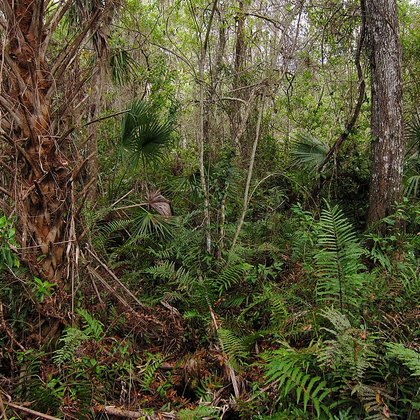
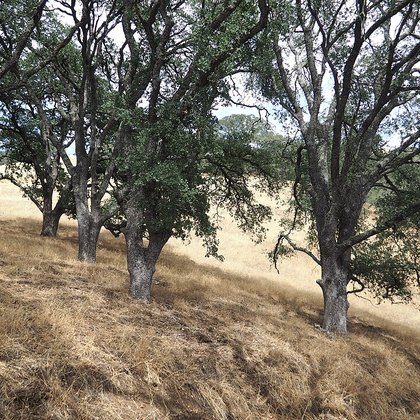
Mountain canyons with old sycamores, oaks and pines, in Arizona between roughly fifteen hundred and two thousand metres, always near running or standing water. What it needs is an old sycamore with a disused woodpecker hole, since it cannot cut a cavity itself; Northern Flickers and Acorn Woodpeckers supply the holes. In Mexico it also uses dry pine-oak woodland and tropical forest that drops its leaves in the dry season. It avoids humid lowland rainforest and open desert.
Where the bird is most often found, arranged by the USNVC — the vegetation classification of the United States and Canada — and CMECS for sea and coast.


Range and movements
The range covers Mexico north of the Isthmus of Tehuantepec, with a spur just across the border. It runs along the Sierra Madre Occidental from Sonora and Chihuahua south to Guerrero and Oaxaca, and along the eastern chain from Nuevo León and Tamaulipas to San Luis Potosí, with a form of its own on the Islas Marías. The birds from Guatemala south to northwestern Costa Rica have counted as a separate species since 2025, Trogon elegans; between the two there is no boundary but a gap, for in Chiapas and on the Pacific slope of Guatemala the bird is all but absent. In the United States it breeds only in the sky islands of southeastern Arizona — the Atascosa, Santa Rita, Patagonia, Huachuca and Chiricahua mountains — and irregularly in a few canyons of southwestern New Mexico. There most birds arrive in April and leave in September, but a small number winters in the lower canyons and along the creeks; in Mexico it is resident.
- Resident
- Breeding (summer)
- Winter
- Passage
- dark = core range, pale = thinly spread
Where and when to look
Walk a sycamore canyon at first light in May, stop every hundred metres and listen; only start searching once you hear the croaking koah koah. Then look at half tree height rather than in the crown: the bird usually sits on a bare side branch, motionless and facing away, and gives itself away by flicking its tail. Madera Canyon, Cave Creek and Ramsey Canyon are the best-known places, and there it pays to come early rather than to stay long.
Conservation
The species is not threatened worldwide, but the northern outpost is small and swings widely with the rain. Since 2013 the Arizona sky islands have been counted every spring: an average of 136 birds a year, 183 in 2023 and a record low of 31 in 2025, after a poor monsoon. The count in any year tracks the rainfall of the year before, which decides how many large insects there are for the young. The threats are the loss of old streamside sycamores and falling groundwater; in New Mexico the bird is on the state list of endangered species.
Scientific name
Trogon ambiguus | Gould, 1835
Gould described the species in 1835 as Trogon ambiguus; the author and year stand without brackets, because the species is still in the genus in which it was described. The genus Trogon was introduced in 1760 by Brisson and goes back to a Greek word for 'gnawing', after the toothed bill with which trogons work their food and their nest hole. ambiguus is Latin for 'doubtful' or 'ambiguous' — Gould saw that this bird was hard to separate from the Elegant Trogon of further south, T. elegans, with which it was long treated as one species. He gave northern Mexico as the type locality.