All species › Kingfishers, bee-eaters and rollers › Kingfishers › Belted Kingfisher
Belted Kingfisher | Megaceryle alcyon
Bandijsvogel | Martín gigante norteamericano
The Belted Kingfisher is the only kingfisher across Canada and most of the United States: a stocky, ragged-crested hunter that hovers straight over water before plunging in headfirst. Unlike almost all other birds, the female here carries the brighter plumage, with an extra rufous band the male lacks.

Voice
Its voice is not a song but a long, rattling call — a dry, mechanical rattle given as it flies low and fast over the water, often heard before the bird itself is seen. When agitated, near the nest or an intruder, the rattle shortens into sharper, repeated bursts. There is no song-like sound at all; the rattle is the only vocalization this species gives.
Recording: Rory Nefdt — CC BY-NC-SA 4.0 · Oscawana, Croton-on-Hudson, Westchester County, New York, United States · xeno-canto
Identification
A thickset bird with a large, shaggy-crested head, a dagger bill and a short tail, blue-grey above with a white collar and white underparts. The male shows a single blue-grey breast band; the female has a second, rust-coloured band across the flanks below it — one of the few North American birds in which the female is more colourful than the male. Juveniles resemble the female but show an irregular rusty wash across the blue band. In flight the large head, uneven, almost crow-like wingbeats, and hovering at a fixed height over water stand out.
Confusion species
Confusion is limited, since no other North American bird combines a shaggy crest, dagger bill and hovering flight over water. A Green Heron can give a similarly hunched impression from a distance but lacks the crest and broad collar and hunts from a perch rather than on the wing. In the extreme southwest, where the much larger Ringed Kingfisher occurs, only its clearly larger size and shaggier, double-pointed crest settle the identification.
Habitat
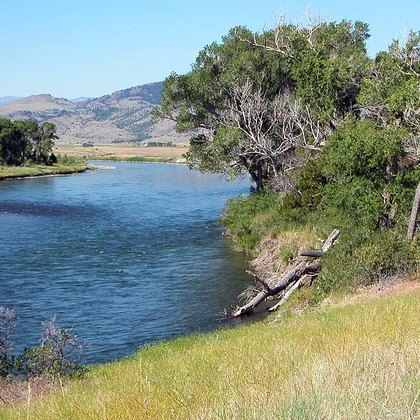
Clear rivers, lakes, ponds and coastal waters, wherever it can spot small fish from a perch or while hovering over open water. Essential is a steep, bare bank of sand or clay in which to dig a horizontal nest tunnel, sometimes a metre or more deep. It avoids turbid water lacking suitable banks, and withdraws in winter as soon as the water freezes over.
Where the bird is most often found, arranged by the USNVC — the vegetation classification of the United States and Canada — and CMECS for sea and coast.




Range and movements
Breeds from Alaska and nearly all of Canada south through the United States, wherever water and a diggable bank occur together. Across most of the United States it stays year-round as long as the water remains open; birds from the north and Canada withdraw in winter to the southern United States, Mexico, Central America and the Caribbean islands. The range has stayed stable over the past century, though the species is locally vulnerable to channelised and concrete-lined banks.
- Resident
- Breeding (summer)
- Winter
- Passage
- dark = core range, pale = thinly spread
Where and when to look
Walk a river or lakeshore and watch for a lone bird on a dead branch or wire directly over the water — the rattling call often arrives before the bird comes into view. Then scan steep sandy banks along the water for round holes at eye level or higher: they betray a nest tunnel even when its owner has just left.
Conservation
Widespread and numerous, with a population considered stable, though local declines have been reported in parts of the range from channelised banks and dam construction. Mercury contamination in fish is a slow-building risk, since the species sits at the top of the food chain in clear inland waters.
Scientific name
Megaceryle alcyon | (Linnaeus, 1758)
Linnaeus described the species in 1758 as Alcedo Alcyon, among the Old World kingfishers; it has since been moved to another genus, hence the parentheses around author and year. The genus Megaceryle unites the largest kingfishers in the world; alcyon refers to Alcyone of Greek mythology, who was transformed into a kingfisher. The type locality lies in South Carolina.