All species › Waders, gulls and terns › Auks, puffins and murres › Craveri's Murrelet
Craveri's Murrelet | Synthliboramphus craveri
Craveri's alk | Mérgulo de Craveri
Craveri's Murrelet is one of the two southernmost breeding auks in the world: a small black-and-white seabird of the warm waters around Baja California that is almost never seen from land. It nests in crevices and under low bushes on arid rocky islets and spends the rest of its life out on the open sea. With at most a few thousand breeding pairs on a handful of islands it is among the most vulnerable seabirds of the region.
Voice
At the colony, and only after dark, it gives a dry rattle recalling a cricket, rising when the bird is excited into a thin reedy trill: tsrrr-tsrrr-i-i-i. At sea it is almost always silent; a pair swimming together keeps in touch with no more than a short chip. Calling birds can be heard at night on the water off the breeding islands, when partners find each other in the dark. By day sound hardly ever betrays it, one of the reasons the species remained so poorly known for so long.
Recording: Paul Marvin — CC BY-NC-SA 4.0 · South Shores Park, Mission Bay, San Diego County, California, United States · xeno-canto
Identification
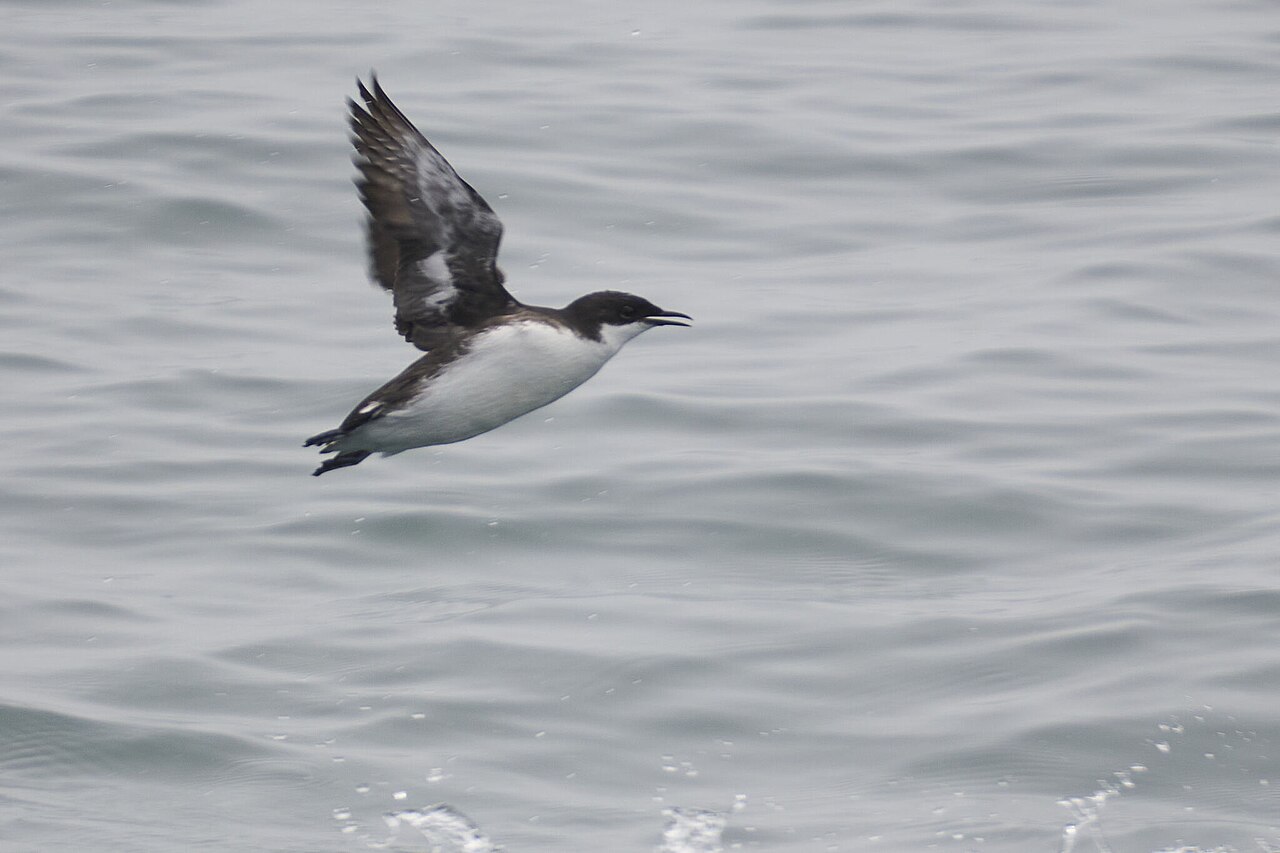
A small, compact auk, black above and white below, with a thin pointed black bill and bluish-grey legs with black claws. The black of the head runs down below the eye, further down than in its relatives, and a narrow white crescent above and below the eye forms a broken eye-ring. A dark partial collar pushes into the white underparts at the sides of the breast, and the flanks are blackish. The underwing is dusky with a paler central panel — the best mark, but visible only at the moment the bird takes off. Male and female are alike and there is no winter plumage; juveniles have a shorter bill and fine dark barring on breast and belly. On the water it often holds the tail cocked upward.
Confusion species
Scripps's Murrelet (Synthliboramphus scrippsi) is the species it is most often confused with: that bird has a clean white underwing, no dark collar at the sides of the breast, and black on the head that stops level with the eye. The same holds for Guadalupe Murrelet (S. hypoleucus), which in addition carries far more white on the face. At range a winter Marbled Murrelet can also look black and white, but it has a white collar and a white scapular bar and belongs far to the north. In the Gulf of California any small black-and-white murrelet is this species; off California the underwing decides it.
Habitat
Outside the breeding season it lives on the open ocean, usually well offshore and over deep water, where the cool California Current meets the warm water of the Gulf of California. It breeds on bare, arid rocky islets: in crevices, under overhanging stones and under dense low bushes, never openly on a cliff ledge. It avoids the shoreline itself — from a beach it is virtually never seen — and comes ashore only at night. Sheltered bays, estuaries and fresh water it does not use.
Where the bird is most often found, arranged by the USNVC — the vegetation classification of the United States and Canada — and CMECS for sea and coast.


Range and movements
It breeds on islands off both coasts of Baja California: Cedros, San Benito and the islets near Asunción and San Roque on the Pacific side, and Rasa, Partida and Tiburón in the Gulf of California. From July the birds leave the Gulf and spread out at sea, north into the waters off central California and south to off Jalisco. How far they travel varies sharply from year to year: in warm years they appear off California in far greater numbers than in cold ones. The breeding range itself has not grown over the past century; colonies have, however, disappeared from islands where rats or cats were introduced.
- Breeding (summer)
- Winter
- Passage
- dark = core range, pale = thinly spread
Where and when to look
There is no point trying from land: you need a pelagic boat trip, preferably in August or September off southern and central California, when the post-breeding spread is under way. Look for a pair of small black-and-white birds flying off low and fast, or diving. Watch above all for the moment of take-off, because only then do you see the dusky underwing that separates it from Scripps's Murrelet.
Conservation
The world population is put at six to ten thousand breeding pairs, spread over a handful of islands, and numbers are falling; the IUCN treats the species as Vulnerable (VU). The heaviest threats are introduced rats and cats on the breeding islands, oil from shipping and drilling, and drowning in gill nets. On several islands the introduced predators have now been removed, and there the number of breeding pairs is rising again.
Scientific name
Synthliboramphus craveri | (Salvadori, 1866)
Tommaso Salvadori described the species in 1866 as Uria craveri; because it was later placed in another genus, author and year stand in parentheses. The genus name Synthliboramphus is built from Greek sunthlibo, 'to press together', and rhamphos, 'bill', after the laterally compressed bill of these auks. The epithet craveri honours the brothers Federico and Ettore Craveri, who worked as collectors in Mexico and sent their material to the natural history museum in Turin, where Salvadori was curator. The type specimen came from the Gulf of California, from Isla Rasa.