All species › Waders, gulls and terns › Auks, puffins and murres › Ancient Murrelet
Ancient Murrelet | Synthliboramphus antiquus
Zilveralk | Mérgulo antiguo
The Ancient Murrelet breeds in burrows it digs under the roots of Sitka spruce, sometimes hundreds of metres inland — a forest bird among the auks. Its chicks leave the burrow one to three days after hatching, in the middle of the night and without ever having been fed, and run down to the surf where the parents lie calling offshore.

Voice
At the colony, in the dark, a high whistled chee-chee-chee and a series of thin, reedy notes that carry far through the forest. On the water offshore the parents call their chick with an insistent, penetrating peeping, sometimes for an hour on end. The chicks answer from the slope with a fine pseet that the adults pick out through the noise of the surf. Outside the breeding season the species is silent.
Recording: Andrew Spencer — CC BY-NC-SA 3.0 · Saint Paul Harbor, St. Paul Island, Alaska, United States · xeno-canto
Identification
Grey back and shoulders, black head and neck, white underparts, and a short, thick ivory-white bill. In breeding plumage the throat is black and a scattering of fine white feathers runs over crown and neck like a shawl across the shoulders. In winter the black leaves the throat and the border between black cap and grey back becomes less sharp. In flight a dark stripe along the flank shows against a clean white underwing. Juveniles resemble winter birds but are duller-headed. On the water it sits low, with the bill tilted slightly up.
Confusion species
Marbled Murrelet (Brachyramphus marmoratus) and Kittlitz's Murrelet (Brachyramphus brevirostris) are also grey and white in winter, but have white scapular stripes, a dark bill and a white collar, and lack the black cap reaching below the eye. Guadalupe Murrelet (Synthliboramphus hypoleucus) and Scripps's Murrelet (Synthliboramphus scrippsi) have a black rather than grey back and a white face, and live much further south. Pigeon Guillemot (Cepphus columba) is larger, with a big white wing patch and red legs. At distance the pale bill against a black head settles it.
Habitat
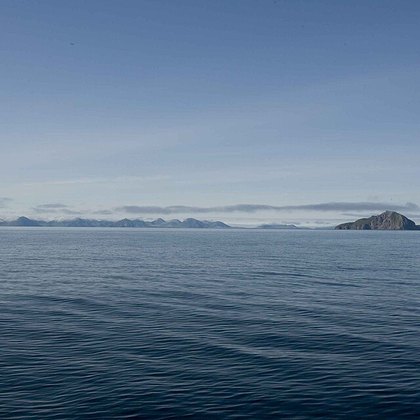
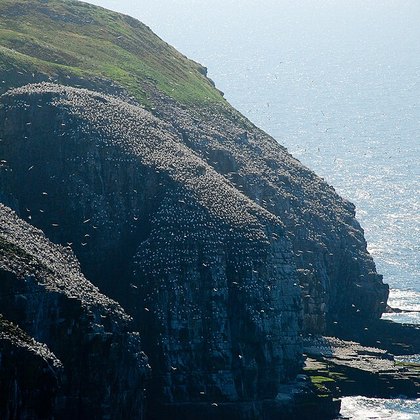
Breeds on islands with deep forest soil: the burrows lie among tree roots, under fallen trunks or in grass tussocks, and occasionally in rock crevices. For the rest of the year it lives on the open sea, usually over the continental shelf break and further offshore than most other auks. In winter it also uses sheltered coastal water, where it floats in parties of a few dozen; it avoids shallow inner bays.
Where the bird is most often found, arranged by the USNVC — the vegetation classification of the United States and Canada — and CMECS for sea and coast.


Range and movements
Breeds from the Yellow Sea and the Russian Far East across the Aleutians and the Gulf of Alaska to British Columbia, with about half the world population on Haida Gwaii. Part of the population migrates thousands of kilometres to the waters off Japan and China; another part moves south along the North American coast and is seen regularly off Washington and Oregon from October to March, in smaller numbers as far as California. Of all the auks this is the one that most often turns up far inland — there are records from Ontario, Quebec and New York, and even from western Europe.
- Resident
- Breeding (summer)
- Winter
- Passage
- dark = core range, pale = thinly spread
Where and when to look
From October to December, stand on a headland on the Washington or British Columbia coast: parties pass low over the water, and through a telescope the black head with its pale bill stands out against the grey back. Look for birds well offshore rather than in the bays, and watch how they dive: a short forward hop and gone, without a splash.
Conservation
The world population is estimated at over a million birds and the species is listed as Least Concern (LC), but in Canada the species has declined sharply over a century. On breeding islands reached by rats or raccoons the burrows empty out: on one island numbers fell from some two hundred thousand breeding birds to fourteen thousand. Eradicating those introduced predators from the islands of Haida Gwaii is the key measure; oil pollution and drowning in gill nets count as well.
Scientific name
Synthliboramphus antiquus | (Gmelin, 1789)
Gmelin described the species in 1789 as Alca antiqua, among the auks; because it was later moved to another genus, author and year stand in parentheses. The genus Synthliboramphus combines Ancient Greek sunthlibo, 'to compress', with rhamphos, 'bill', after the short, deep bill flattened from the sides. antiquus is Latin for 'ancient': the grey mantle on a black head suggested the shawl of an old woman, an image that survives in the English and Spanish names too. Gmelin gave the type locality as the region west of North America to Kamchatka and the Kurils, that is to say the Bering Sea.