All species › Passerines › Mockingbirds and thrashers › Curve-billed Thrasher
Curve-billed Thrasher | Toxostoma curvirostre
Krombekspotlijster | Cuitlacoche piquicurvo
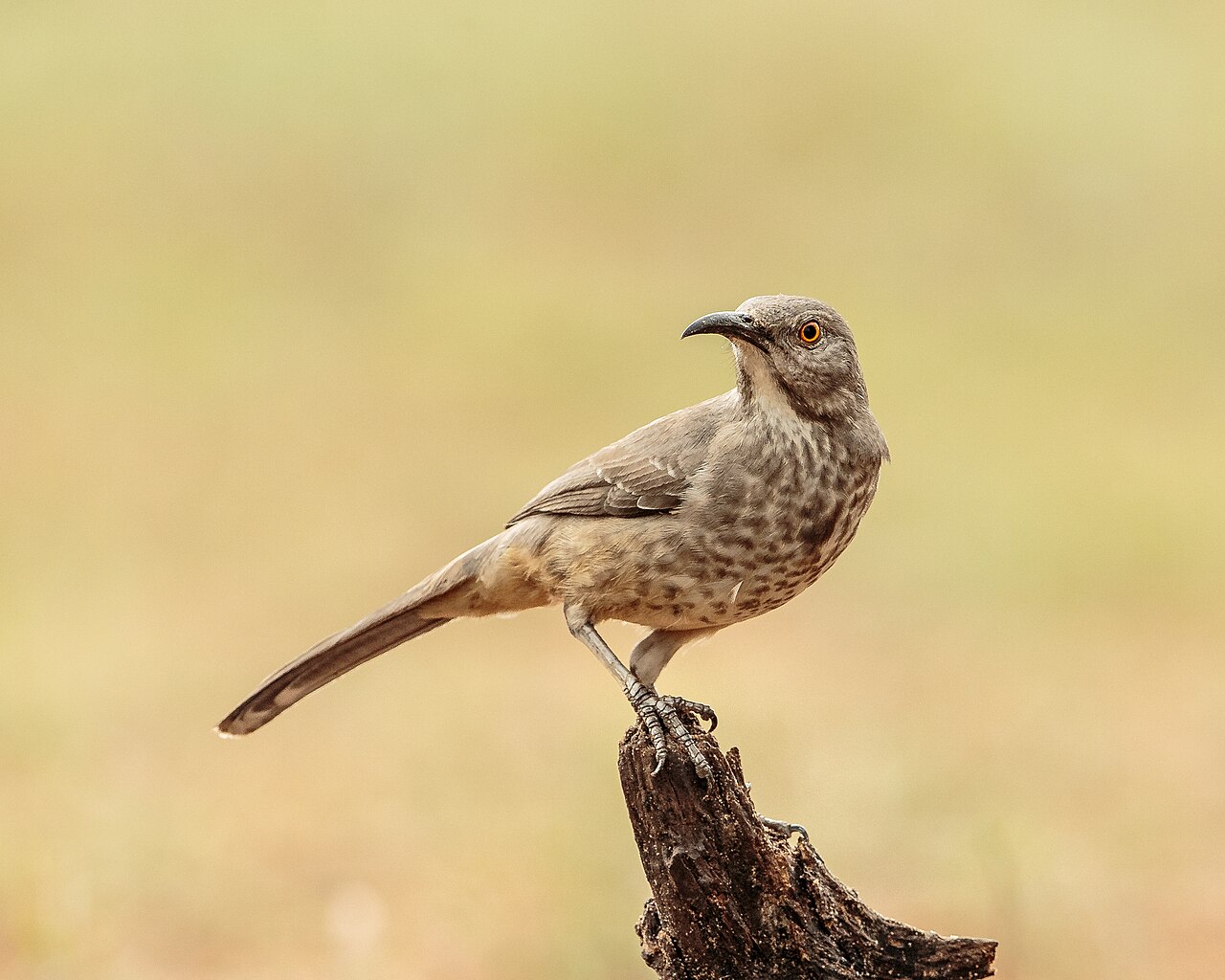
The Curve-billed Thrasher is the commonest large thrasher of the southwestern deserts: a greyish-brown bird with a long decurved bill, an orange iris and blurry spotting on the breast. It nests by preference in cholla cactus and announces itself with a sharp, two-syllabled whistle.
Voice
The call is a loud, abrupt whit-wheet, stressed on the second part, as though someone were whistling for attention; it is usually the first sound a visitor learns in the desert. The song is a long, varied series of clear, gurgling and grating phrases with imitated fragments between them, delivered from the top of a cactus or shrub. Unlike Northern Mockingbird it repeats a phrase at most twice. In Mexico its repertoire has earned it the name cuicacoche, 'songbird'.
Recording: Pat Goltz — CC BY-NC-SA 4.0 · Tucson, Pima County, Arizona, United States · xeno-canto
Identification
A large, elongated thrasher with a long rounded tail, sturdy legs and a long, clearly decurved black bill. The plumage is greyish brown above and dingy grey to buff-white below, with round, blurred grey spots on the breast. The iris is orange to orange-yellow. The tail corners are white, most clearly so in birds of the Chihuahuan Desert. Sonoran Desert birds (the 'palmeri' group) have a greyer breast with barely visible spotting and almost no white wingbars; Chihuahuan Desert birds (the 'oberholseri' group) have more sharply marked breast spots, white wingbars and larger white tail corners.
Confusion species
Bendire's Thrasher is smaller, with a shorter, straighter bill showing a pale base to the lower mandible, triangular rather than round breast spots and a yellower iris; its call is a low chuck instead of the sharp whit-wheet. Long-billed Thrasher of south Texas is warmer brown and has sharply black-streaked rather than blurrily spotted underparts. Crissal Thrasher has a longer, more strongly curved bill, an unspotted breast and a rusty undertail, and keeps to scrub along dry washes. Brown Thrasher has a streaked breast and two white wingbars and is absent from most of the desert region.
Habitat
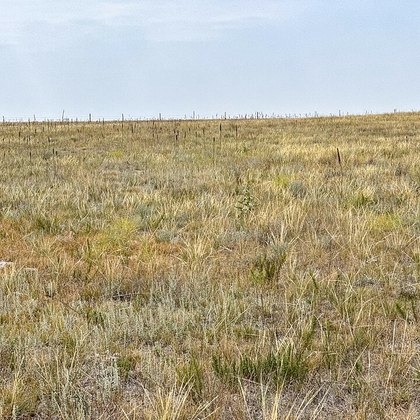
Desert and semi-desert with cholla, saguaro (the giant columnar cactus of the Sonoran Desert), mesquite (a thorny pod-bearing shrub of the Southwest that forms dense thickets) and creosote bush, thorn scrub and dry washes, and higher up also pinyon (a low-growing pine of the dry southwestern foothills)-juniper and dry oak scrub, to about 2500 metres on the Mexican plateau. It also occupies gardens, parks and residential districts in desert cities, foraging at feeders and under shrubs. The nest stands almost always in a thorny cactus, most often in cholla.
Where the bird is most often found, arranged by the USNVC — the vegetation classification of the United States and Canada — and CMECS for sea and coast.




Range and movements
It is resident in the southwestern United States and most of Mexico: from southeastern California and Arizona through New Mexico and western and southern Texas to southeastern Colorado and southwestern Kansas, and south across the Mexican plateau to Oaxaca. It does not migrate; outside the range only occasional vagrants turn up, as far as North Dakota and Alberta. The division into a western (Sonoran) and an eastern (Chihuahuan) subspecies group follows the two desert systems.
- Resident
- Breeding (summer)
- Winter
- dark = core range, pale = thinly spread
Where and when to look
Look for it in the first hour after sunrise on top of a cholla or a mesquite: it then sings from a fixed post and the curved bill shows well against the sky. Outside those hours the whit-wheet gives it away, even when it is digging in the sand with its bill under a shrub. In the residential districts of Tucson and Phoenix it is one of the most frequently seen desert birds.
Conservation
The species is listed as Least Concern (LC) thanks to its large range, but numbers in the United States have fallen over recent decades. Loss of cholla and mesquite to grazing, housing and desert fire reduces the supply of nest sites; where cholla is kept in gardens and parks the species holds on. Predation by feral cats and the spread of introduced grasses that carry fire are the main local pressures.
Scientific name
Toxostoma curvirostre | (Swainson, 1827)
William Swainson described the species in 1827 as Orpheus curvirostris, from material of the Mexican plateau; because it was later moved to another genus, author and year stand in parentheses. The genus name Toxostoma is formed from Greek toxon 'bow' and stoma 'mouth, bill', after the curved bill of the group. The species name curvirostre is Latin for 'curve-billed', from curvus 'curved' and rostrum 'bill' — the same meaning as the English name.