All species › Passerines › Mockingbirds and thrashers › Brown Thrasher
Brown Thrasher | Toxostoma rufum
Rosse spotlijster | Cuitlacoche rojizo
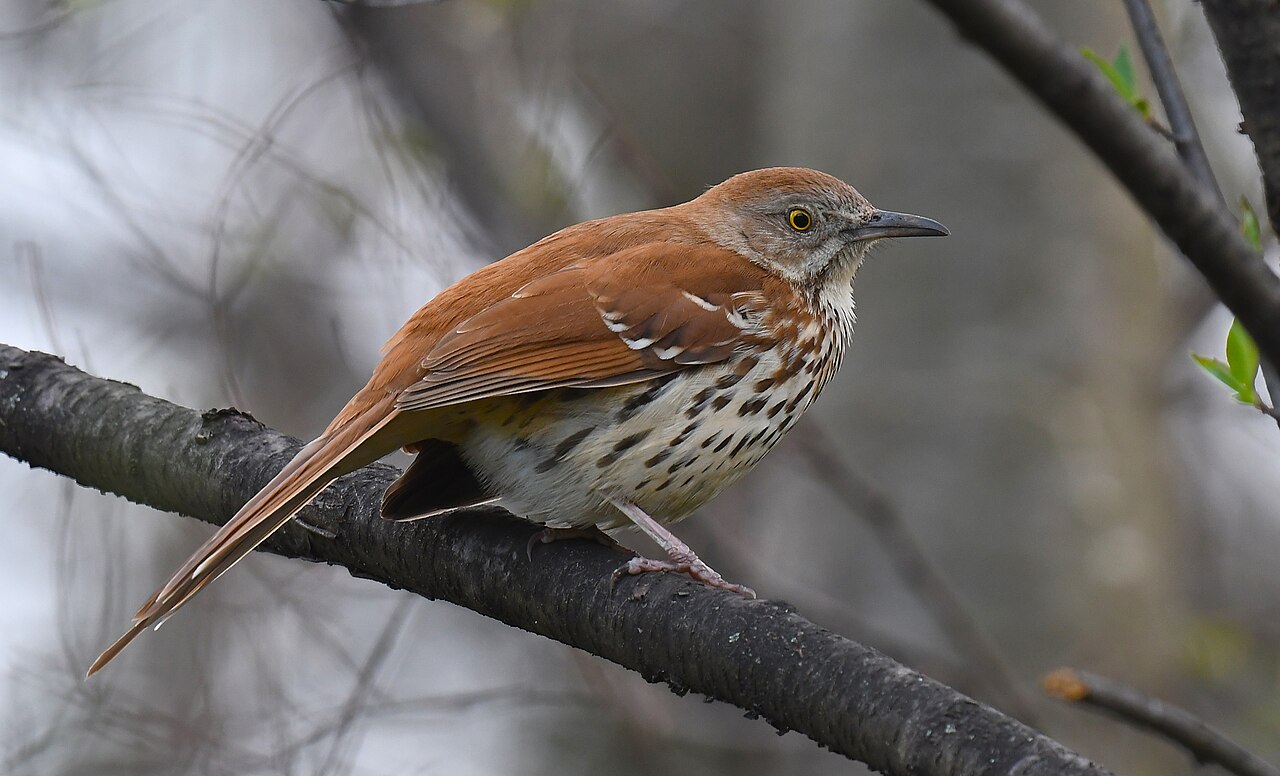
The Brown Thrasher is the only thrasher found across almost the whole of eastern North America. It is rufous above and heavily streaked below, and spends most of the year low in dense thickets, throwing leaf litter aside with its bill.
Voice
The song consists of short phrases usually repeated twice in succession; Northern Mockingbird repeats three times or more, Gray Catbird mostly only once. That count is the most usable field character. A male's repertoire is the largest established for any North American songbird: over a thousand song types have been counted and estimates run to several thousand phrases, part of it taken from other species. The calls are a sharp, smacking chack and a drawn-out whistled cher-ree.
Recording: David Darrell-Lambert — CC BY-NC-SA 4.0 · Point Pelee National Park, Essex County, Ontario, Canada · xeno-canto
Identification
Rufous from crown to tail tip, with two narrow white wing bars. The underparts are white to cream with dense blackish-brown streaks running down onto the flanks. The iris is bright yellow, the bill long and slightly decurved, the tail long and rounded at the end. Male and female look alike; young birds have a greyish iris.
Confusion species
It separates from the true thrushes by the long curved bill, the long tail and the yellow iris: Hermit Thrush is smaller, has a short straight bill and round rather than streaked breast spots. Long-billed Thrasher overlaps in south Texas and has a greyer face, whiter underparts, heavier black breast streaks and a longer, blacker, more curved bill with an orange iris. Curve-billed Thrasher of the southwest is grey-brown without rufous and shows blurred, blotchy rather than crisp streaks.
Habitat
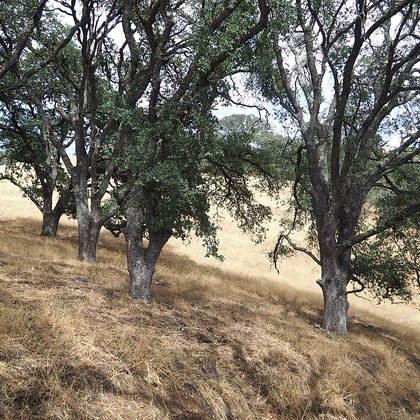
Dense scrub, hedgerows, woodland edges, overgrown clearings and neglected field margins. On the Great Plains it uses shelterbelts and streamside strips of cottonwood, willow or dogwood; in the southeast, young regrowth after cutting and open oak woodland with dense understorey. It reaches gardens and parks, but keeps to the thickest part and avoids the immediate surroundings of houses.
Where the bird is most often found, arranged by the USNVC — the vegetation classification of the United States and Canada — and CMECS for sea and coast.




Range and movements
Breeds from southern Canada — Alberta east to Nova Scotia — across the whole eastern and central United States to the eastern edge of the Rocky Mountains and central Texas. Northern populations leave in September and October; from roughly Virginia, Tennessee and Oklahoma southward the species stays all year. In winter the concentration lies in the southeastern states and Texas. In northeastern Mexico it is a rare winter visitor, and west of the Rockies a vagrant.
- Resident
- Breeding (summer)
- Winter
- Passage
- dark = core range, pale = thinly spread
Where and when to look
Look for it in April and May, when the male sings from a bare branch above the thicket; the rest of the year it stays down in cover and gives itself away mainly by the rustling of leaves. Count the repetitions of each phrase — two means Brown Thrasher — and watch for the yellow iris, which shows even in the gloom of a hedgerow.
Conservation
The species is listed as Least Concern (LC). Partners in Flight puts the breeding population at 6.2 million birds. The Breeding Bird Survey shows a decline of about 37 per cent between 1966 and 2019, roughly 1 per cent a year. Two opposite changes play a part: in farmland, hedgerows and rough field corners disappear with larger field sizes, while elsewhere young scrub grows on into closed forest. Partners in Flight scores the species 10 out of 20 on the Continental Concern Score.
Scientific name
Toxostoma rufum | (Linnaeus, 1758)
Linnaeus described the species in 1758 as [Turdus] rufus; because it was later moved to another genus, author and year stand in parentheses. The type material came from South Carolina. The genus Toxostoma was introduced in 1831 by Johann Georg Wagler, from Greek toxon 'bow' and stoma 'mouth', after the curved bill. The species name rufum is Latin for 'red'. The Dutch name follows the same colour; the English name thrasher is linked to the sweeping stroke with which the bird throws leaf litter aside.