All species › Passerines › Mockingbirds and thrashers › Long-billed Thrasher
Long-billed Thrasher | Toxostoma longirostre
Langsnavelspotlijster | Cuitlacoche piquilargo
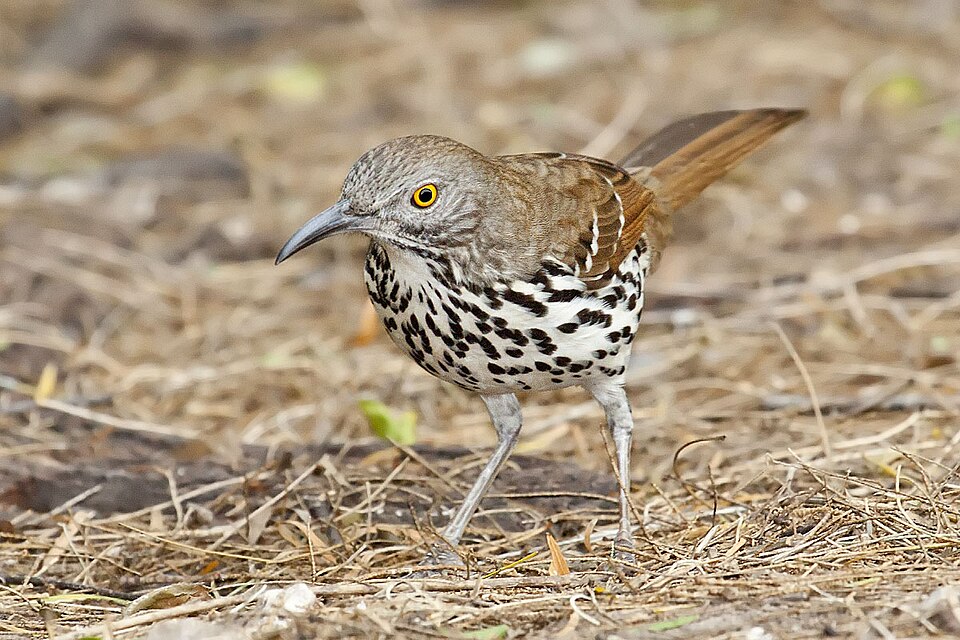
The Long-billed Thrasher is the thrasher of the thorn scrub along the Gulf slope of northeastern Mexico and the lower Rio Grande. It closely resembles Brown Thrasher, but has a longer, blacker bill, a greyer face and an orange iris, and stays in the same thicket all year.
Voice
The song is a series of short, musical phrases repeated two to four times, lower and fuller in tone than Brown Thrasher's and with less mimicry. More distinctive is the call: a loud, clear whistled chu-wee that carries through the densest scrub, alongside a sharp chack and a rattling chatter. It sings mainly from February to May, including in the middle of the day.
Recording: Scott Gravette — CC BY-NC-SA 4.0 · Choke Canyon SP, Calliham Unit, McMullen County, Texas, United States · xeno-canto
Identification
Grey-brown crown and face, rufous back, rump and tail, and white underparts with crisp black streaks on breast and flanks. The iris is orange to orange-yellow, the bill long, black and clearly decurved, longer than the width of the head. The wing coverts have narrow white tips. The sexes are alike.
Confusion species
Brown Thrasher winters in the same area: it is warmer rufous across the whole upperside including the crown, has cream rather than white underparts, browner and less sharply defined streaks, a shorter bill with a paler base, and a yellow iris. Curve-billed Thrasher shares the range in northeastern Mexico and west Texas, but is plain grey-brown with blurred spots, without rufous and without crisp streaking. Northern Mockingbird is grey with large white wing patches and white tail sides.
Habitat
Dense, thorny scrub and low woodland of the Tamaulipan type, with mesquite (a thorny pod-bearing shrub of the Southwest that forms dense thickets), huisache, acacia, hackberry, granjeno and columnar cactus, and also willow strips and riparian woodland along rivers. It forages on the ground under cover, throwing leaves and loose soil aside. Where the scrub is cleared it disappears; in abandoned citrus groves and overgrown village edges it holds on.
Where the bird is most often found, arranged by the USNVC — the vegetation classification of the United States and Canada — and CMECS for sea and coast.





Range and movements
From south Texas — north to about San Antonio and Aransas County — through Tamaulipas, Nuevo León and southeastern Coahuila south to San Luis Potosí, Hidalgo, Querétaro, northern Veracruz and northern Puebla. The species does not migrate; outside the breeding season it moves locally at most. North of the Rio Grande valley it spread as mesquite advanced into former grassland. Away from this range it is a distinct rarity.
- Resident
- Winter
- dark = core range, pale = thinly spread
Where and when to look
The best chance is in March in the refuges of the lower Rio Grande, along a trail through dense scrub: listen first for the loud whistled chu-wee and then look for the bird on the ground beneath the bushes. With any brown thrasher in this area, check the iris colour — orange in this species, yellow in the wintering Brown Thrasher.
Conservation
The species is listed as Least Concern (LC). Partners in Flight puts the world population at about 280,000 birds and scores the species 12 out of 20 on the Continental Concern Score. In the United States numbers rose between 1966 and 2015, by an estimated 6.1 per cent a year, as mesquite spread across former grassland. Against that, less than five per cent of the original Tamaulipan scrub of the lower Rio Grande remains; the rest has been turned into farmland and built-up land. What is left of the range is heavily fragmented.
Scientific name
Toxostoma longirostre | (de Lafresnaye, 1838)
Frédéric de Lafresnaye described the species in 1838 as [Orpheus] longirostris, from material out of Mexico; because it was later placed in Toxostoma, author and year stand in parentheses. The genus Toxostoma goes back to Greek toxon 'bow' and stoma 'mouth'. The species name longirostre comes from Latin longus 'long' and rostrum 'bill'; the Dutch, English and Spanish names all say the same thing.