All species › Passerines › Mockingbirds and thrashers › Bendire's Thrasher
Bendire's Thrasher | Toxostoma bendirei
Cactusspotlijster | Cuitlacoche piquicorto
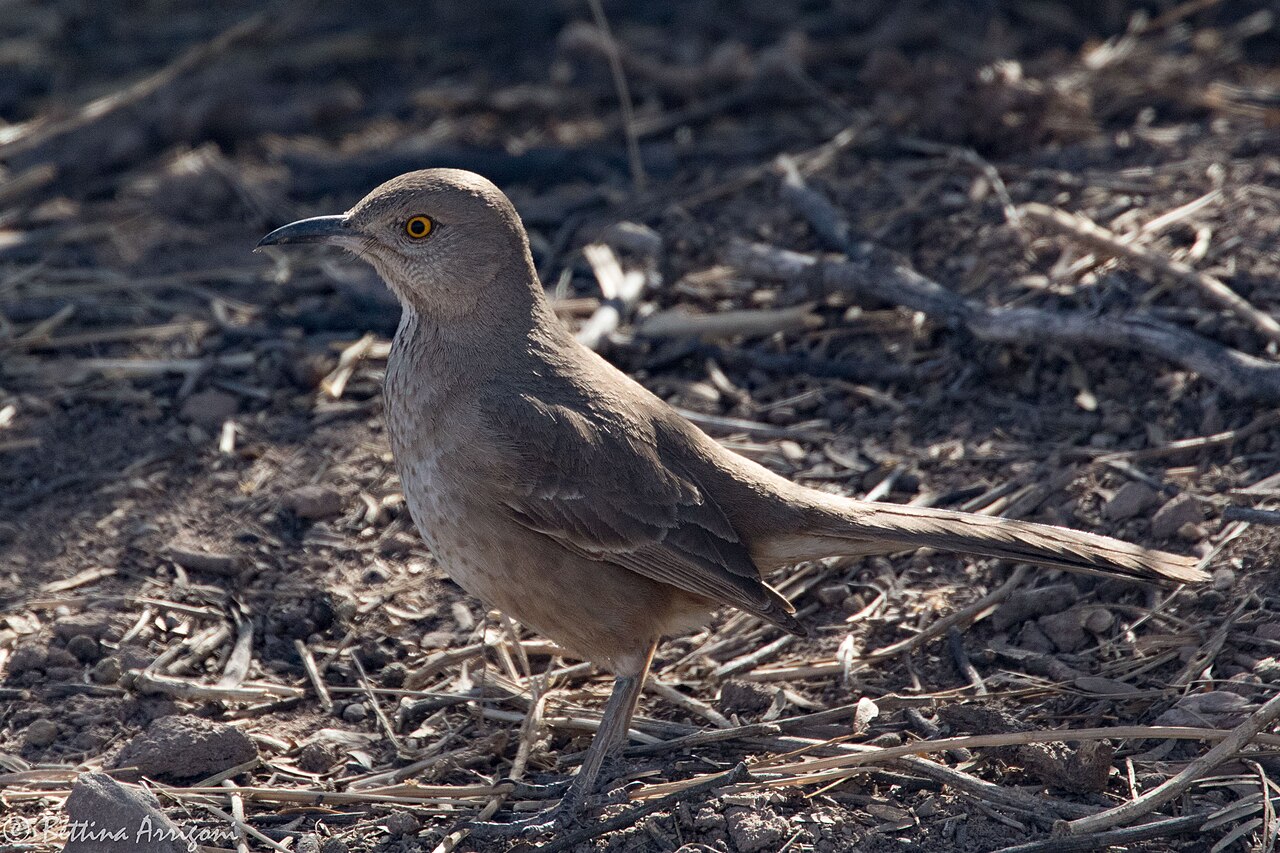
Bendire's Thrasher is the short-billed thrasher of open desert flats and semi-desert in the southwest. It resembles Curve-billed Thrasher and is confused with it almost everywhere; the difference lies in the shorter, straighter bill with a pale base and in the crisper, triangular breast spots. The species has fallen steeply in fifty years and is listed as Vulnerable.
Voice
The song is a long, continuous run of low, gurgling and warbling phrases without clear pauses, which can go on for minutes; it does not repeat phrases in short blocks as the other thrashers do, and works in imitations of other desert birds. It sings from the top of a shrub or yucca, mainly in early spring. The usual call is a sharp, short chek; the loud whit-wheet of Curve-billed Thrasher is absent.
Recording: Paul Marvin — CC BY-NC-SA 4.0 · S Sagittarius St, Eloy, Pinal County, Arizona, United States · xeno-canto
Identification
Grey-brown above, dingy white to pale buff below, with small, crisply defined triangular or arrowhead spots on the breast that fade on worn birds. The iris is yellow to yellow-orange. The bill is short for a thrasher, only slightly decurved, with a clearly pale base to the lower mandible. The outer tail feathers have narrow white tips.
Confusion species
Curve-billed Thrasher is larger, has a longer, heavier black bill curved along its whole length and without a pale base, round rather than triangular breast spots that are often barely visible on fresh birds, and an orange iris; it also gives a loud, double whit-wheet. Sage Thrasher is smaller, with a short straight bill, sharp black streaks on a white breast and white tail corners. LeConte's Thrasher is much paler, sandy and virtually unspotted, with a longer black bill.
Habitat
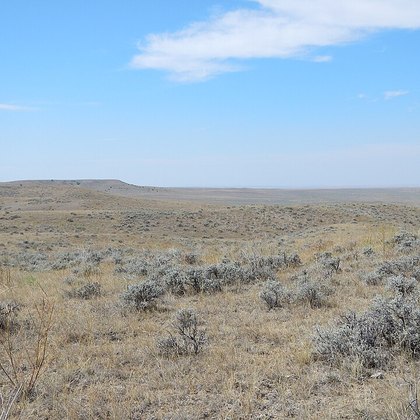
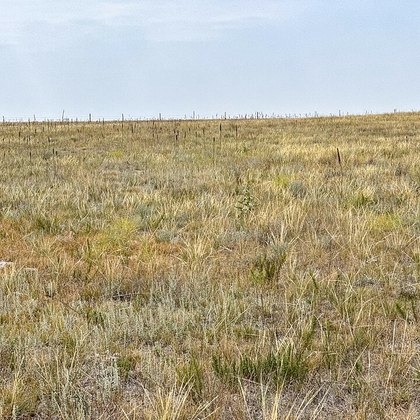
Open desert and semi-desert with scattered shrubs and low trees: sagebrush (grey-green sagebrush scrub of the dry West) and saltbush flats, juniper and pinyon edges, grassland with yucca and cholla, and the margins of saguaro desert. It chooses more open ground with lower vegetation than Curve-billed Thrasher, and also occurs in lightly grazed grassland and along field edges, as long as clumps of shrubs remain for nesting.
Where the bird is most often found, arranged by the USNVC — the vegetation classification of the United States and Canada — and CMECS for sea and coast.



Range and movements
Breeds from southern Utah and southwestern Colorado through Nevada, northwestern New Mexico, Arizona and the extreme southeastern corner of California south to Sonora. It withdraws from the northern part of the range in winter, when the concentration lies in southern Arizona, Sonora and Sinaloa. In southern Arizona part of the population stays all year.
- Resident
- Breeding (summer)
- Winter
- Passage
- dark = core range, pale = thinly spread
Where and when to look
Look for it in February and March, when it sings and still perches in view on a shrub top; later in the year it is silent and no longer perches in the open. On any doubtful bird, check the base of the lower mandible: pale in this species, uniformly black in Curve-billed Thrasher. The shape of the breast spots — crisp triangles against round blotches — is unreliable on worn summer birds.
Conservation
Partners in Flight puts the world population at about 83,000 birds. The Breeding Bird Survey shows a decline of 2.7 per cent a year between 1968 and 2023, a cumulative loss of 78 per cent; the 2025 State of the Birds report places the species in its highest alert category. The IUCN lists it as Vulnerable. The main cause is the conversion of open desert scrub to farmland and built-up land; light grazing formerly kept the ground open, but that effect is outweighed by habitat loss.
Scientific name
Toxostoma bendirei | (Coues, 1873)
Elliott Coues described the species in 1873 as Harporhynchus Bendirei, from a specimen taken at Tucson, Arizona; because it was later placed in Toxostoma, author and year stand in parentheses. The name honours Charles Bendire, a lieutenant in the United States Army and a collector, who came upon the species in 1872 near Fort Lowell outside Tucson. The genus Toxostoma is from Greek toxon 'bow' and stoma 'mouth'. The Dutch name refers to the cholla and other cacti in which it nests.