All species › Passerines › Thrushes and allies › Dusky Thrush
Dusky Thrush | Turdus eunomus
Bruine lijster | Zorzal oscuro
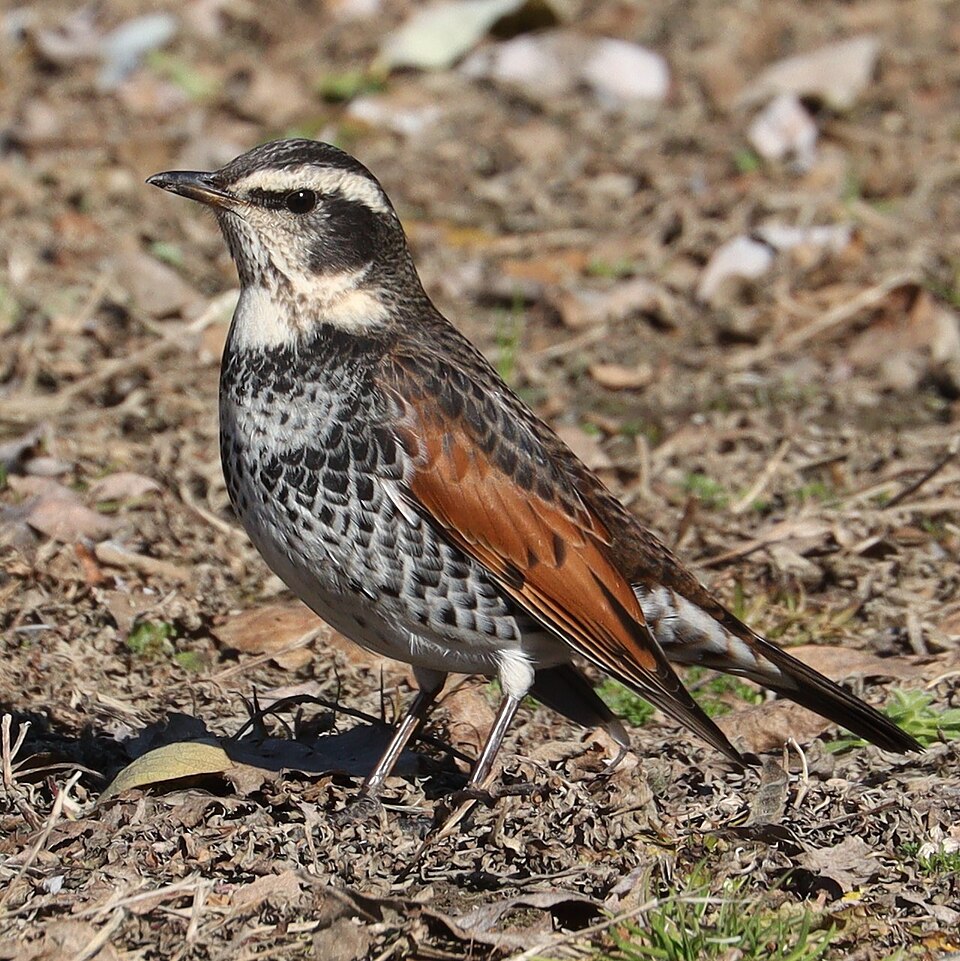
The Dusky Thrush breeds in Siberia and winters in East Asia; in the guide area it is a vagrant, largely confined to the western Aleutians and the Bering Sea islands of Alaska, with a few records on the mainland and in British Columbia. A black breast shield, a white supercilium and rufous wing panels distinguish it.
Voice
The song is simple: a short series of fluting or slightly shrill notes, similar in structure to that of the Redwing, and virtually never heard in the guide area. The calls matter more: a hard, rapid chak-chak recalling Fieldfare, and a thin, rather rasping queek or sheep on take-off. Vagrants usually sit quietly among other thrushes and give themselves away only when they flush.
Recording: Barry Edmonston — CC BY-NC-SA 4.0 · Izumi, Kagoshima, Japan · xeno-canto
Identification
Upperparts dark brown, with rufous panels on the wing coverts and primaries and a rusty underwing. The head is dark with a long white to cream supercilium. The underparts are white, with a broad black band across the upper breast and black scaly spotting on the flanks; that shield is dense and black in the male, looser and browner in the female. The bill is dark with a yellow base.
Confusion species
Naumann's Thrush, treated as the same species until recently, has rufous rather than black spotting on breast and flanks and a rufous tail; hybrids occur in the zone of overlap in Siberia and cannot always be named. Fieldfare has a grey head and rump and a black tail, with no rufous in the wing. Redwing is smaller, plain brown above and streaked rather than scaled. American thrushes lack both the black breast shield and the supercilium.
Habitat
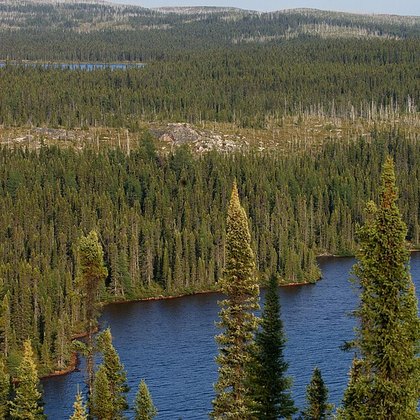
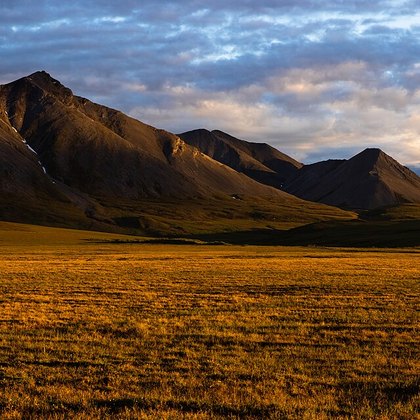
On the breeding grounds open conifer and birch woodland of the northern taiga and the scrub at the tundra edge. In winter open country in East Asia: rice fields, pasture, field margins, parks and gardens, often in flocks on the ground. Vagrants in Alaska turn up in low scrub, on grassy ground and at village edges, where little other cover exists.
Where the bird is most often found, arranged by the USNVC — the vegetation classification of the United States and Canada — and CMECS for sea and coast.




Range and movements
The breeding range runs from central Siberia east to Kamchatka; it winters in Japan, Korea, southern China and Myanmar. In North America it is an irregular spring and autumn migrant on the western Aleutians and an exceptional visitor to St. Lawrence Island and St. Paul, with scattered records north to Utqiagvik and south to Juneau and Petersburg in southeastern Alaska. British Columbia has two accepted records, from 1993 and 1994, Washington State one from 2002 and Yukon two. Most birds appear in late autumn or winter, often in the company of American Robins.
Where and when to look
The best chance is Attu or Shemya in May, or an autumn visit to an Aleutian island; away from Alaska it is worth working through a winter flock of American Robins at a rowan or an apple tree. When a bird flushes, watch for the rusty underwing and the pale wing panels, visible at a distance while the breast shield can only be judged close up.
Conservation
The species is listed as Least Concern (LC): the range is large and the population is put at millions of birds. In the East Asian wintering areas it has declined, partly through changes in land use and through trapping; in Japan it has remained a common winter bird. The North American records involve single birds and say nothing about the state of the population.
Scientific name
Turdus eunomus | Temminck, 1831
Temminck described the species in 1831 as Turdus eunomus, from a specimen from Japan; because it still stands in its original genus, author and year appear without parentheses. Turdus is Latin for thrush. The species name goes back to Greek eunomos 'orderly, lawful', from eu 'good' and nomos 'law, custom'. The species was long regarded as a subspecies of Turdus naumanni and only later recognised again as separate; both the English and the Dutch name refer to the dark markings.