All species › Passerines › Leaf warblers › Dusky Warbler
Dusky Warbler | Phylloscopus fuscatus
Bruine boszanger | Mosquitero sombrío
The Dusky Warbler is a small, plain brown Phylloscopus of Siberia and northeastern Asia that keeps low in cover. In the area of this guide it is a vagrant: almost annual on the Bering Sea islands of Alaska, and in autumn occasionally on the coast of California.
Voice
The song is a monotonous, flat whistle: a short series of the same slightly falling note, repeated at intervals. What matters to the observer is the call, a hard, dry tchek like two pebbles struck together, often the only thing that gives the bird away. Vagrants call regularly from cover without showing themselves.
Recording: Bo Shunqi 薄顺奇 — CC BY-NC-SA 4.0 · 门源,Hai Bei Zang Zu Zi Zhi Zhou, Qing Hai Sheng, China · xeno-canto
Identification
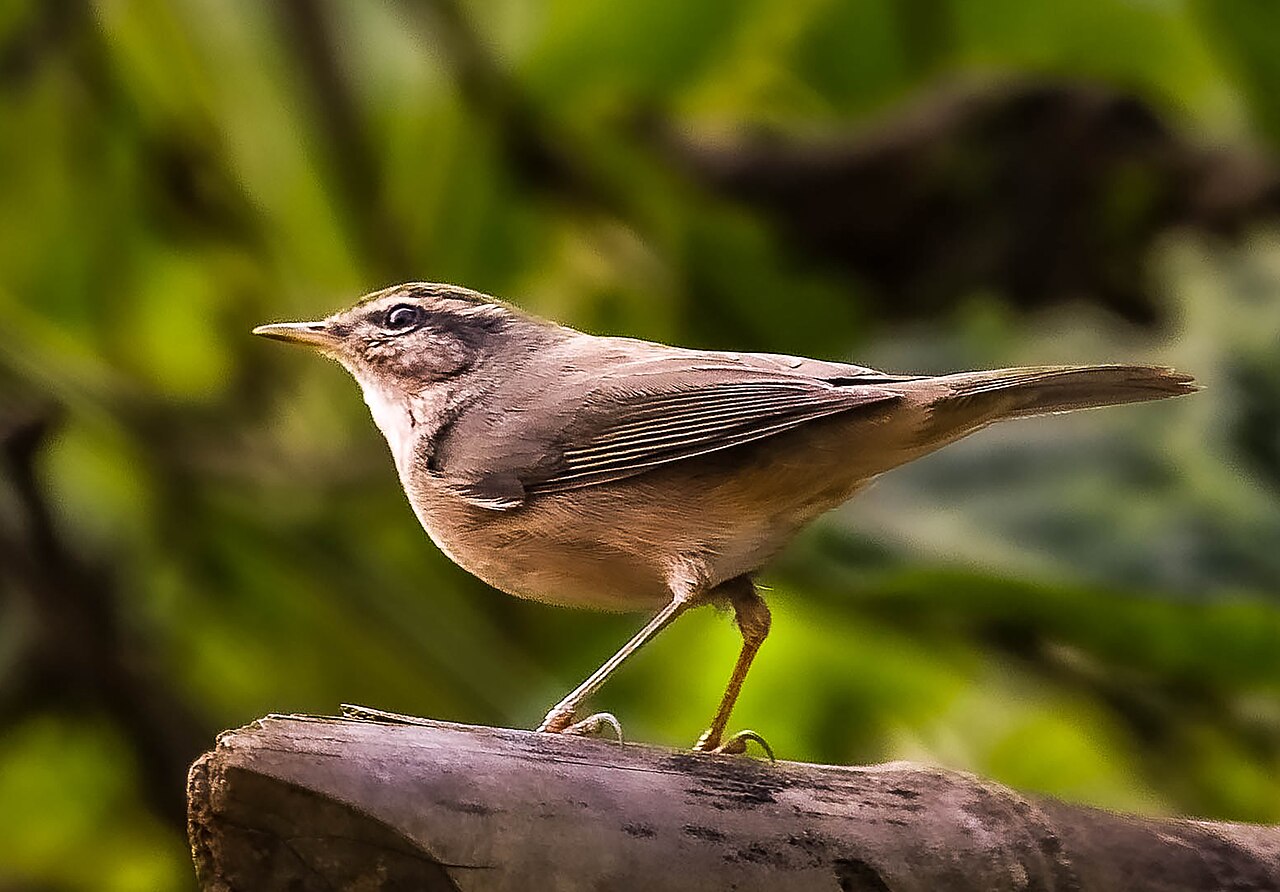
Small and stocky, with a fine, pointed bill and fairly sturdy pale brown legs. Upperparts plain dark olive-brown, with no wingbar and no pale wing panel; underparts dingy white with buff flanks and undertail coverts. The long, narrow, creamy supercilium runs well behind the eye and stands sharply against a dark eye-stripe. A pale rim shows below the eye. It moves low and mouse-like, often on the ground or in rank growth, with much flicking of tail and wings.
Confusion species
The build recalls a chiffchaff, but the combination of a wholly absent wingbar, brown rather than green upperparts and a long supercilium carried well behind the eye settles it. Radde's Warbler is redder brown, with a shorter supercilium and a finer bill. Siberian Chiffchaff has blacker legs and a high, thin eep call instead of the hard tchek. American wood-warblers of this size almost always show yellow or white in the plumage or white tail spots; Dusky Warbler shows no pale patch anywhere.
Habitat
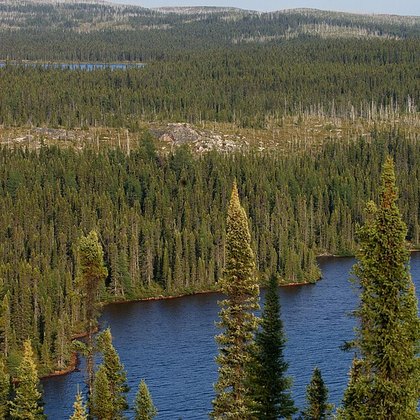
Breeds in low scrub along the edge of taiga bog, in willow and birch thickets along rivers, in wet sedge and in mountain scrub up above the treeline. It winters in reeds, thickets and rank growth along watercourses in southern and southeastern Asia. Vagrants in Alaska and California sit in low scrub, tamarisk, nettle beds and garden hedges, nearly always close to the ground.
Where the bird is most often found, arranged by the USNVC — the vegetation classification of the United States and Canada — and CMECS for sea and coast.




Range and movements
The breeding range runs from the Ob east through Siberia to Kamchatka and south to northern Mongolia and northeastern China; the winter is spent from northeastern India and Nepal to southern China and Indochina. Within the area of this guide there are only vagrants. Most records come from St. Lawrence Island and the Aleutians, in late spring and in late summer; in California there are a few records a year, mostly in October along the coast. The species is also a regular autumn vagrant to western Europe, which shows how far it can drift from its route.
Where and when to look
Follow the sound. At Gambell or in the Aleutians a hard, dry tchek from a patch of bog willow or a rubbish heap means standing still until the bird comes up for a moment. Then look at the wing first: not a single pale line. Only after that look for the long supercilium behind the eye.
Conservation
The world population is large and the breeding range extensive; the IUCN places the species in the Least Concern category (LC) and there is no sign of decline. North America has no population of its own: the birds that turn up here are drifted migrants from Asia, and their number says more about the number of observers on the islands than about the species. Loss of reedbed and riverside vegetation in the Asian winter range is the main pressure.
Scientific name
Phylloscopus fuscatus | (Blyth, 1842)
Blyth described the species in 1842 as Phillopneuste fuscata, from a bird taken near Calcutta; its placement in another genus puts author and year in parentheses. The genus Phylloscopus was introduced in 1826 by Friedrich Boie, from Greek phullon 'leaf' and skopos 'seeker', hence 'leaf-searcher'. The species name fuscatus is from Latin fuscus 'dark, brown'. The English, Dutch and Spanish names all say the same thing: a leaf warbler without green.