All species › Passerines › Bush warblers and allies › Japanese Bush Warbler
Japanese Bush Warbler | Horornis diphone
Japanse struikzanger | Cetia japonés
On Hawaii the Japanese Bush Warbler can be heard everywhere and seen almost nowhere: an inconspicuous brown bird of dense scrub that gives itself away with a whistle carrying across a whole valley. It was released on Oahu in 1929; it now lives on every main island except Niihau, from gardens by the sea up into mountain forest. Walk there and you will hear it dozens of times in a morning and perhaps see it once.
Voice
The song has two parts that hardly seem to belong together: first a high, pure whistle of two to three seconds, hoooo, and then a short, bursting closing phrase, ho-kek-kyo. It sings from February to July, usually unseen in cover and sometimes at first light from a bare twig. Disturb it and you get something quite different: a hard rattling kek-kyo kek-kyo, along with a dry ticking. In Japan the bird is the 'uguisu', and that first whistle counts there in poetry as the sign that spring has begun.
No freely licensed recording has been found for this species yet; what to listen for is described below.
Identification
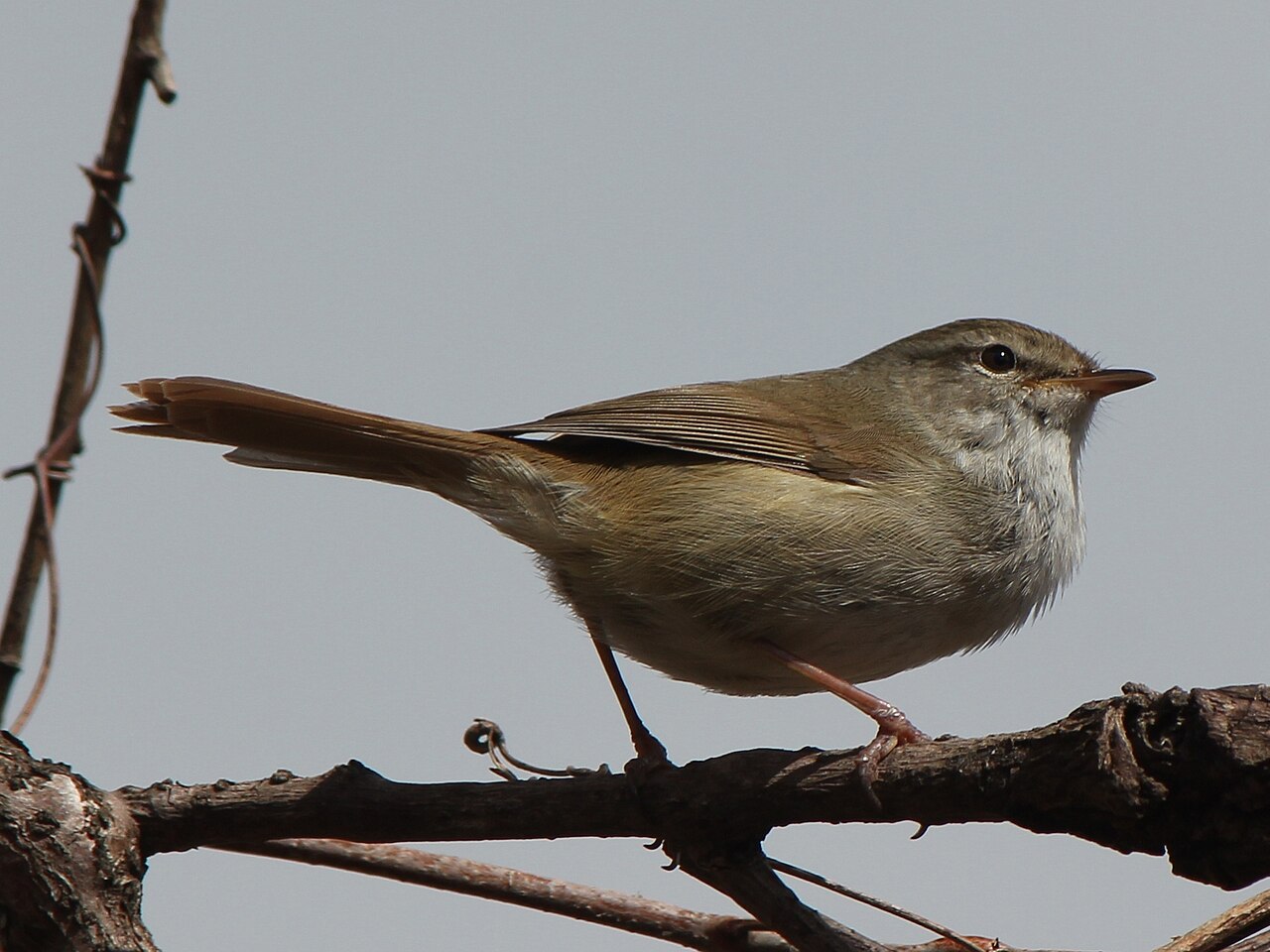
Fifteen to eighteen centimetres, with short rounded wings and a long graduated tail often held slightly raised. Olive-brown above with rusty tones in wings and tail, dirty white below with buff flanks; a narrow pale line runs over the eye with a dark line beneath it. Male and female look alike but differ sharply in size: a male weighs about twice as much as a female — the range runs from nine to twenty-one grams — so a pair together looks like two species. The bill is fine and pointed, the legs pale and strong, and wingbars or spots are entirely absent.
Confusion species
The Red-billed Leiothrix (Leiothrix lutea) hides in the same scrub but is colourful: red bill, orange-yellow throat and yellow and red in the wing. The Warbling White-eye (Zosterops japonicus) is much smaller and green, has a white eyering and moves through the canopy in loose parties rather than through the undergrowth. In native forest the Hawaii Elepaio can cause confusion: it has two white wingbars and cocks its black and white tail. If all you had was half a second of a brown bird, the long graduated tail and the complete lack of markings decide it.
Habitat
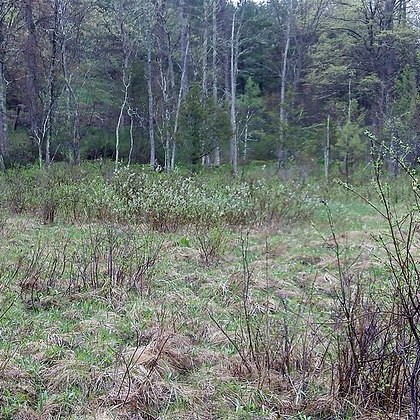
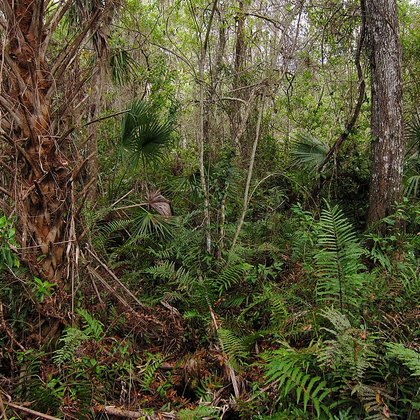
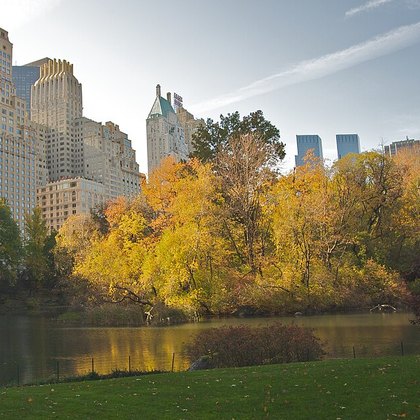
Dense undergrowth: gulches full of guava and ginger, run-wild scrub, plantation edges, gardens with tall hedges, and the understorey of native ohia and koa forest. It occurs from sea level to about two thousand metres and becomes scarce above that. What it asks for is a shrub layer closed all the way to the ground; open country and bare forest floor it does not use. Even in mountain forest it stays low, among ferns and trunk bases, seldom more than a couple of metres up.
Where the bird is most often found, arranged by the USNVC — the vegetation classification of the United States and Canada — and CMECS for sea and coast.
Range and movements
Its own range lies in Japan, Korea and northeastern China, outside this map. On the map only Hawaii appears, where birds were released on Oahu from 1929 onward — about a hundred and forty in all up to 1941, partly to control insects and partly for the song. For half a century it stayed confined to Oahu; then it crossed water: Molokai in 1979, Maui and Lanai in 1980, Kauai in 1983 and the island of Hawaii in 1997. On the Alakai plateau of Kauai alone four to eight thousand birds were estimated in 2012. On Kahoolawe it has been recorded on and off since 1992 without forming a settled population, and from Niihau there are no reports; those two islands are therefore left uncoloured on the map.
- Resident
Where and when to look
You will hear it first. Between February and July, stand still in the morning at the edge of a gulch or a dense hedge and wait; the singer is usually within ten metres, in the thickest part. The best chance of seeing it is at first light, when it comes briefly onto an open twig, or at the moment it crosses a path. The trails above Honolulu and the forest of Kokee on Kauai are as good as anywhere.
Conservation
Not threatened (LC). It is common in its own range, and on Hawaii it has become one of the most numerous birds of the understorey; its numbers are counted in the annual forest bird surveys. It is neither managed nor controlled there. The release of 1929 was meant partly to control insects in crops; what it actually eats is insects and spiders of the lowest shrub layer, in native forest as well.
Scientific name
Horornis diphone | (Kittlitz, 1830)
Kittlitz described the species in 1830 as Sylvia diphone, from birds of the Bonin Islands (Ogasawara); because it was later placed in another genus, author and year stand in parentheses. The genus Horornis was introduced by Hodgson in 1845, from Greek hora, 'season, spring', and ornis, 'bird'. diphone is Greek for 'two-voiced', after the two utterly different sounds the bird makes. The name thus records exactly what stands out in the field: the whistle and the rattle are hard to hear as one bird.