All species › Passerines › Tit-warblers, bushtits and long-tailed tits › Bushtit
Bushtit | Psaltriparus minimus
Struikmees | Sastrecillo
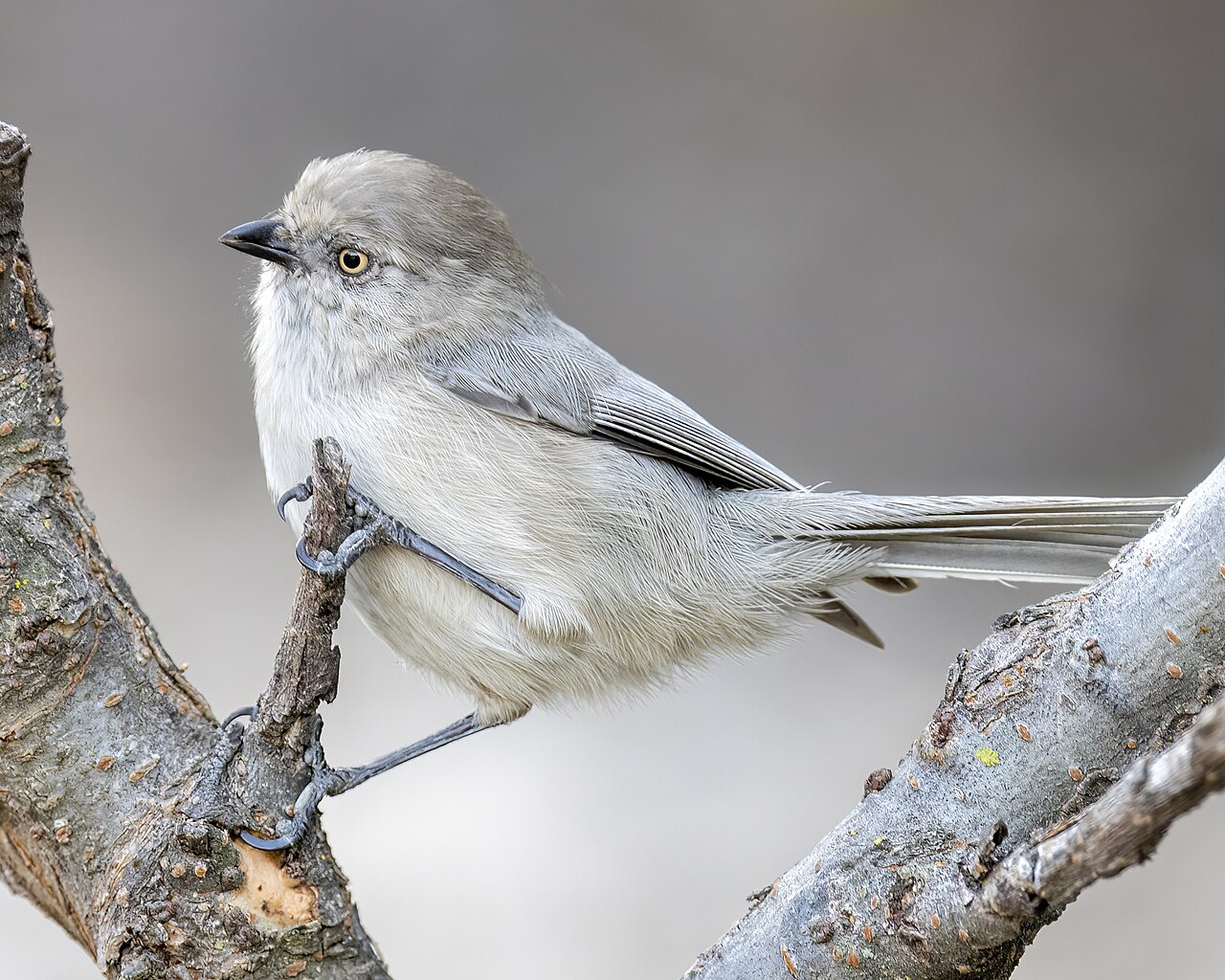
The Bushtit is one of the smallest songbirds on the continent: a fluffy grey-brown ball of four to six grams with a long tail and a bill of almost nothing. Male and female differ only in the colour of the eye — dark in the male, pale yellow in the female — and at this size that is a usable mark. You rarely see one: it comes ten to forty at a time, or not at all.
Voice
There is no song; what a flock keeps up all day is a soft, high, continuous tsit ... tsit with which the birds follow one another through dense shrubs. Then there is the alarm: when a hawk or a jay passes over, every bird in the flock strikes up a thin quavering whistle at the same moment and holds it for seconds while they all sit dead still. That combined sound is almost impossible to place — it seems to come from everywhere at once — and it stops as abruptly as it began. Even the heaviest voice in such a party stays thin and high; everything a Bushtit says, it says at the top of hearing.
Recording: Greg Irving — CC BY-NC-SA 4.0 · Dungeness Trails, Sequim, Clallam County, Washington, United States · xeno-canto
Identification
Ten to eleven centimetres, almost half of that tail, with a large round head, a thick coat of feathers and a long tail that seems to trail behind the body in flight. The plumage is plain: grey-brown above, dirty white to pale grey below, without wingbars or any other marking. Birds of the coastal belt have a brown crown and grey cheeks, birds of the interior a grey crown with a brown ear patch. The adult female has a pale yellow iris, the male and the young birds a dark one. In the far south, from western Texas southward, males also carry a black mask over the ear coverts. The flight is weak and dancing, with much fluttering and short crossings from shrub to shrub.
Confusion species
The Ruby-crowned Kinglet is just as small but has a white eye-ring, a clear white wingbar with a black bar behind it, and it flicks its wings without pause. The Blue-gray Gnatcatcher is blue-grey rather than grey-brown and swings a long tail that is white and black from below. In Californian chaparral (dense, hard-leaved scrub of California's Mediterranean climate) the Wrentit (Chamaea fasciata) is the most similar species: also brown, also long-tailed and also pale-eyed, but half as long again, with a stouter bill and a loud accelerating song the Bushtit does not have. A young Verdin is likewise grey and without yellow, but has a needle-like bill and sits alone or in twos.
Habitat
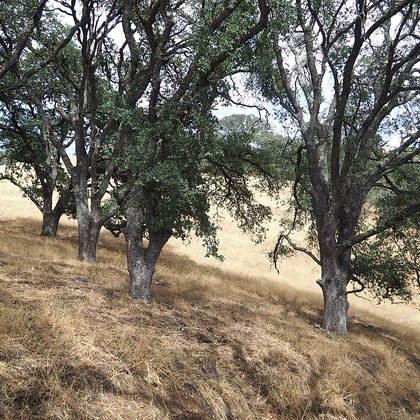
Oak and pine-oak woodland, chaparral, juniper and pinyon scrub, willows along creeks, and among them gardens, parks and cemeteries with dense shrubbery. In the mountains it goes above three thousand metres, and in winter the flocks drop to lower slopes. What it needs is a dense shrub layer with small-leaved twigs; open grassland and dark closed conifer forest it passes by. It uses exotic ornamental shrubs as readily as native ones, and so makes a living in suburbs where nothing of the original scrub is left.
Where the bird is most often found, arranged by the USNVC — the vegetation classification of the United States and Canada — and CMECS for sea and coast.




Range and movements
Resident in the west: from the extreme southwest of British Columbia south through Washington, Oregon and California, east across the Great Basin to Colorado, New Mexico and western Texas, and on through the highlands of Mexico into Guatemala. There is no migration; flocks do come down from the mountains in winter and wander through lower valleys. In the northwest it is a common bird right into the city gardens of Vancouver and Seattle. Across that whole range only the colour of crown and cheeks changes, from brown-capped birds on the coast to males with a black mask in the south.
- Resident
- Breeding (summer)
- Winter
- Passage
- dark = core range, pale = thinly spread
Where and when to look
Do not walk after a flock; stand where it is heading. A flock crosses a garden in under a minute and then keeps going one way, so whoever hears the ticking has about twenty seconds to look. Use those seconds on the eyes: every pale yellow iris is a female, and at a glance you can see how the party is made up.
Conservation
Least Concern (LC), with an estimated 4.3 million breeding birds and a population that has been stable since the surveys began in 1966. It belongs to the handful of species that do as well in planted gardens as in their own scrub, and that keeps it numerous in regions where the chaparral itself has been cleared. Locally it does disappear where scrub is removed altogether for building rather than replaced.
Scientific name
Psaltriparus minimus | (Townsend, 1837)
Townsend described the species in 1837 as Parus minimus, among the tits, from birds out of the forests along the Columbia — probably near Fort Vancouver in what is now Washington state; because it was later placed in another genus, author and year stand in parentheses. The genus Psaltriparus was introduced by Bonaparte in 1850, from Greek psaltria, 'female harpist', and Latin parus, 'tit'. minimus is Latin for 'the smallest'. The name is thus a diminutive twice over, which suits a bird that hardly weighs anything in the hand.