All species › Passerines › Tyrant flycatchers and allies › Eastern Kingbird
Eastern Kingbird | Tyrannus tyrannus
Koningstiran | Suirirí boreal
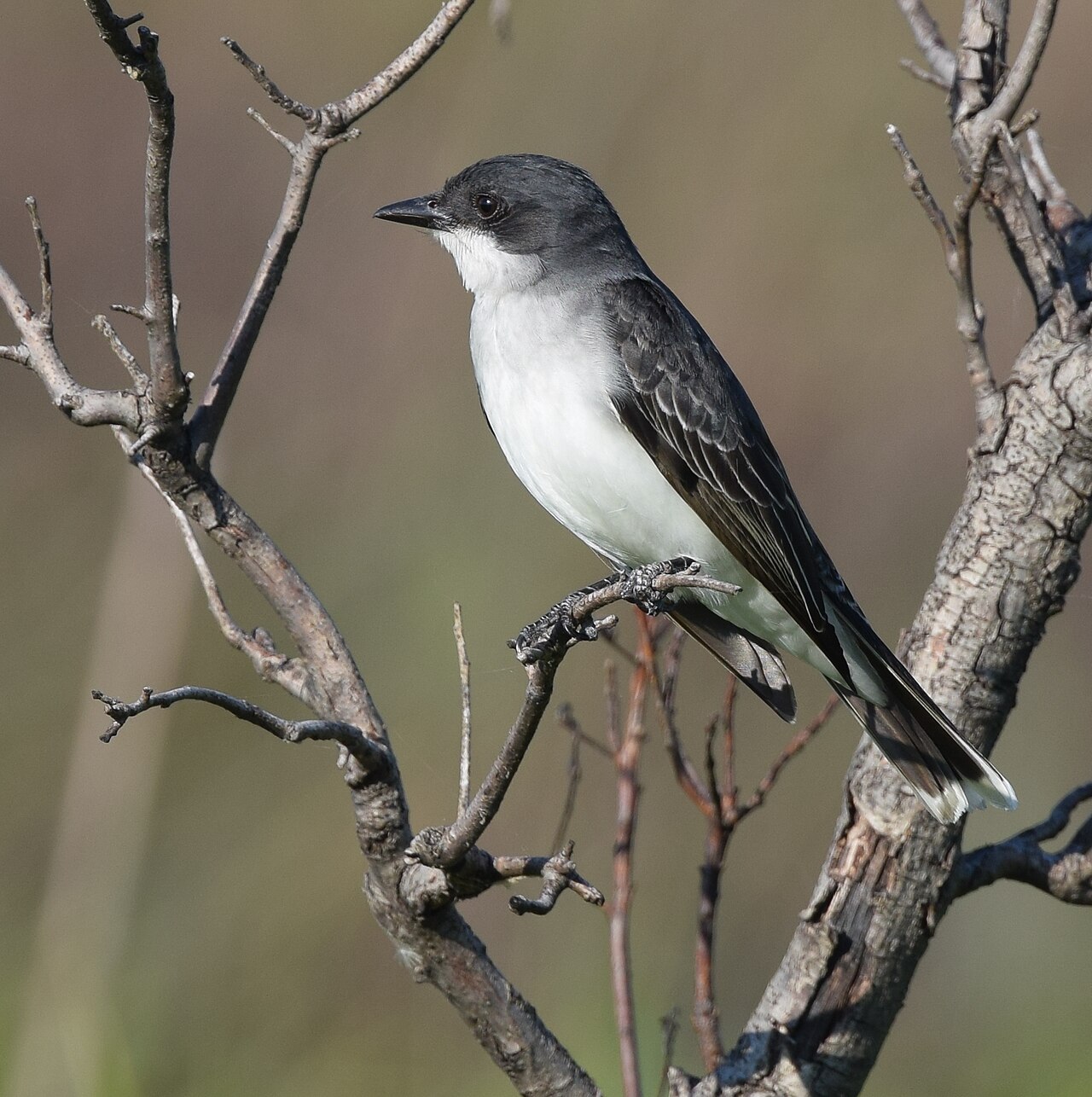
The Eastern Kingbird sits bolt upright on a wire or a dead branch above a meadow, black above and white below, with a narrow white band along the tail tip like a stroke of paint. This is the bird that attacks a hawk ten times its own weight. In Amazonia, where it winters, it is another animal altogether: silent, in flocks, and living on fruit.
Voice
The sound is sharp, high and electric: a fast tzee-tzee-tzee like a short circuit, and a stuttering kit-kit-kitter-zeer as it launches from its perch. There is not one musical note in it, and it carries far over open ground. The dawn song, which the male begins long before sunrise, is not delivered from a branch but in the air, the bird hanging on quivering wings. In the winter quarters it is all but mute.
Recording: Stanislas Wroza — CC BY-NC-SA 4.0 · Marais Léon-Provancher, Portneuf, Québec, Canada · xeno-canto
Identification
Slate grey to black above, clean white below, with a dark cap running down below the eye; the boundary between black and white is sharp. The safe mark is the tail: square-cut, black, with a white band along the trailing edge that shows up even at distance. On the crown lies a flame-red to orange patch that is almost never visible. Male and female are alike; young birds are browner and lack the crown patch. In flight the wingbeat is stiff and quivering, shallow and fast, as though the bird were trembling.
Confusion species
Western Kingbird (Tyrannus verticalis) is grey with a yellow belly and has white edges along the sides of the tail rather than a white terminal band. Gray Kingbird (T. dominicensis) of the Florida coast and the Caribbean is a paler grey, with a far heavier bill and a slightly forked tail without a white end. Eastern Phoebe (Sayornis phoebe) is smaller and a duller brown-grey, wags its tail constantly and lacks the sharp black-and-white division. In doubt it comes down to the tail tip: no other flycatcher in the east carries that white band.
Habitat
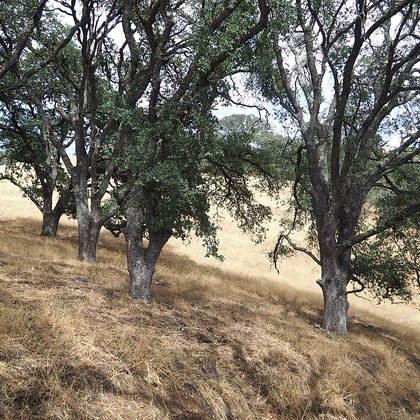
Open country with scattered trees: pastures with hedgerows, rough ground along ditches and streams, woodland edges, orchards and the shores of lakes and reservoirs. It needs two things — a free lookout with air around it, and a tree or bush to nest in — and where those two stand together it settles, farmland included. Closed forest it avoids entirely, and so it does dry open plains without a tree in them. Water nearby is a clear preference; nests often stand over the bank or right beside it.
Where the bird is most often found, arranged by the USNVC — the vegetation classification of the United States and Canada — and CMECS for sea and coast.




Range and movements
It breeds from the southern Northwest Territories and British Columbia across Canada and over nearly all of the United States east of the Rocky Mountains, with outposts into Oregon and Washington. It leaves as early as August, and migration runs in flocks over the Gulf Coast and straight through Central America. The winter is spent in the western Amazon basin, far south of the guide area; the map alongside therefore shows only the breeding and passage range. In the United States it has clearly become scarcer over the past half century, above all where old pasture and hedgerow have been built over or have grown shut.
- Breeding (summer)
- Winter
- Passage
- dark = core range, pale = thinly spread
Where and when to look
In June, follow a country road with wire fencing between pastures: the kingbird sits on a post or on the top strand, breast into the wind, and returns to the same place after every sally. Come back along that same road in August and it is often no longer alone but in small parties in a mulberry or an elder, the birds having turned to fruit just before departure.
Conservation
The breeding population is put at around 26 million birds and the species is listed as Least Concern (LC). Even so, numbers fell by about 41 per cent between 1966 and 2019, roughly one per cent a year. The loss of open pasture — to building on one side and to closing woodland on the other — is held to be the main cause, together with the decline of large insects.
Scientific name
Tyrannus tyrannus | (Linnaeus, 1758)
Linnaeus described the species in 1758 as Lanius tyrannus, among the shrikes; since its move to Tyrannus, author and year stand in parentheses. The genus was introduced by Lacépède in 1799, and because genus name and species name are identical, Tyrannus tyrannus is one of those names that zoology allows and botany does not. tyrannus is Latin for 'absolute ruler', after its conduct towards larger birds. The specimen described came from northern America; the American Ornithologists' Union restricted the type locality to South Carolina in 1931.