All species › Passerines › Tyrant flycatchers and allies › Thick-billed Kingbird
Thick-billed Kingbird | Tyrannus crassirostris
Diksnavelkoningstiran | Tirano Pico Grueso
The Thick-billed Kingbird is the heaviest kingbird of the region, with a massive, slightly hooked bill larger than that of any relative. It is a bird of western Mexico; in the United States it breeds only along a few creeks in southeastern Arizona and occasionally in southwestern New Mexico.
Voice
It calls loudly and often, frequently right after returning to its perch. The usual call is a shrill, squeaky pit-tee-rree or chee-bree with a grating, two-part build; there is also a series of rapid, high notes resembling twittering. The display call is a sustained, rattling kee-ee-ee-eer. The sound carries through a whole canyon and earned it the description of Arizona's loudest bird.
Recording: Jules Evens — CC BY-NC-SA 4.0 · San Antonio Tlayacapan, Chapala, Jalisco, Mexico · xeno-canto
Identification
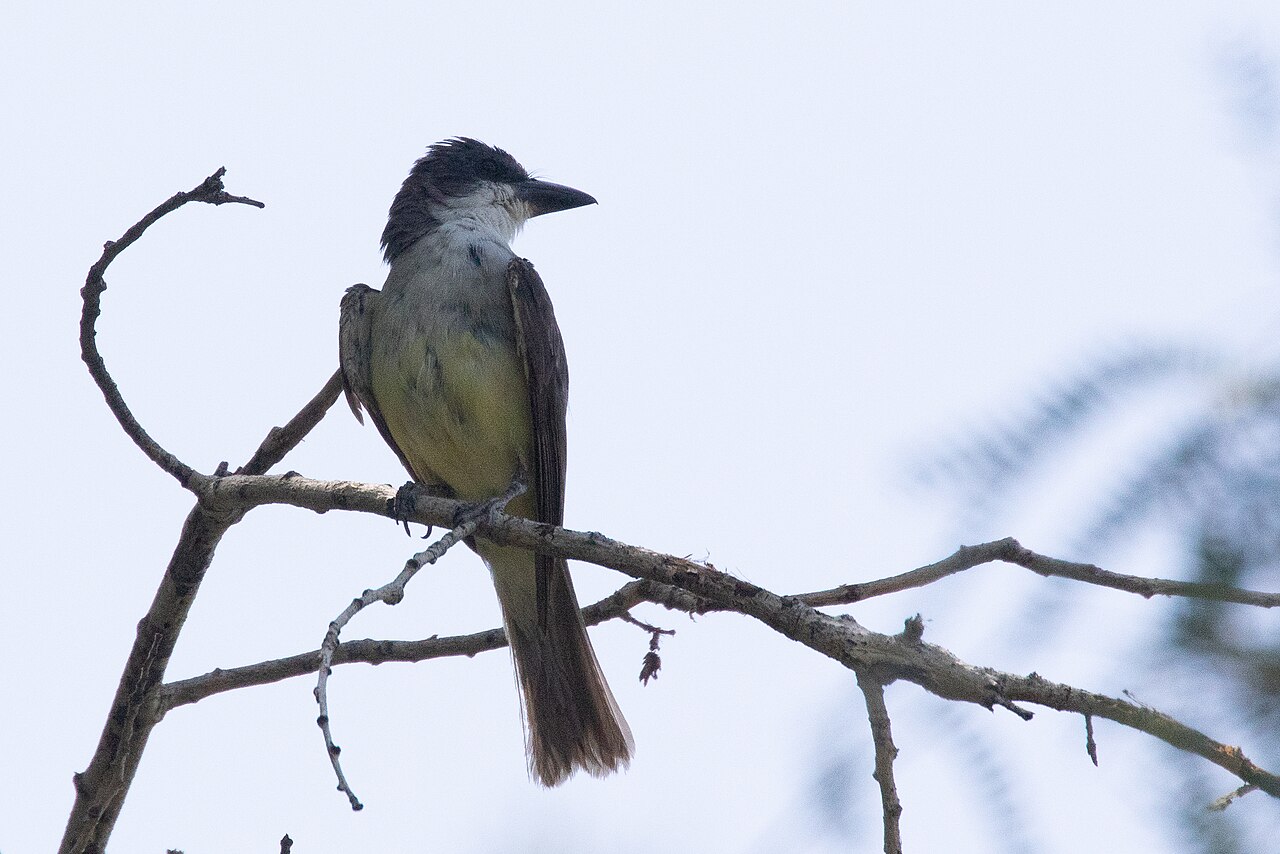
A large flycatcher with a heavy, slightly hooked black bill. Forehead and crown are dark gray-brown to nearly black and run into a dark mask, against which the white throat and cheek stand out. The back is gray-olive, the wings and tail dark brown with cinnamon edging. The underparts are white on the breast, passing into pale yellow on belly and flanks — obvious on fresh birds, often barely visible on worn ones. A partly concealed yellow patch sits in the crown.
Confusion species
The contrast between the dark head and the white throat is sharper than in any other kingbird, and no relative has a bill as heavy. Cassin's Kingbird has a gray, not brown-black, head, a yellow belly rather than a pale yellow wash, and a much smaller bill. Gray Kingbird has a heavy bill, but pale gray upperparts with a narrow, sharp mask and pure white underparts. Tropical and Couch's Kingbird have a gray head and a bright yellow belly, and both a forked or notched tail; Thick-billed has an almost straight, broad tail. Great Kiskadee has a black-and-white striped head and wholly yellow underparts.
Habitat
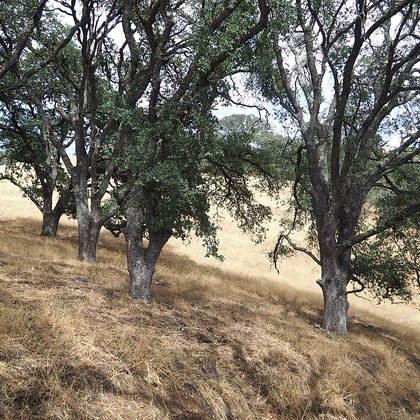
In the United States almost exclusively riparian woodland with cottonwood and sycamore along creeks and floodplains in southeastern Arizona. Further south in Mexico the choice of ground is wider: tropical deciduous forest, thorn forest, scrub and woodland edge along watercourses, up to about 2000 metres. It perches high in the crown of an isolated tree and returns repeatedly to the same branch.
Where the bird is most often found, arranged by the USNVC — the vegetation classification of the United States and Canada — and CMECS for sea and coast.




Range and movements
The range runs from Sonora and western Chihuahua south along the Pacific slope of Mexico to Chiapas and adjoining Guatemala. The northern part is breeding range: the birds of Sonora, Chihuahua, Arizona and southwestern New Mexico leave it in autumn and winter further south in Mexico. From Sinaloa southward it is resident. In the United States it has been known as a breeder only since 1958 and occupies a handful of sites, among them Guadalupe Canyon and the area around Patagonia; a few birds winter in southern California.
- Resident
- Breeding (summer)
- Winter
- Passage
- dark = core range, pale = thinly spread
Where and when to look
Go in June and July to a creek valley with cottonwoods in southeastern Arizona and follow the sound: it almost always gives itself away by voice before it is seen. Then search the highest dead branch; the silhouette with the heavy bill and the broad, straight tail is recognisable at a distance.
Conservation
Partners in Flight puts the world population at about 2 million mature birds and scores the species 12 out of 20 on the Continental Concern Score, a low concern category. There is no evidence of a range-wide decline. The United States population is small and depends on the survival of riparian woodland in a few canyons; falling groundwater and grazing are the pressures there.
Scientific name
Tyrannus crassirostris | Swainson, 1826
Swainson described the species in 1826 as Tyrannus crassirostris, from material taken in the warm districts of Mexico; the type was later restricted to Acapulco in Guerrero. Author and year stand without parentheses because the genus has not changed. Tyrannus is Latin for 'absolute ruler' or 'king'. The species name combines crassus 'thick' and rostrum 'bill' and thus means 'with the thick bill', after the character that separates the species from all its relatives.