All species › Passerines › Tyrant flycatchers and allies › Couch's Kingbird
Couch's Kingbird | Tyrannus couchii
Texaanse koningstiran | Tirano Cuír
Couch's Kingbird is the yellow kingbird of the Lower Rio Grande Valley and the Gulf Coast of eastern Mexico. In appearance it is barely separable from Tropical Kingbird; in voice it is.
Voice
The call is a single, nasal kip and an intensifying series kip-kip-kip-breeer, in which the last note grates downward. The sound is lower, rougher and more varied in pitch than the tinkling trill of Tropical Kingbird. There is also a drawn-out, plaintive breeer, often repeated from a treetop. In the breeding season calling begins well before sunrise.
Recording: Jacob R. Saucier — CC BY-NC-SA 4.0 · Texas: Kinney County; Brackettville, Fort Clark, United States · xeno-canto
Identification
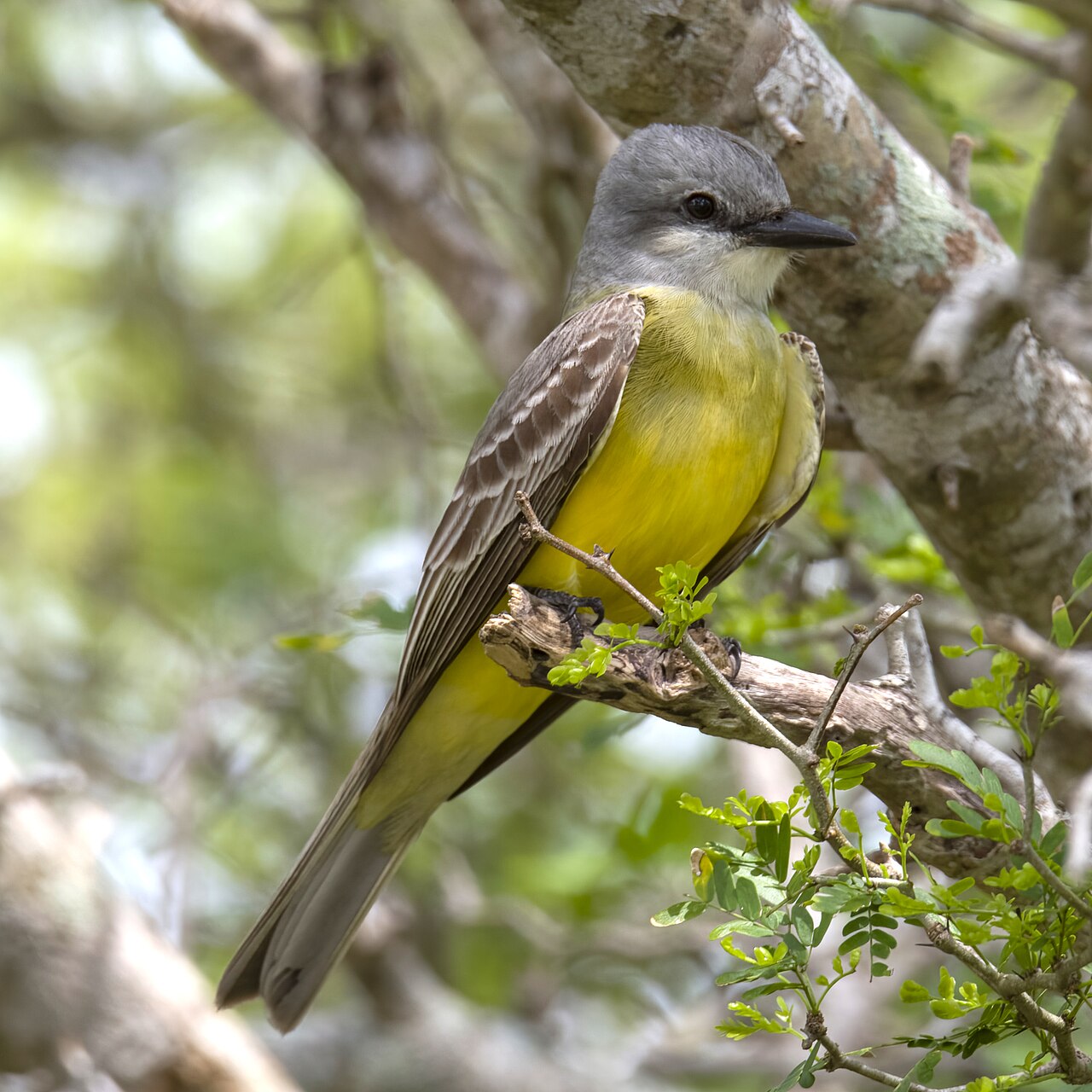
A bulky flycatcher with a big head, a straight, heavy bill and a long, notched tail. The head is pale gray with a slightly darker ear patch and a white throat; the back is gray-green with a distinct green cast. The breast is olive and passes into a bright yellow belly. Wings and tail are dark brown, with no white in the outer tail feathers. A concealed orange patch sits in the crown.
Confusion species
Tropical Kingbird is the hard one and can be separated with certainty only by voice: kip-kip-breeer (nasal, grating) against pip-pip-pirrrr (tinkling). Supporting but not conclusive: Couch's has a shorter bill and a greener back, Tropical a longer bill and a grayer back. Western Kingbird has white outer tail feathers visible in flight, and more extensive gray on the chest. Cassin's Kingbird has a darker gray head, back and breast, a white chin patch and a white-tipped tail — all characters Couch's lacks. Great Kiskadee has a black-and-white striped head and rufous wings.
Habitat
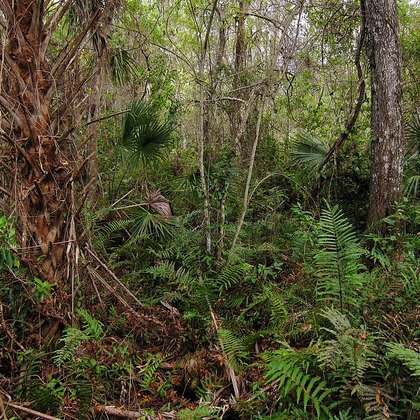
Woodland edge and semi-open woodland with edges and openings: thorn forest with taller trees, riparian woodland along rivers and creeks, orchards and citrus groves, and spacious suburbs and towns with tall trees. It sits in more wooded country than Tropical Kingbird, which uses open landscape. Nearness to water is a recurring element in its choice of ground.
Where the bird is most often found, arranged by the USNVC — the vegetation classification of the United States and Canada — and CMECS for sea and coast.





Range and movements
The range runs from southern Texas — the Lower Rio Grande Valley and the coastal strip north to roughly Corpus Christi — along the Gulf Coast of eastern Mexico through Tamaulipas, Nuevo León, San Luis Potosí, Veracruz and Tabasco onto the Yucatán Peninsula, and on to Belize and northern Guatemala. Over virtually all of the range it is resident; only at the northern edge in Texas do some birds move a distance south in winter, with flocks of several dozen recorded. Beyond the range there are vagrants as far as the eastern United States.
- Resident
- Breeding (summer)
- Winter
- Passage
- dark = core range, pale = thinly spread
Where and when to look
Look for it year round in the Lower Rio Grande Valley, for instance at Santa Ana and Bentsen-Rio Grande Valley: it perches high and in the open on a dead branch or a wire. Wait for the call before writing it down; a silent yellow kingbird in southern Texas stays unresolved in winter, because Tropical Kingbird occurs there too.
Conservation
The species is listed as Least Concern (LC). Partners in Flight puts the world population at about 1.1 million breeding birds and scores the species 10 out of 20 on the Continental Concern Score, a low concern category. In the United States numbers increased strongly between 1966 and 2015 and the range has expanded northward over the past half century. In Mexico numbers fluctuate locally with urbanization and deforestation.
Scientific name
Tyrannus couchii | Baird, 1858
Spencer Fullerton Baird described the species in 1858 as Tyrannus couchii, from specimens taken in Nuevo León in northeastern Mexico; author and year stand without parentheses because the genus has not changed. Tyrannus is Latin for 'absolute ruler' or 'king'. The species name honours Darius Nash Couch (1822–1897), a United States Army officer who collected in northeastern Mexico at his own expense in 1853 and passed the material to Baird. The bird was long treated as a subspecies of Tropical Kingbird; the split rests chiefly on the difference in call.