All species › Gamebirds › Partridges, pheasants, grouse and allies › Erckel's Spurfowl (Francolin)
Erckel's Spurfowl (Francolin) | Pternistis erckelii
Erckels frankolijn | Francolín de Erckel
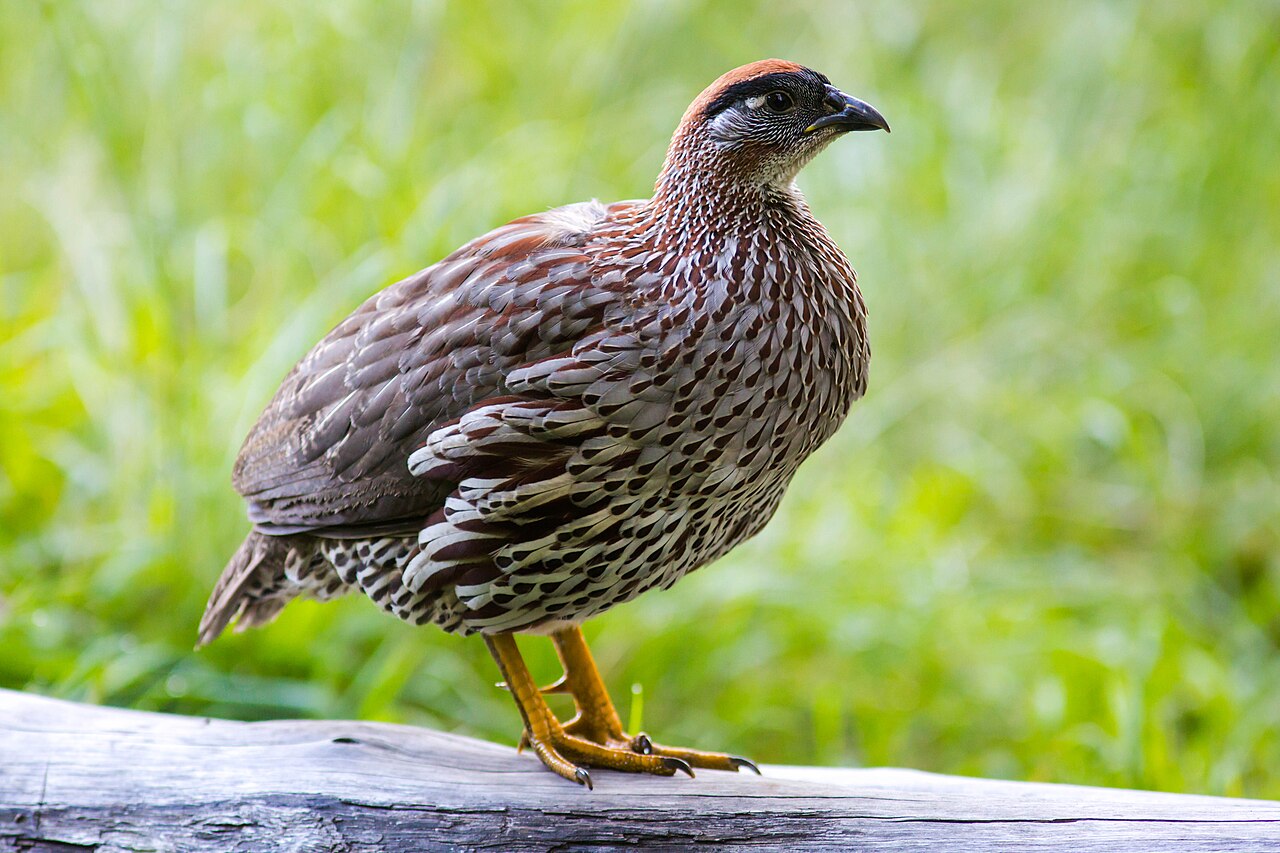
Erckel's Spurfowl is a large, chestnut-barred gamebird native only to the dry highlands of Eritrea, Ethiopia and Sudan, but has had a foothold on Hawaii since 1957. On the dry slopes of Hawaii Island he is now one of the commonest large gamebirds, though his wary habits mean he is still heard more often than seen.
Voice
The call is a long, building cackle of fifteen to twenty notes that speeds up until it becomes an almost frantic sound, usually launched from a rock or a clifftop. Groups call in chorus at first light, the sound seeming to pass from one hillside to the next. When disturbed a shorter, harsh alarm call sounds while the birds run rather than fly. Outside the dawn chorus he is largely quiet.
Recording: Rolf A. de By — CC BY-NC-SA 4.0 · Jemma Escarpment, Ethiopia · xeno-canto
Identification
A large, heavily built gamebird with a black head and bill, a chestnut crown and nape, a white streak behind the eye and white ear coverts set against the black. Neck, breast and flanks are densely barred chestnut on a darker ground, and the legs are yellow. Male and female look much alike, though the male is somewhat larger and heavier. Young birds are duller and less sharply marked. Between his size — distinctly bigger than a female Ring-necked Pheasant — and his habit of walking about in the open, he draws attention through behaviour more than through staying hidden.
Confusion species
On Hawaii Gray Francolin is the other common gamebird of open country, but it is much smaller, uniformly grey-brown and scaled, and lacks the black head and chestnut barring of Erckel's Spurfowl. Wild Turkey, also released on some islands, is considerably larger, with a bare, blue-red head and neck instead of a feathered black head. Kalij Pheasant (Lophura leucomelanos), which shares the same islands but favours damper forest edges, has bare red facial skin and glossy grey-black plumage without the chestnut barring of Erckel's Spurfowl.
Habitat
He seeks dry, open to lightly vegetated slopes: pasture, low scrub and the edge of dry forest, usually below a thousand metres. He uses boulders and steep slopes as calling posts but forages on open, short-cropped ground for food. He avoids wet rainforest and the dense, tall vegetation of the moister mountain slopes. In his original range in north-eastern Africa he occupies similarly dry scrubland and treeline habitat between two and three and a half thousand metres.
Where the bird is most often found, arranged by the USNVC — the vegetation classification of the United States and Canada — and CMECS for sea and coast.





Range and movements
In North America Erckel's Spurfowl occurs only on Hawaii, where he has been released as a gamebird since 1957 and has established mainly on Hawaii Island; smaller numbers live on Maui. His original range lies in the mountains of Eritrea, northern Ethiopia and adjoining north-eastern Sudan. He does not migrate and disperses only slowly, so the Hawaiian population remains entirely a product of the original release and spreads outward only gradually from where it was set free.
- Resident
Where and when to look
Look for him at first light on the dry slopes above Kona or Waimea on Hawaii Island and listen for the building chorus; it is the most reliable way to find him, since by day he stays hidden in low scrub. A car moving slowly along a gravel road surprises him more often than a walker on foot.
Conservation
Worldwide the species is listed as Least Concern (LC), though his original African range is small and poorly documented. On Hawaii the released population is stable and locally common, with no clear short-term threat. He is treated as a gamebird there, with a limited hunting season on some islands.
Scientific name
Pternistis erckelii | (Rüppell, 1835)
Rüppell described the species in 1835 as Perdix Erckelii, among the partridges; because it was later moved to another genus, author and year stand in parentheses. The genus Pternistis is Greek in form and refers to the spur many African spurfowl carry on the leg. The specific name honours Theodor Erckel, a German taxidermist who accompanied Rüppell on his expedition to Abyssinia and shot the first specimen at the Taranta mountains. The type locality is given as the Taranta mountains in present-day Eritrea.