All species › Waders, gulls and terns › Sandpipers and allies › Eurasian Whimbrel
Eurasian Whimbrel | Numenius phaeopus
Regenwulp | Zarapito trinador
Since 2024 the Eurasian Whimbrel is no longer the same bird as the striped-crowned curlew that breeds in North America: that one is now the Hudsonian Whimbrel, and the Eurasian Whimbrel is a Eurasian species recorded here only as a vagrant. In spring it turns up on the outermost islands of Alaska, in late summer occasionally along the Atlantic coast. To claim one you have to wait until it flies, because the difference is mostly on its back.
Voice
The call is a fast, rippling whistle of six or seven even notes, ti-ti-ti-ti-ti-ti-ti, flat in pitch and rattled off in one breath; it is the sound by which a passing bird is noticed before it is seen. Over the breeding grounds, which lie outside this continent, the same motif is drawn out into a long rising trill delivered from a slow display flight. When alarmed it gives a short hard whip, often repeated two or three times. By voice it cannot be separated from the Hudsonian Whimbrel: the calls of the two are the same, and hearing one call on the shore proves nothing.
Recording: Paul Kelly — CC BY-NC-SA 4.0 · Rosslare Harbour, Wexford, County Wexford, Ireland · xeno-canto
Identification
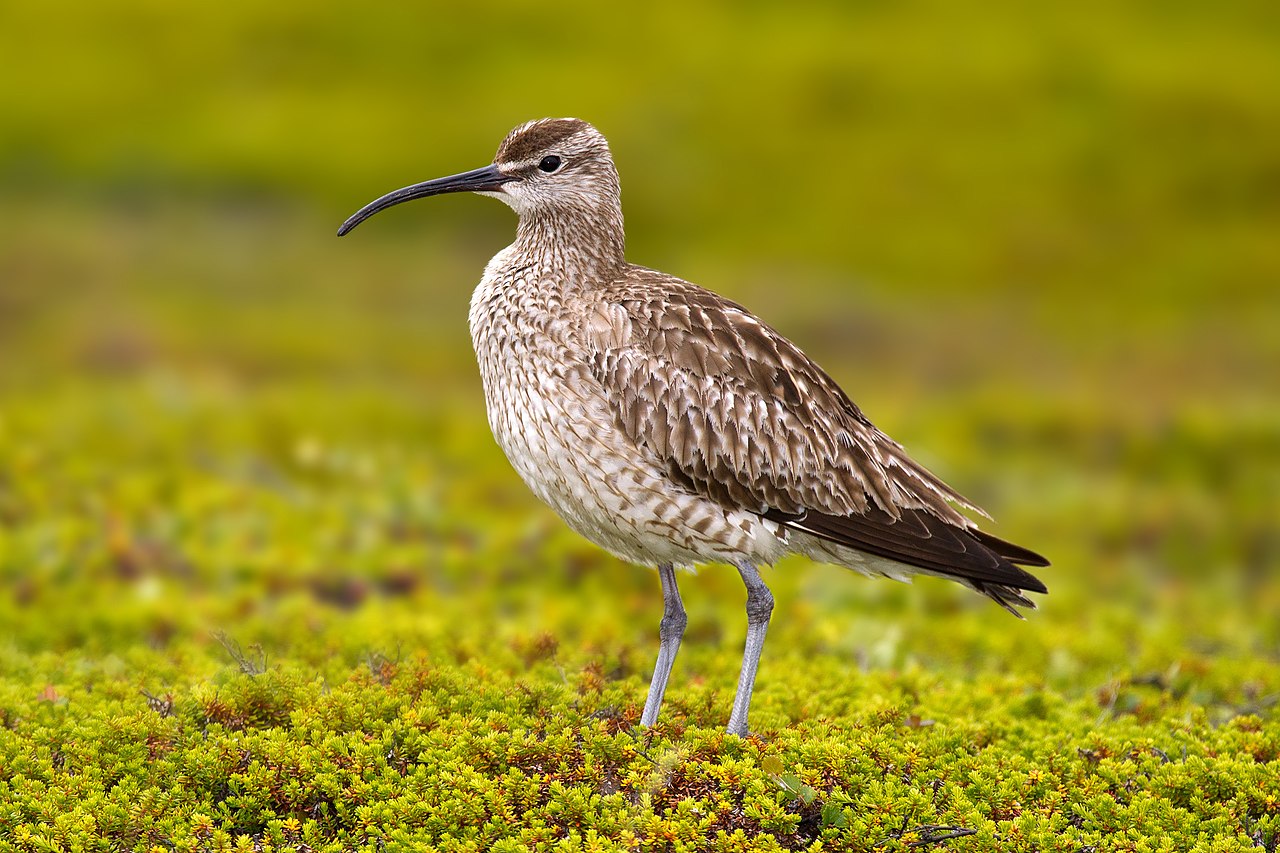
A medium-sized grey-brown curlew with a comparatively short, evenly decurved bill about twice the length of the head. The head carries the mark of the group: two dark bands across the crown with a pale stripe between them, and a pale eyebrow above a dark eye-line. Male and female look alike; the female is slightly larger and longer-billed, and juveniles are neater above, with warm cream spots on the coverts. The difference that counts is on the back: birds from northwestern Europe and western Siberia show a white wedge running from the rump far up the back, and the underwing is largely white. Birds from northeastern Siberia, the form that reaches Alaska, have that back and that underwing closely barred brown and look far darker in flight.
Confusion species
Hudsonian Whimbrel (Numenius hudsonicus), lumped with this species until 2024, is all but identical at rest and differs only in flight: its back is as brown as the rest of the bird and its underwing is closely barred. Long-billed Curlew (N. americanus) is far larger, warm cinnamon, much longer-billed and lacks the crown bands. Bristle-thighed Curlew (N. tahitiensis) of western Alaska has a plain buff rump and tail and long stiff feather shafts on the flanks, visible as hairs at close range. When in doubt: look at the crown first to settle the group, then wait for the flight to settle the species.
Habitat
In North America it is a bird of the coast: tidal flats that fall dry at low water, salt marsh, river mouths, and the sandy beaches and rocky edges beside them. It walks among the other shorebirds and probes with the curved bill for crabs, which it often shakes apart before swallowing. On the islands of western Alaska it also stands on short tundra vegetation and along the creeks just behind the shore. Open water and the deep interior it does not use; it keeps to the edge where fresh and salt meet. Its breeding ground, which lies outside this continent, is damp moorland and tundra with dwarf scrub.
Where the bird is most often found, arranged by the USNVC — the vegetation classification of the United States and Canada — and CMECS for sea and coast.





Range and movements
It breeds from Iceland and northern Europe east through Siberia to the Bering Sea, and winters along the coasts of Africa, southern Asia and Australia. In North America it is a vagrant. In spring, birds from northeastern Siberia appear in the western and central Aleutians and on the Bering Sea islands, and rarely further down the Pacific coast. On the Atlantic coast the birds come from northwestern Europe, mostly in late summer and autumn, from Newfoundland and Nova Scotia southward. Because the species was separated from the Hudsonian Whimbrel only in 2024, older sightings without a description of the back can no longer be assigned, and the number of records is not yet settled.
Where and when to look
Look for it in a flock of whimbrels on the coast and do not linger over the perched birds: stand where you will see them fly away from you. The moment the wings open the matter is decided — a white wedge on the back and a pale underwing belong to this species, a plain brown back to the Hudsonian Whimbrel. In western Alaska late May is the best time, on the Atlantic coast August and September. Photograph the bird as it flies if you can; without that image a report is rarely accepted.
Conservation
The Red List classifies the species, even after the recent taxonomic split, as Least Concern (LC). Overall the bird is doing well enough, but the Icelandic breeders, about a third of the world population, are falling in almost every part of the country, most likely through drainage and building on the breeding ground. For North America that changes little on the map: a handful of birds a year is what it amounts to.
Scientific name
Numenius phaeopus | (Linnaeus, 1758)
Linnaeus described the species in 1758 as Scolopax Phaeopus, among the snipes; because it was later moved to another genus, author and year stand in parentheses. The genus Numenius was introduced by Brisson in 1760 and is formed from Greek neos 'new' and mene 'moon': the decurved bill has the shape of a new moon. phaeopus combines phaios 'dusky' and pous 'foot', after the dark legs. Linnaeus gave the origin as Europe; the type locality was later restricted to Sweden.