All species › Passerines › New World sparrows › Field Sparrow
Field Sparrow | Spizella pusilla
Veldgors | Chingolo campestre
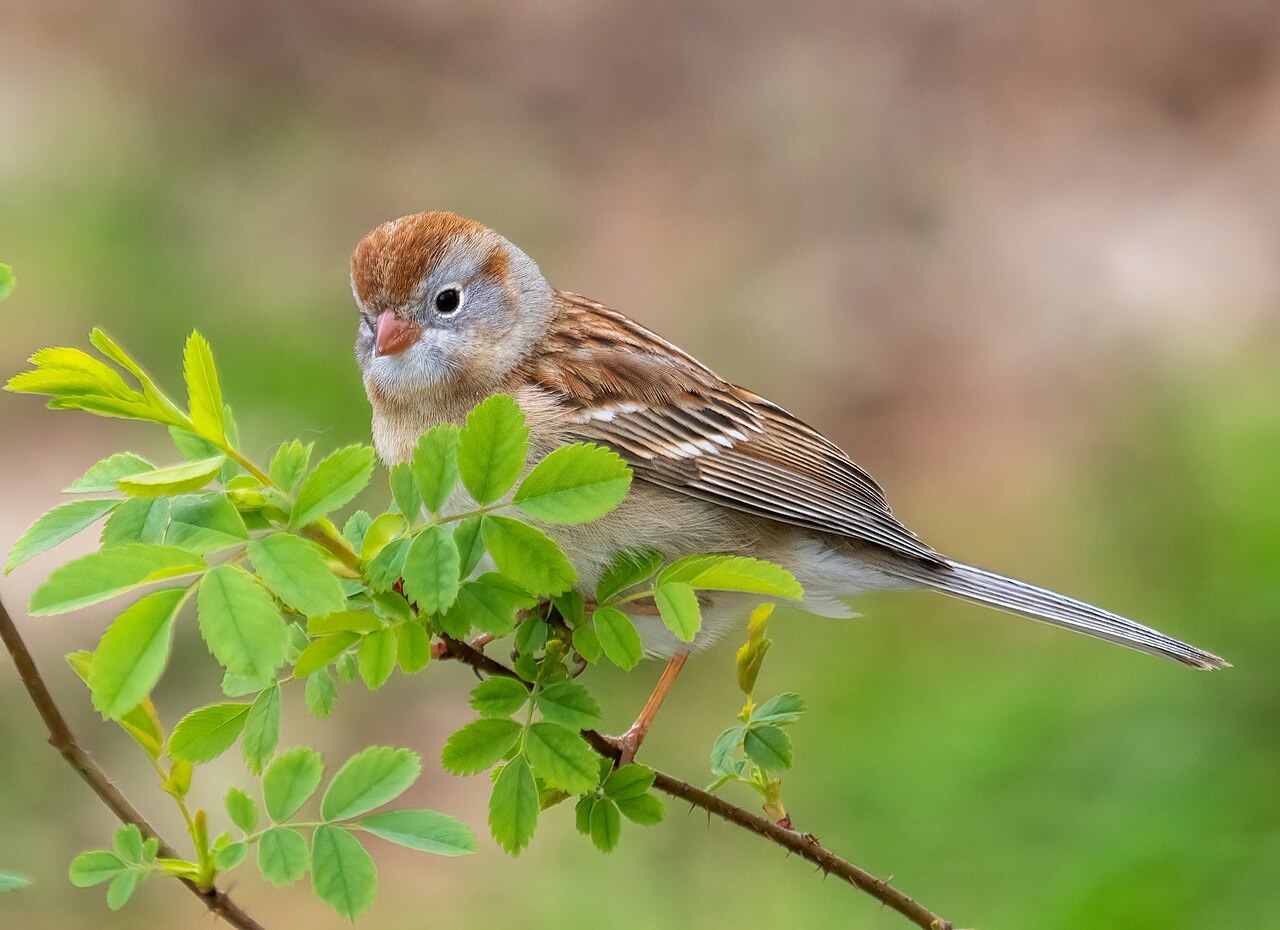
The Field Sparrow is a small sparrow of overgrown fields, abandoned pasture and hedgerows in eastern North America. The plain grey face with a white eyering and the pink bill together make the quickest mark. Its song, a series of whistles accelerating like a bouncing ball, carries from a shrub or a fence wire from March into August.
Voice
The song lasts about four seconds: clear, plaintive whistles that crowd closer together and run into a fast trill, exactly the rhythm of a ball bouncing to rest. Each male has one fixed version, so neighbouring birds can be told apart by ear. The call is a short, high tsip; in flight a thin tseee. Singing is done from an exposed twig or post inside the territory.
Recording: Jonathon Jongsma — CC BY-SA 3.0 · Murphy-Hanrehan Park Reserve, Dakota, Minnesota, United States · xeno-canto
Identification
The face is plain pale grey with a distinct white eyering and no dark eyeline, which gives the head a blank look. The crown is rufous, the back brown with black streaks and two narrow pale wingbars. The underparts are unstreaked, warm buff on breast and flanks and white on the belly. The bill is small, conical and pink; the tail is long and slightly notched. A greyer and a more rufous form exist.
Confusion species
Chipping Sparrow in breeding plumage has a black eyeline, a white supercilium and a dark bill, not the blank grey face and pink bill of a Field Sparrow. Clay-coloured Sparrow has a sharply outlined brown ear patch with a dark border and a pale central crown stripe. Black-chinned Sparrow is greyer on neck and breast and has no rufous crown. Juvenile Field Sparrows are finely streaked below but keep the white eyering and the pink bill.
Habitat
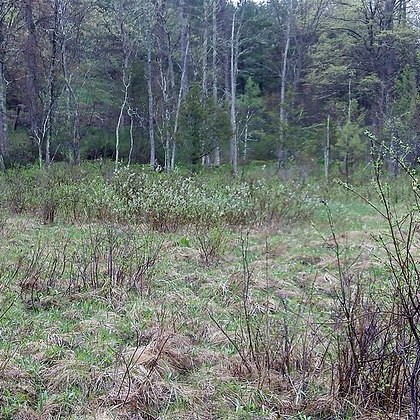
Old fields and pastures growing up in scrub, with low shrubs for song perches and plenty of grass broken by bare patches. Also hedgerows, woodland edges, power line corridors and young plantations. The species avoids dense settlement and rarely nests close to houses. Once the scrub grows on into woodland it leaves again, so a site stays suitable for only a few years.
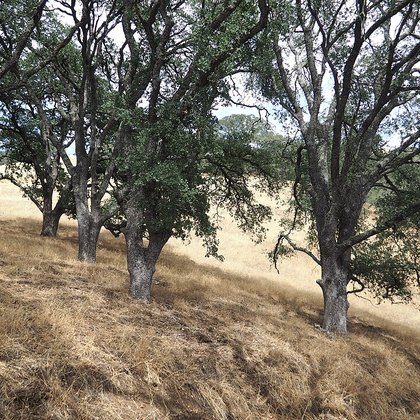
Where the bird is most often found, arranged by the USNVC — the vegetation classification of the United States and Canada — and CMECS for sea and coast.


Range and movements
The breeding range runs from southern Ontario and southern Quebec south across the eastern United States to the prairies of Kansas, Nebraska and the Dakotas. Through the middle and south of that range the species is resident. Northern breeders move south in October and November; the winter range reaches Florida and northeastern Mexico in Coahuila, Nuevo León and Tamaulipas.
- Resident
- Breeding (summer)
- Winter
- Passage
- dark = core range, pale = thinly spread
Where and when to look
Look for it in April and May along the edge of a weedy field and go by sound first: the accelerating whistled series gives away the territory even when the bird sits low. When it comes into view, check the bill — a small pink bill in an otherwise unmarked grey face rules out nearly every other sparrow of the same ground.
Conservation
The IUCN keeps the species at Least Concern, but the North American Breeding Bird Survey shows a decline of about 74 per cent since 1966, which puts the Field Sparrow on the Tipping Point list with a yellow alert. The cause lies in the loss of the stage between field and forest: land is brought back into use or grows on into closed woodland. In the prairie states numbers hold up better where ground has been taken out of production under the Conservation Reserve Program.
Scientific name
Spizella pusilla | (Wilson, 1810)
Alexander Wilson described the species in 1810 as Fringilla pusilla; because it was later moved to Spizella, author and year stand in parentheses. The genus Spizella is a diminutive of Greek spiza, 'finch'. The species name pusilla is Latin for 'very small'. The specimen described came from Pennsylvania, from near Philadelphia.