All species › Passerines › New World sparrows › Brewer's Sparrow
Brewer's Sparrow | Spizella breweri
Brewers gors | Chimbito desértico
Brewer's Sparrow is the sparrow of the sagebrush (grey-green sagebrush scrub of the dry West): a small, pale, almost unmarked bird that is the most numerous breeder of extensive sagebrush across the Great Basin and the northern plateaus. The plumage gives little to hold on to, the song a great deal more — a long, insect-like string of trills. A second form, the Timberline Sparrow, breeds in dwarf scrub high in the northern Rocky Mountains.
Voice
There are two song types. The short type is a few rolling trills lasting a couple of seconds and sounds like a drawn-out Chipping Sparrow. The long type may run for half a minute or more, stringing together trills and rattles of constantly shifting pitch with no clear ending; it is heard mostly early in the season and at dusk. The call is a thin, high tsip, often from a small party in the bushes.
Recording: Don Profota — CC BY-NC-SA 4.0 · South Bozeman, Gallatin County, Montana, United States · xeno-canto
Identification
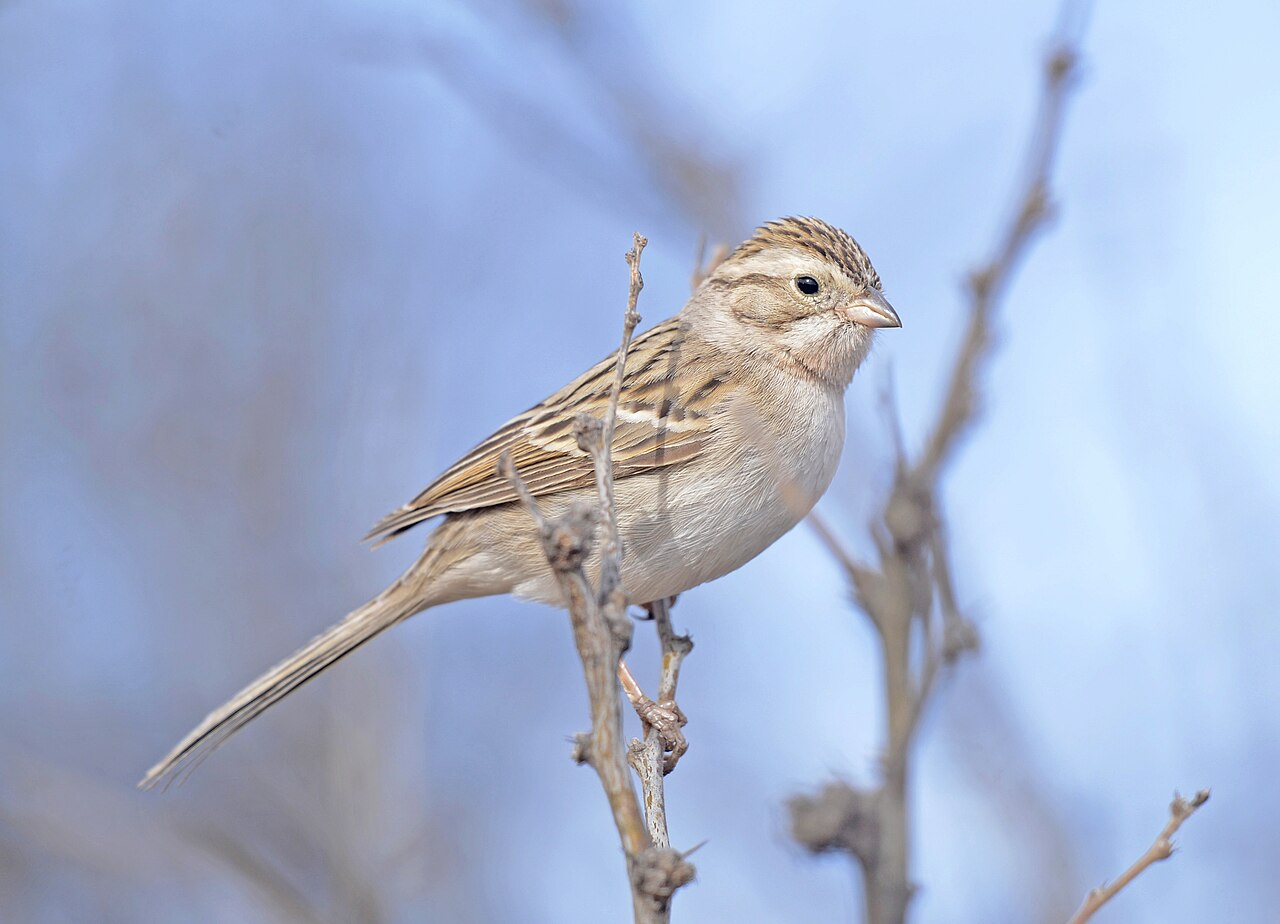
This is the palest and least marked sparrow of its genus: grey-brown above with fine black streaks, plain dingy white to buff below with no breast streaking. The crown is brown with dense black streaks and no pale central stripe. The key mark is a complete, narrow white eyering in an otherwise even face with a finely outlined ear patch. The bill is small and flesh-coloured, the tail long and notched.
Confusion species
Clay-colored Sparrow is the most similar: it does have a pale central crown stripe, a more sharply defined brown ear patch with a dark border, and a grey, unstreaked nape. Brewer's instead has the crown streaked throughout and a grey-brown, finely streaked nape. Chipping Sparrow has a redder crown and a greyer rump and, in breeding plumage, a black eyeline. The Timberline Sparrow, the northern form of Brewer's itself, is darker and more heavily streaked and more often shows fine streaks on the breast.
Habitat
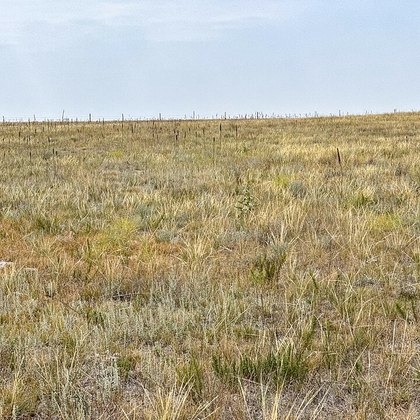
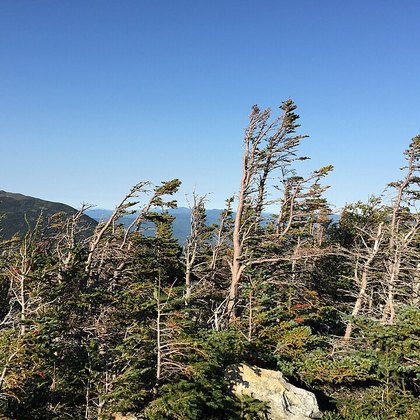
Unbroken sagebrush steppe with shrubs roughly half a metre to a metre and a half high and open ground between them; large, unfragmented tracts are required. Also bitterbrush and saltbush (two dry western steppe shrubs) and other dry scrub and, in the north, dwarf willow and dwarf birch above treeline. In winter, desert scrub, thorn scrub and field edges in the Southwest and on the Mexican plateau.
Where the bird is most often found, arranged by the USNVC — the vegetation classification of the United States and Canada — and CMECS for sea and coast.




Range and movements
Breeds from southern British Columbia, southern Alberta and southwestern Saskatchewan south through Washington, Oregon, Idaho, Montana, Wyoming, Nevada, Utah, Colorado, eastern California and the Dakotas. The northern montane form breeds as far as Yukon and the Northwest Territories. From August to October birds move to southern Arizona, New Mexico, West Texas and northern and central Mexico, from Baja California and Sonora to Guanajuato and northern Jalisco.
- Resident
- Breeding (summer)
- Winter
- Passage
- dark = core range, pale = thinly spread
Where and when to look
The best chance is in May and June on a sagebrush flat in the Great Basin, around sunrise. Drive or walk along the edge of a large shrub field and wait: once a male starts the long song type he will stay on the same shrub top for minutes. In the field you look not for a pattern but for its absence — a pale sparrow with no head stripes and a complete white eyering.
Conservation
The IUCN keeps the species at Least Concern (LC); the population is large, but North American surveys have shown a steady decline for decades. The cause is loss of continuous sagebrush through conversion to cropland, grazing, the spread of cheatgrass (an introduced annual grass that crowds out the sagebrush steppe) and the fires that go with it, and infrastructure. The species does not breed in small, fragmented remnants, so the area and connectedness of the shrubland are what count.
Scientific name
Spizella breweri | Cassin, 1856
Cassin described the species in 1856 already in the genus Spizella, so author and year stand without parentheses. The genus Spizella is a diminutive of Greek spiza, 'finch'. The species name breweri honours Thomas Mayo Brewer (1814–1880), a Boston physician and oologist and co-author of a standard work on North American birds. The type came from the Black Hills.