All species › Passerines › New World sparrows › Black-chinned Sparrow
Black-chinned Sparrow | Spizella atrogularis
Zwartkingors | Gorrión barbinegro
The Black-chinned Sparrow is a slim, long-tailed sparrow of dry brushy slopes in the southwestern United States and the Mexican highlands. The male is largely plain grey with a black chin and throat and a pink bill. In the field the accelerating song from the top of a shrub usually reaches you before the plumage does.

Voice
The song opens with a few clear, high whistles and then accelerates into a rattling trill, much like a ball bouncing to a standstill on a stone floor. It is higher and more mechanical than the similarly built song of the Field Sparrow. The call is a high, soft tsip, often the only sound outside the breeding season. Males sing from March into July from an exposed twig on a hillside.
Recording: Omar Suárez García — CC BY-NC-SA 4.0 · San Nicolás Tlaminca, Texcoco Municipality, Estado de México, Mexico · xeno-canto
Identification
Head, neck, breast and belly are plain slate grey; the back is rufous brown with black streaks and the wings are brown as well. The bill is short, conical and bright pink, standing out against the grey. The tail is long for the size of the bird and slightly notched at the tip. The breeding male has a black chin, throat and forehead; females and non-breeding males lack that black and show a plain grey head.
Confusion species
Black-throated Sparrow also has a black throat, but with a white supercilium and a white submoustachial stripe above it, a grey rather than streaked back, and a short tail with white corners. Dark-eyed Junco of the grey-headed forms is equally plain grey, but has a white belly meeting the grey breast along a sharp line, white outer tail feathers that flash on take-off, and a pale horn bill. Field Sparrow has a rufous crown and a white eye-ring in an otherwise plain pale face, with no grey neck.
Habitat
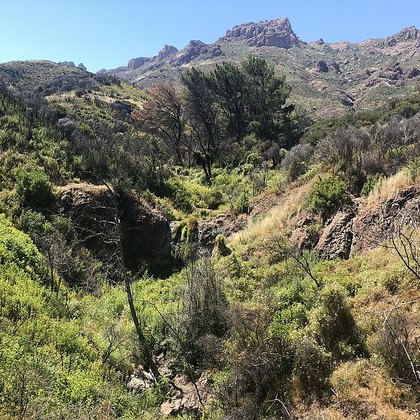
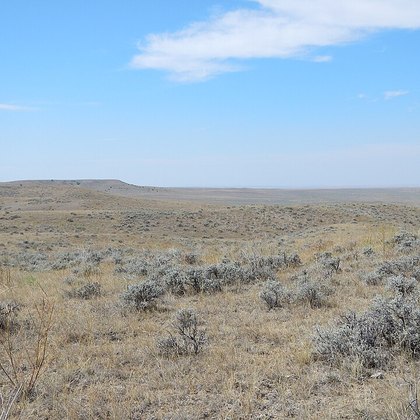
Dry, stony slopes with dense low scrub: chaparral (dense, hard-leaved scrub of California's Mediterranean climate) with ceanothus and manzanita, sagebrush (grey-green wormwood scrub of the dry western interior) and rabbitbrush (a dry western steppe shrub), and the transition into pinyon (a low-growing pine of the dry southwestern foothills)-juniper. In the United States from near sea level to about 2400 metres, in Mexico mainly in the mountain ranges and on the plateau. Outside the breeding season it drops to lower desert scrub. Closed woodland and built-up land are avoided.
Where the bird is most often found, arranged by the USNVC — the vegetation classification of the United States and Canada — and CMECS for sea and coast.




Range and movements
The breeding range runs from central and southern California across southern Nevada and southern Utah to Arizona, New Mexico and West Texas. Northern breeders move in autumn to southern Arizona, southwestern New Mexico and northern Mexico. In the Mexican highlands, from Sonora and Chihuahua south to Oaxaca north of the Isthmus of Tehuantepec, the species is present all year.
- Resident
- Breeding (summer)
- Winter
- Passage
- dark = core range, pale = thinly spread
Where and when to look
The best chance is between mid-April and June, early in the morning, on a brushy slope in the mountains of southern California or in the Chiricahua Mountains. Walk a slope trail and stop at the first accelerating trill; the singing bird is then usually on the highest twig around. Outside that period it stays low in the scrub and gives only a thin tsip.
Conservation
The IUCN keeps the species at Least Concern (LC), with an estimated population of 450,000 to 1,100,000 birds. North American surveys show a decline of about 74 per cent since 1967, which places it on the Tipping Point list with a yellow alert (State of the Birds report, 2025) and on the US Fish and Wildlife Service list of Birds of Conservation Concern. Heavy grazing of chaparral and an altered fire regime play a part; local recovery has been measured after livestock were removed.
Scientific name
Spizella atrogularis | (Cabanis, 1851)
Cabanis described the species in 1851 as Spinites atrogularis; because it was later moved to another genus, author and year stand in parentheses. The genus Spizella is a diminutive of Greek spiza, 'finch'. The species name atrogularis comes from Latin ater 'black' and gula 'throat', and so describes the male's black throat patch, as the English and Dutch names do. The specimen described came from Mexico.