All species › Passerines › New World sparrows › Five-striped Sparrow
Five-striped Sparrow | Amphispizopsis quinquestriata
Vijfstrepengors | Gorrión cincorrayas
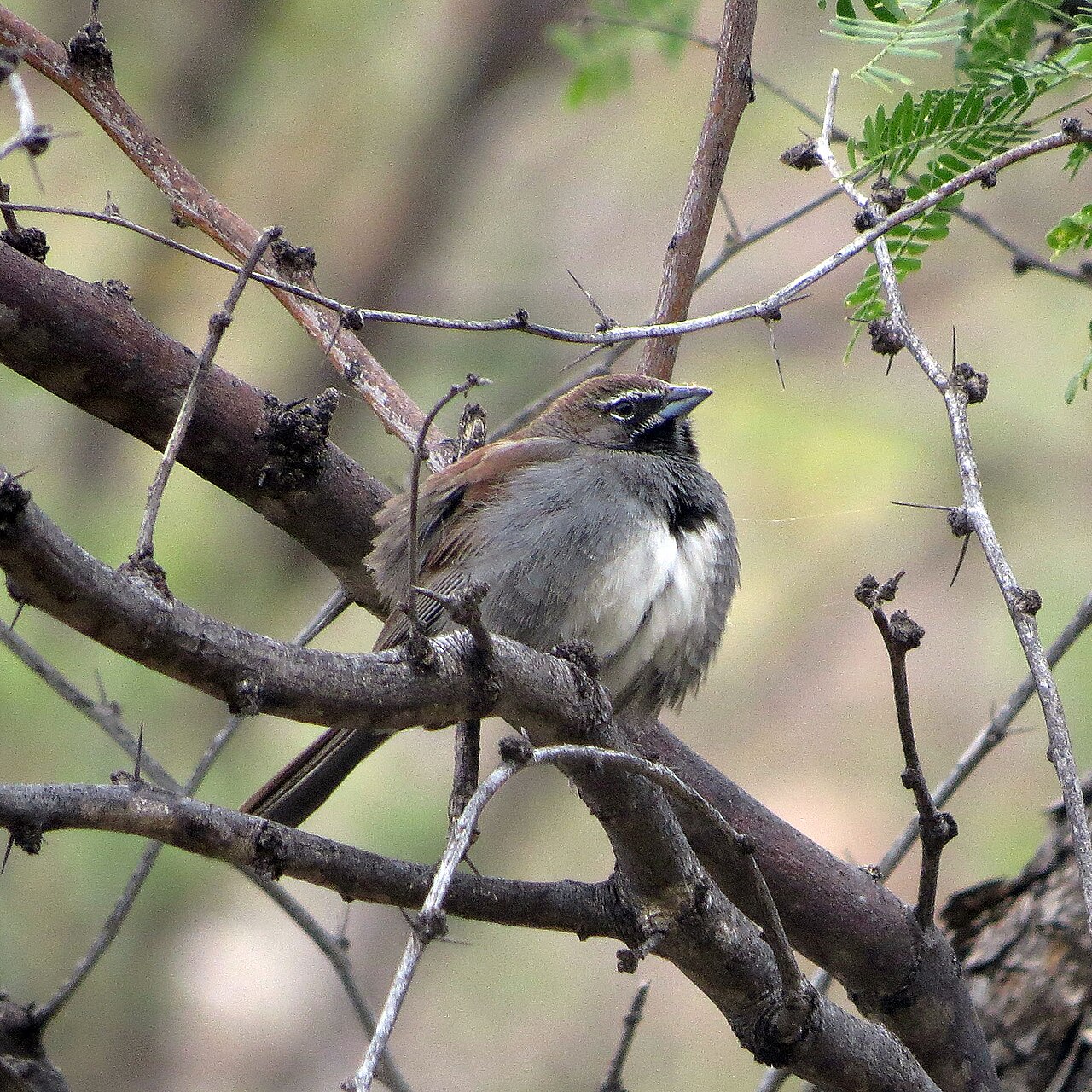
The Five-striped Sparrow is a sparrow of dense thornscrub on dry slopes in northwestern Mexico that reaches the United States only in a few canyons of southern Arizona. The plumage is strongly patterned: a dark grey head with white stripes, a chestnut back and a black spot in the middle of the white breast. The five stripes of the name run across chin and throat.
Voice
The male sings from a projecting twig or boulder, including in the middle of the day and well into the summer, when most other sparrows have gone quiet. The song consists of short phrases, each different and each repeated a few times before the next follows, introduced by one or two clear ticks and ending in a roll or buzz. The calls are a thin high seep and a sharp chip.
Recording: Alex Lin-Moore — CC BY-NC-SA 4.0 · Box Canyon, Pima County, Arizona, United States · xeno-canto
Identification
A heavy sparrow with a thick bill and a long, rounded tail. Head and breast are dark slate grey, with a white supercilium, a white malar stripe and a white throat bordered by black lines — together the five stripes on the side of the head. The back and wings are warm chestnut and unstreaked; the centre of the breast and the belly are white with a single black spot. The sexes look alike; immatures lack the black breast spot and have a vaguer head pattern.
Confusion species
Black-throated Sparrow shares the grey head with white stripes but has a large solid black throat patch instead of a white throat edged in black, a grey rather than chestnut back, and white tail corners. Five-striped is also darker below and keeps to denser, taller scrub, where Black-throated uses more open desert scrub. Rufous-winged Sparrow has a white throat but a streaked crown and no black breast spot.
Habitat
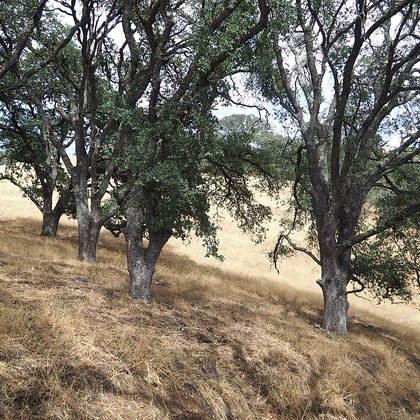
Steep, rocky canyon walls and dry slopes with dense thornscrub one to two metres high, among grass clumps, agaves and scattered oaks; in Arizona usually between 900 and 1400 metres, along or close to a canyon floor with broadleaf trees. In Mexico also in tropical deciduous forest and on brushy slopes at its edge. It forages on the ground and in low shrubs and, outside the singing season, stays hidden in the dense layer.
Where the bird is most often found, arranged by the USNVC — the vegetation classification of the United States and Canada — and CMECS for sea and coast.




Range and movements
The core of the range lies in northwestern Mexico, from eastern Sonora and southwestern Chihuahua south through Sinaloa and western Durango to Nayarit, Zacatecas and Jalisco. In the United States the species was first recorded in 1957 and has bred regularly since 1974, in a handful of canyons in Santa Cruz and Pima counties of southern Arizona, among them California Gulch, Sycamore Canyon and Warsaw Canyon. Those Arizona birds number in the tens of pairs, and some leave the canyons in winter, while the Mexican population is resident.
- Resident
- Breeding (summer)
- Winter
- dark = core range, pale = thinly spread
Where and when to look
Look for it in Arizona from late June into August, during the monsoon: that is when males sing most and keep going through the afternoon heat, whereas without song the bird rarely shows itself outside the scrub. Stay on the track and scan the tops of the thorn bushes for a perched, singing bird; the road into California Gulch needs a high-clearance vehicle.
Conservation
Partners in Flight puts the world population at about 200,000 breeding birds and scores the species 15 out of 20 on the Continental Concern Score; it is on the Yellow Watch List and numbers are falling, although the IUCN lists the species as Least Concern (LC). The United States share of the range is so small that it carries little weight for the species as a whole, but those canyons are sensitive to grazing, fire in the dry months and disturbance from border traffic. In Mexico the conversion of tropical deciduous forest and scrub to pasture is the main change.
Scientific name
Amphispizopsis quinquestriata | (Sclater; Salvin, 1868)
Sclater and Salvin described the species in 1868 as Zonotrichia quinquestriata, probably from a bird taken at Bolaños in Jalisco; the later moves put authors and year in parentheses. It passed through Aimophila and Amphispiza before being placed in 2021 in the new genus Amphispizopsis, a name meaning 'resembling Amphispiza', with Greek opsis 'appearance'. The species name quinquestriata is Latin for 'five-striped', after the stripes on chin and throat, which is what the English, Dutch and Spanish names say as well.