All species › Passerines › Old World buntings › Rustic Bunting
Rustic Bunting | Emberiza rustica
Bosgors | Escribano rústico
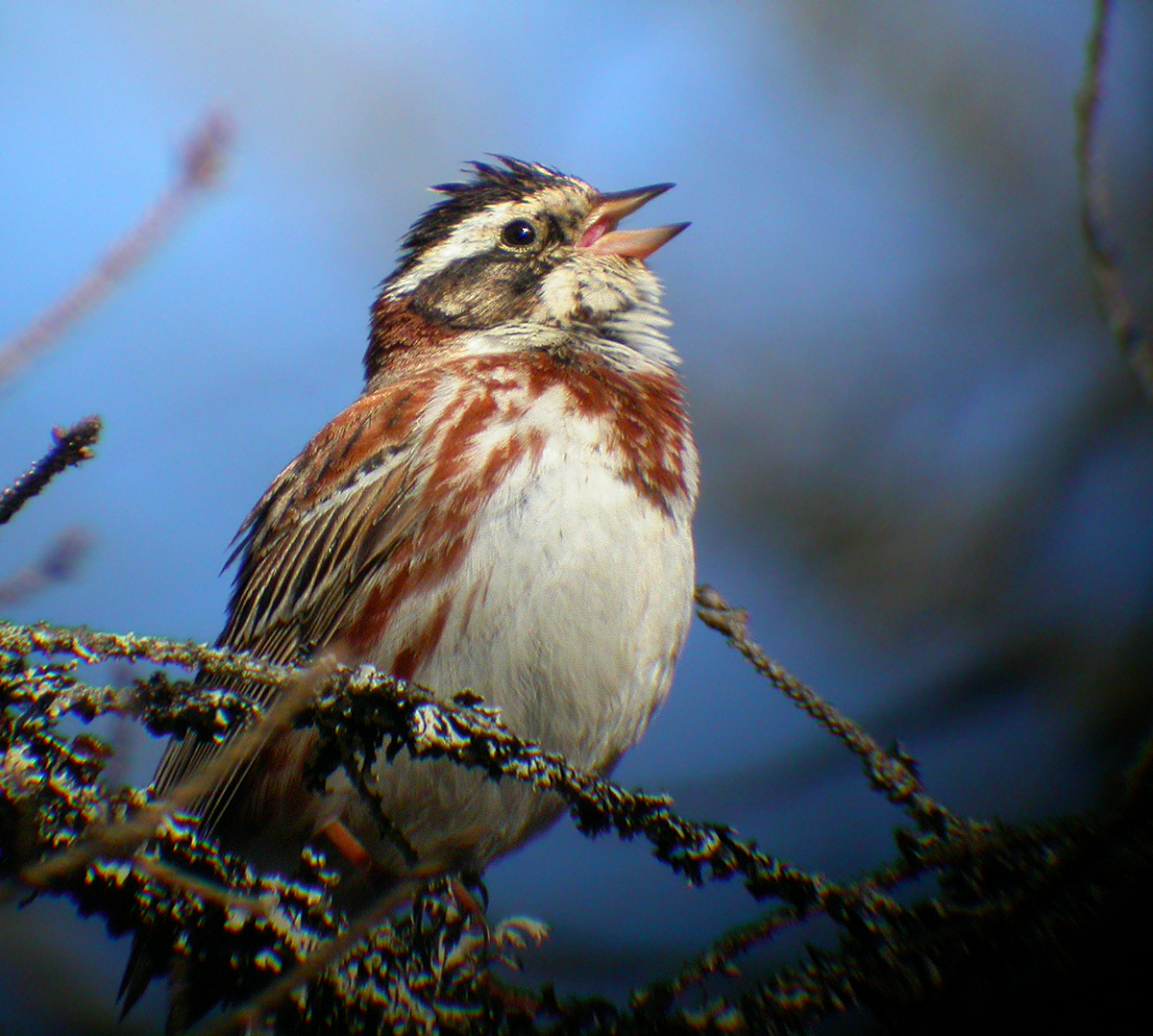
The Rustic Bunting breeds in the wet taiga from northern Europe to Kamchatka and winters in East Asia; in this region it is a scarce but more or less annual visitor to the western Aleutians and the islands of the Bering Sea. It is a compact bunting with rusty streaking on a white ground, a pale spot on the nape and a pink lower mandible, and it raises a short pointed crest when agitated. It is one of the few Red List songbirds whose decline is looked for not on the breeding grounds but along the migration route.
Voice
The song is a short, flowing, faintly melancholy phrase of a handful of clear notes, tyu-tyu-tyuwee-tyuwee, delivered from the top of a young spruce or birch at the edge of a clearing. The call is a hard, short tzik, sharper and drier than the chip of the American sparrows and closest to the call of a Song Thrush. On the Bering Sea islands almost every bird gives itself away by that call rather than by song: away from the breeding grounds it hardly ever sings. Once the note is known, it is heard rising from a tussock of grass before anything is seen.
Recording: Stanislas Wroza — CC BY-NC-SA 4.0 · Iivara national Park, Finland · xeno-canto
Identification
The breeding male has a black head with a broad white supercilium, a white throat and a white spot at the rear of the ear-coverts, and below that a rusty red breast band with rusty streaks along the flanks. Nape and rump are cinnamon, the belly is white and the outer tail feathers are white. In females and in winter plumage the black is replaced by warm brown, but the rusty — not black — streaking, the pale nape spot and the pale mark behind the ear-coverts remain. The lower mandible is pink to flesh-coloured and the legs are pale flesh; those two colours hold good even on a skulking bird. When alarmed the crown feathers are raised into a short, angular crest that makes the head look peaked. In flight it is compact, with a fairly short, slightly forked tail.
Confusion species
Little Bunting (Emberiza pusilla), which turns up on the same islands, is smaller and more finely streaked, has chestnut ear-coverts framed in black and a narrow pale eye-ring, and lacks both the rust on the flanks and the crest. For anyone used to American birds, Savannah Sparrow comes closest: it has yellow before the eye, black rather than rusty streaking and a grey lower mandible. Song Sparrow is larger and longer-tailed and carries a dark spot in the centre of the breast. A bunting with rusty flank streaks, a pale nape spot and a pink lower mandible is, in this region, always a Rustic Bunting.
Habitat
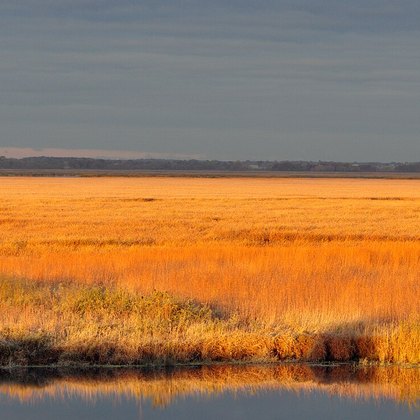
On the breeding grounds, wet conifer forest and birch carr: boggy ground with sphagnum, willow and birch scrub and standing dead trees, along streams and at the edges of raised bog. Dry closed forest is avoided, and so is bare tundra. Outside the breeding season it uses stubble fields, reed fringes, rank weedy ground and woodland edges, often among other buntings. On the Bering Sea islands, where no tree grows, it takes whatever cover there is: a clump of tall weeds, a strip of creeping willow, or the untidy edge of an abandoned building.
Where the bird is most often found, arranged by the USNVC — the vegetation classification of the United States and Canada — and CMECS for sea and coast.




Range and movements
The breeding range runs as a broad band through the northern taiga, from northern Scandinavia and Finland east to Kamchatka and Sakhalin. The whole range moves off to the southeast: the winter is spent in eastern China, on the Korean peninsula, in southern Japan and on Taiwan, far outside the window of this map — so none of the winter range shows here. In this region it appears mainly in late spring on the western Aleutians and in late May and early June on St. Lawrence and the Pribilofs; there are fewer autumn records. Further south it is a true vagrant: along the coasts of British Columbia, Washington, Oregon and California there is a handful of records per state or province, mostly in autumn, and now and then a bird stays the winter at a feeder. The western outpost of the range has shrunk sharply within a few decades; in Finland numbers have fallen hard.
- Breeding (summer)
- Winter
- Passage
- dark = core range, pale = thinly spread
Where and when to look
Look in late May and early June, in the days after a westerly blow across the Bering Sea, in the weeds and creeping willow around the buildings of Gambell on St. Lawrence or on the western Aleutians: vagrants come to whatever cover and food there is. The first sign is almost always the call, a hard, short tzik out of a grass tussock. If the bird shows itself, look first at the colour of the flank streaks and then at the lower mandible; those two together are enough.
Conservation
Near Threatened (NT) on the Red List. In Europe and Siberia the species has fallen away sharply within a few decades, and the cause is looked for chiefly away from the breeding grounds: in the large-scale trapping of buntings on migration and in the wintering areas of East Asia. The same trapping took the closely related Yellow-breasted Bunting (Emberiza aureola) from common to critically endangered within roughly a human lifetime. How many Rustic Buntings end up in those nets nobody knows, and that is exactly what makes the size of the loss hard to establish.
Scientific name
Emberiza rustica | Pallas, 1776
Pallas described the species in 1776 as Emberiza rustica, in the third volume of the account of his journey through the Russian empire; author and year stand without parentheses, because the bird has not changed genus since. Emberiza is the latinised form of Embritz, an old German word for a bunting. rustica is Latin for 'of the countryside, rustic', after the plain, muted plumage. As the type locality Pallas gives Dauria, the country east of Lake Baikal.