All species › Passerines › Old World buntings › Little Bunting
Little Bunting | Emberiza pusilla
Dwerggors | Escribano pigmeo
The Little Bunting is the smallest bunting of Eurasia and breeds from northern Scandinavia through the Siberian taiga to Chukotka. In North America it is a vagrant: virtually all records come from the west coast of Alaska and the Bering Sea islands, with a few sightings further south along the Pacific coast.
Voice
The call is a short, sharp, hard tzik, drier and more clicking than the calls of most American sparrows — with vagrants it is often the first thing noticed. The song, barely heard in North America since the species does not breed there, is a short rolling phrase of clear notes, roughly siroo-sir-sir-siroo, opening in a way that recalls a European Robin.
Recording: Bo Shunqi 薄顺奇 — CC BY-NC-SA 4.0 · Farm, Fengxian, Shang Hai Shi, China · xeno-canto
Identification
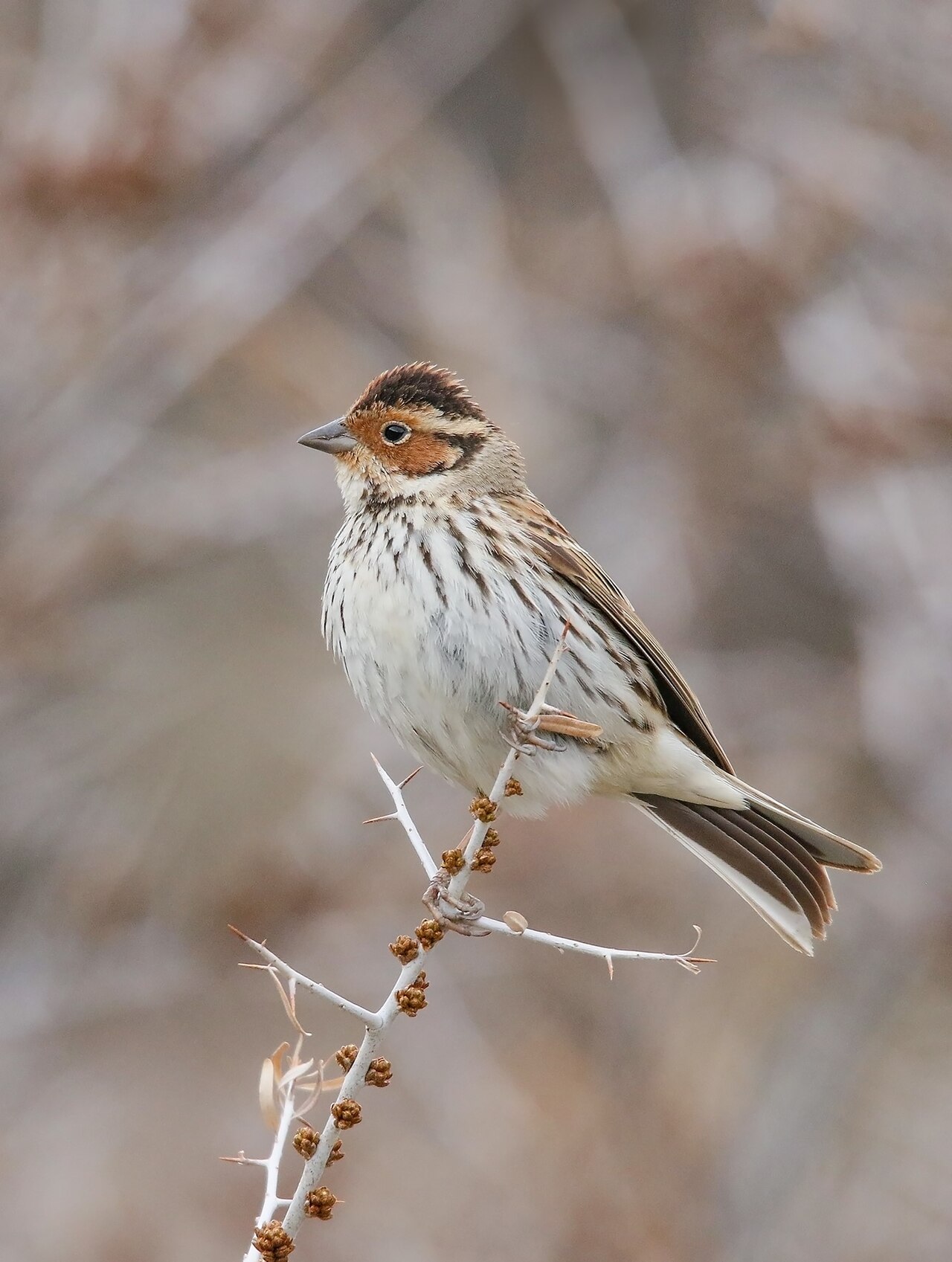
A small, short-tailed bunting with a fine pointed bill whose upper mandible is almost straight. The face is the mark: a rufous crown stripe between two black lateral crown stripes, rufous cheeks with a black rear border, a narrow white eye-ring and a pale stripe from the base of the bill. The underparts are white with sharp black streaking on breast and flanks. The back is brown with dark streaks; the sexes look alike and the pattern remains in winter plumage, only duller.
Confusion species
New World sparrows, particularly immatures, are the trap on a brief view. Song Sparrow is larger, longer tailed and has a grey supercilium and a breast spot rather than a rufous cheek with a black border. Savannah Sparrow has yellow before the eye and a notched tail. Among the other Eurasian buntings turning up in Alaska the head pattern decides: Reed Bunting has a grey or black head without a rufous crown stripe and looks far bulkier, and Pallas's Reed Bunting is paler and unstriped on the crown.
Habitat
Breeds in open coniferous woodland and birch bog with an understorey of willow and dwarf birch, in peatland and along the forest edge to beyond the treeline. Outside the breeding season it uses scrub, field edges, rice fields and rough ground. Alaskan vagrants are usually reported from low vegetation on the islands: weedy patches, ditches and village gardens, where cover is scarce.
Where the bird is most often found, arranged by the USNVC — the vegetation classification of the United States and Canada — and CMECS for sea and coast.




Range and movements
The breeding range runs from northern Norway and Finland east across Russia to Chukotka and south to northeastern China; wintering is in northeastern India, southern China, northern Indochina, Korea and Taiwan. Within the guide area there is a small number of records, nearly all from Alaska and above all from St. Lawrence Island at Gambell and from the Aleutians, mostly in autumn with an occasional spring find. Outside Alaska there are scattered records in California and Oregon.
Where and when to look
The only realistic chance is an autumn visit to Gambell or Attu, in the last week of August and in September, when Asian songbirds arrive on easterly winds. Listen for the sharp tzik from a ditch or weedy field and look for a small bunting that, unlike most American species, shows a rufous face with a black rear border.
Conservation
The species is widespread across the Eurasian taiga and the population is large; the Red List treats it as Least Concern (LC). The number of North American records says nothing about the trend, but tracks observer effort on a few Bering Sea islands and the weather during autumn migration. In the wintering range in Southeast Asia buntings of this genus are trapped for food in some areas; for Little Bunting the scale of this has not been quantified.
Scientific name
Emberiza pusilla | Pallas, 1776
Pallas described the species in 1776 from a bird in the Daurian range of southeastern Siberia; because it has never been moved from the genus, author and year stand without parentheses. Emberiza goes back to Old High German Embritz, an old word for bunting. The species name pusilla is Latin for 'very small', which matches the English and Dutch names: it is the smallest species of the genus.