All species › Waterfowl › Ducks, swans and geese › Gadwall
Gadwall | Mareca strepera
Krakeend | Ánade friso
The Gadwall is the duck you notice only once it flushes: up close a subdued grey-brown bird, but in flight both sexes flash a bright white wing patch. It breeds in the prairie potholes of the northern Great Plains and winters south deep into Mexico, and has increased sharply in numbers over recent decades.
Voice
The male gives a short, dry burp — a hoarse errp repeated two to five times in a row, often in flight — along with a high-pitched whistle. The female quacks much like a Mallard, but higher and more nasal: a descending series of quack-quack-quack. Outside the breeding season the Gadwall is one of the quieter ducks, and it more often betrays itself by the sound of its wings on take-off than by voice.
Recording: David Darrell-Lambert — CC BY-NC-SA 4.0 · Rainham Marshes, London, United Kingdom · xeno-canto
Identification
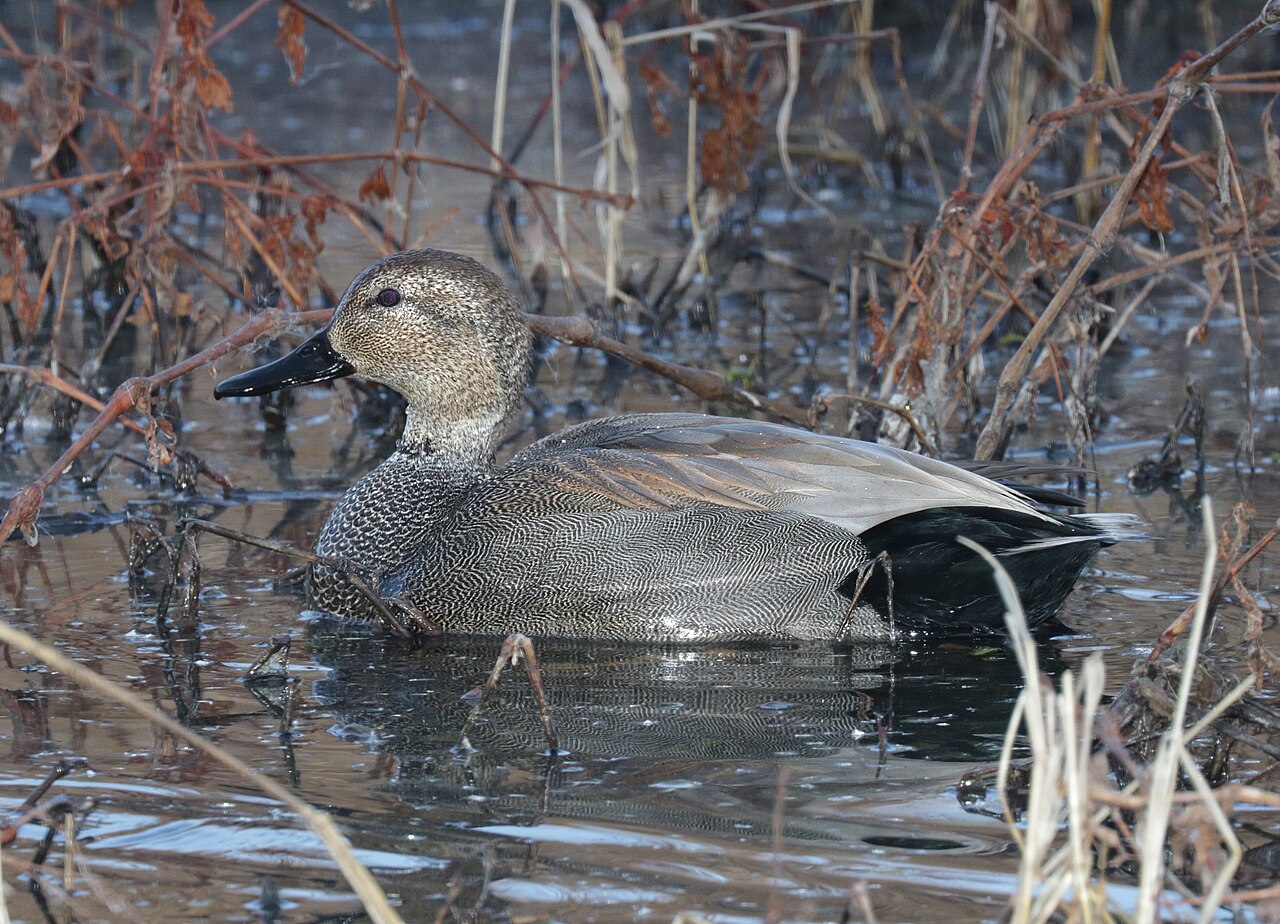
The male is a grey duck with a finely scaled, almost black-and-white pattern on neck and breast and a plainer, coarsely vermiculated grey flank; the rear end is black, and the bill is plain dark. The female is mottled brown, closely resembling a female Mallard, but with a thinner, darker bill edged in orange and a flatter profile. Both sexes carry a white wing patch that flashes clearly in flight, flanked in the male by black and chestnut. Juveniles resemble the female. The silhouette gives the species away at range: a fairly large, square head with a steep forehead and a noticeably thinner bill than the Mallard's, and a slimmer body in flight.
Confusion species
The female is most often confused with a female Mallard, but has a thinner, darker bill edged with orange rather than a broad orange bill blotched with black, and a white rather than blue wing patch. From the female American Wigeon the Gadwall is told by its longer, dark bill — short and pale grey in the wigeon — and by the absence of the white belly patch that shows in the wigeon's flight. At a distance the male can suggest an American Wigeon, but lacks that species' cinnamon flanks and green eye-stripe, showing instead an evenly grey body with a black rear end.
Habitat
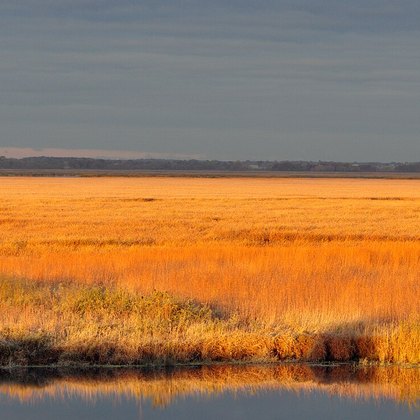
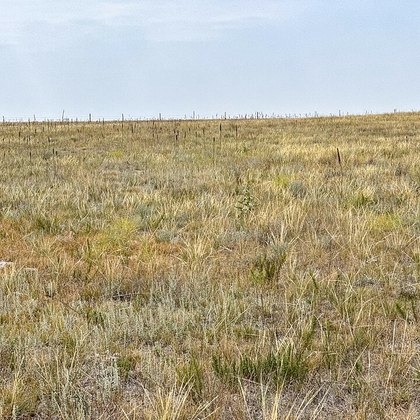
The Gadwall seeks open fresh water with rich submerged vegetation: prairie potholes, shallow lakes, marshes and — more than most ducks — constructed reservoirs and farm ponds, where it plucks vegetation from the surface rather than dabbling in mud like the Mallard. It avoids fast-flowing water and the open tidal coast, but in winter regularly turns up on estuaries and sheltered brackish lagoons. It uses dense shoreline cover to nest, preferably on an islet or at the tip of a peninsula, out of reach of ground predators.
Where the bird is most often found, arranged by the USNVC — the vegetation classification of the United States and Canada — and CMECS for sea and coast.



Range and movements
It breeds from the prairies of Alberta, Saskatchewan and Manitoba through the northern Great Plains and around the Great Lakes, and winters south across nearly the entire United States into Mexico. Since the 1980s the Gadwall has increased sharply and pushed its breeding range eastward, into country where it was absent a century ago. Migration is mostly nocturnal, in small to medium flocks, and many birds winter as far north as open water allows.
- Resident
- Breeding (summer)
- Winter
- Passage
- dark = core range, pale = thinly spread
Where and when to look
Look for it among flocks of American Wigeon on a large reservoir or marsh refuge: Gadwalls readily mix with other dabbling ducks and then stand out mainly for their plain grey colour among the brighter species. On flushing birds, watch for the white flash in the wing — often the only usable mark at a distance — and listen for the male's dry burp.
Conservation
The North American population is estimated at over 2.4 million birds, clearly above the long-term survey average and many times the numbers of the mid-twentieth century. The growth is linked to the construction of reservoirs and farm ponds, which the species readily exploits, and to the recovery of prairie wetlands. It is hunted across parts of its range, within quotas set from the annual surveys; no specific threat is otherwise recorded.
Scientific name
Mareca strepera | (Linnaeus, 1758)
Linnaeus described the species in 1758 as Anas strepera; because it has been placed in the genus Mareca since 1824, author and year stand in parentheses. That genus was introduced that year by Stephens, from the Portuguese marreca, 'small duck'. strepera is Late Latin for 'noisy', after its call. The type locality lies in Europe; Linnaeus himself restricted it to Sweden in 1761.