All species › Waterfowl › Ducks, swans and geese › Eurasian Wigeon
Eurasian Wigeon | Mareca penelope
Smient | Silbón europeo
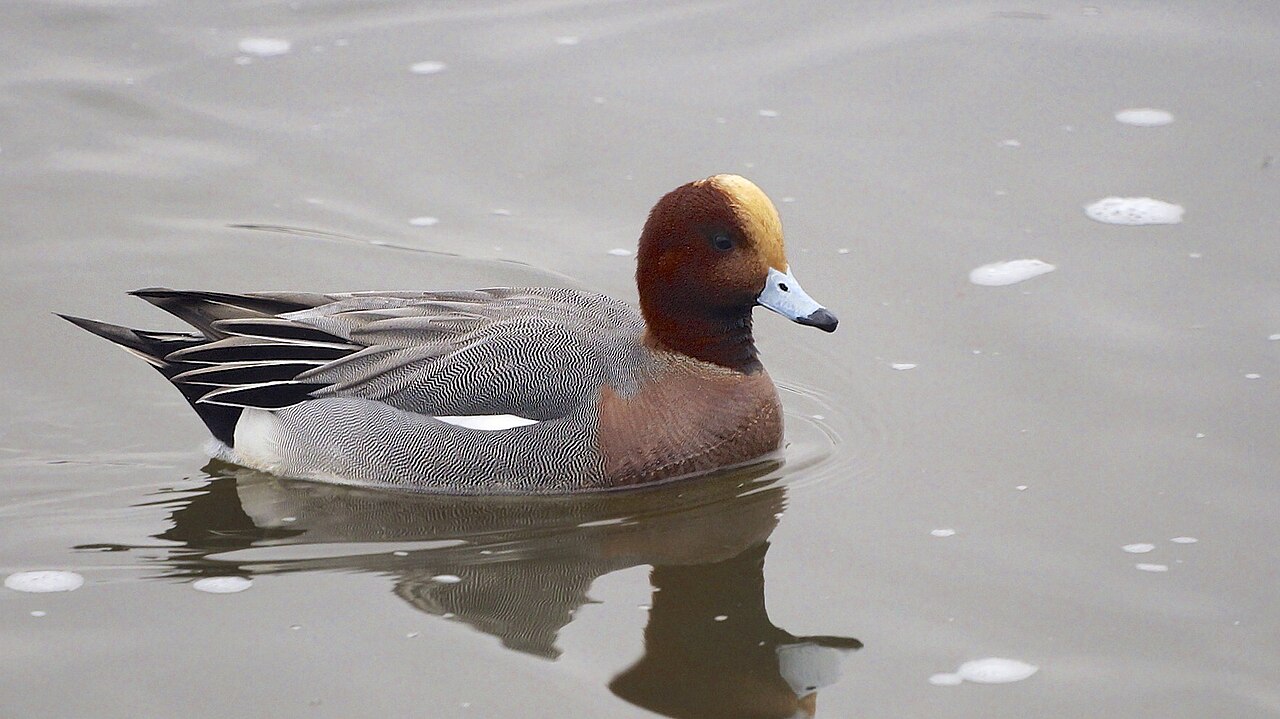
The Eurasian Wigeon is the duck you hear before you see: a shrill, two-note whistle that carries far across the water. The male has a chestnut head with a creamy forecrown stripe and a pinkish breast above an otherwise grey body — a colour combination no other duck in this guide's area shares. Here it is a scarce but regular winter visitor, almost always found among flocks of its American counterpart.
Voice
The male gives a piercing, two-note whistle, whee-oo, audible at long range and unlike any other duck call in this area; also a deeper, broken wip-weu. The female is far quieter and, mainly when disturbed, gives a hoarse, growling call. In a flock mixed with American Wigeon, the male's whistle is usually the first sign that a Eurasian Wigeon is present, before it is even seen.
No freely licensed recording has been found for this species yet; what to listen for is described below.
Identification
The male has a chestnut head with a creamy stripe from bill to crown, a pinkish breast, an otherwise finely vermiculated grey body and a black rear end; the bill is blue-grey with a black tip. The female is warm reddish-brown, with a plain head lacking a distinct eye patch and a rounded head on a short bill. In flight the male shows a large white patch on the forewing with a dark green speculum; in the female that patch is greyish rather than white. Outside the breeding season the male becomes duller and more rufous, but keeps the white wing patch.
Confusion species
The main confusion species is American Wigeon (Mareca americana), among which the Eurasian Wigeon nearly always associates: the male lacks that species' green eye-stripe and white crown, showing instead a uniform chestnut head, while the female is warmer reddish-brown and shows a grey rather than white armpit in flight — the best mark at range. The two species occasionally hybridize, and such males show a head pattern intermediate between the two, matching neither cleanly. From the female Gadwall, the Eurasian Wigeon is told by its shorter, blue-grey bill rather than a long dark one, and by its rounded rather than square head.
Habitat
In this hemisphere it chiefly uses sheltered estuaries, bays and salt marshes along the coast, where it dabbles for eelgrass and other aquatic plants or, where shallow enough, simply grazes on foot. Smaller numbers use freshwater marshes and lakes further inland, almost always amid flocks of American Wigeon. Like its American relative, it grazes grassland and closely cropped fields near water, though less conspicuously and in smaller groups.
Where the bird is most often found, arranged by the USNVC — the vegetation classification of the United States and Canada — and CMECS for sea and coast.





Range and movements
The Eurasian Wigeon breeds across northern and central Eurasia and winters there south to Africa and southern and southeastern Asia; it does not breed in North America. Here it is a regular but scarce winter visitor, chiefly along the Pacific coast from Alaska to California and along the mid-Atlantic coast from New York to North Carolina, always in small numbers among flocks of American Wigeon. It is rare inland. The number of wintering birds in North America is small but has remained stable for decades.
- Resident
- Breeding (summer)
- Winter
- Passage
- dark = core range, pale = thinly spread
Where and when to look
Don't look for it alone, but within any large flock of American Wigeon on an estuary or sheltered bay in winter: a single chestnut head among the greyer heads of the majority is usually all it takes to pick it out. The west coast, from British Columbia to California, and Chesapeake Bay give the best chance.
Conservation
In North America the wintering total runs to a few hundred to a couple of thousand birds, a fraction of the millions that winter across Europe and Asia; the number here has stayed stable for decades. No specific threat is recorded in this area, and the small, scattered numbers leave the species largely unaffected by local habitat change. Elsewhere in its range it remains a numerous and much-hunted duck.
Scientific name
Mareca penelope | (Linnaeus, 1758)
Linnaeus described the species in 1758 as Anas Penelope; because it has been placed in the genus Mareca since 1824 — introduced that year by Stephens, from the Portuguese marreca, 'small duck' — author and year stand in parentheses. The species name honours not a person but the mythological Penelope, wife of Odysseus: an old legend held that a duck saved her when she was thrown into the sea. Penelope's own name traces to Ancient Greek pēnē, 'weaving-thread', and ops, 'face' — a reference to the ruse with her loom by which she kept her suitors waiting for years. The type locality lies in Europe, restricted by Linnaeus himself to Sweden.