All species › Passerines › Kinglets › Golden-crowned Kinglet
Golden-crowned Kinglet | Regulus satrapa
Amerikaanse goudhaan | Reyezuelo sátrapa
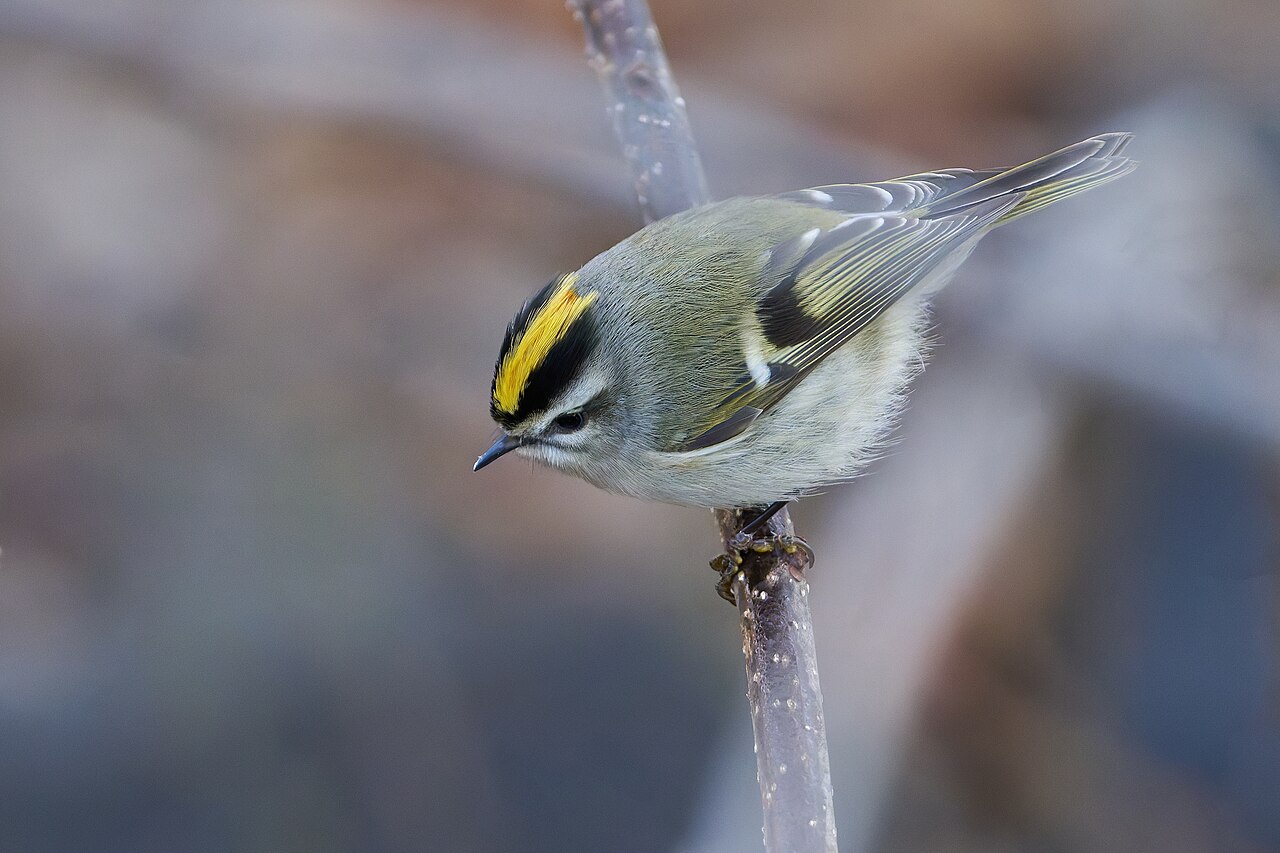
The Golden-crowned Kinglet weighs six grams and winters in spruce woods where the temperature can drop to forty below; no other songbird of that weight stays so far north. The crown is a yellow or orange stripe between two black borders, and unlike the Ruby-crowned Kinglet's it is always open to view. It feeds high in the needles, hanging and hovering, and gives itself away with a note at the upper edge of human hearing.
Voice
The call is a series of three or four high, thin notes, see see see, all on the same pitch and so high that many people over fifty no longer hear them. The song begins with those same notes, gradually gets faster and higher and turns at the end into a falling, tumbling chatter. All of it comes from the treetops, so you have the sound more often than the bird. In mixed winter flocks with chickadees and nuthatches that thin note is usually the first sign it is among them.
Recording: Greg Irving — CC BY-NC-SA 4.0 · Surveyor Creek Trail, Deer Park Clearcut, Clallam County, Washington, United States · xeno-canto
Identification
Small, round and short-tailed, olive-green above and grey-white below, with two white wing bars and a black patch behind the rear bar. The head is marked: a white eyebrow, a dark line through and above the eye, and between them the crown stripe — yellow in the female, yellow with an orange centre in the male, black-bordered in both. There is no eye ring, so the face reads as striped rather than startled. The bill is short, black and needle-fine, the legs dark with yellow toes. It regularly hangs upside down from a conifer twig and hovers briefly to take prey from the underside of a branch.
Confusion species
Ruby-crowned Kinglet has a broken white eye ring and an unstriped head, and the male's red crown patch is hidden nine times out of ten; this species carries its crown stripe open at all times. Hutton's Vireo (Vireo huttoni) of the west has the same wing bars, but a heavier bill hooked at the tip, an eye ring, and moves deliberately. Yellow-rumped Warbler is larger, longer-tailed and carries a yellow rump patch. At a distance behaviour decides: this bird almost never holds still and hovers at the needle tips again and again.
Habitat
Breeds in dense conifer forest of spruce, fir and hemlock, from the boreal woods to the mountain forests of the west and the spruce-clad tops of the Appalachians. In winter part of the population stays in that same forest while the rest drops into deciduous woodland, thickets, riverside scrub, gardens and parks, where a group of planted conifers is already enough. In the east it has gained from spruce plantations outside its old breeding range and now breeds in districts where it was absent a century ago. Open country without trees is avoided.
Where the bird is most often found, arranged by the USNVC — the vegetation classification of the United States and Canada — and CMECS for sea and coast.





Range and movements
Resident and short-distance migrant at the same time: it breeds from southeast Alaska and boreal Canada to Newfoundland, south through the Rocky Mountains and the Sierra Nevada to Arizona and New Mexico, and in the Appalachians to North Carolina and Tennessee. In the mountains of eastern Mexico and Guatemala it is present all year in pine-oak and fir forest, in forms of its own that do not move out. The birds of the boreal interior leave the north in winter and spread across the eastern and central United States to the Gulf coast; those of the coast and the mountains largely stay where they are. How many come south in a given winter varies widely from year to year.
- Resident
- Breeding (summer)
- Winter
- Passage
- dark = core range, pale = thinly spread
Where and when to look
Learn the call, because it nearly always comes first: three or four thin notes from the top of a spruce, higher and finer than any chickadee's. In winter walk along for a while with a mixed chickadee flock and stand still where the flock lingers; it is usually in there, but higher than the rest. If you want to see the orange core of the crown you need the bird from the side and from above — straight up from the ground it stays yellow.
Conservation
Numerous, and increasing over the past half-century; the population runs into many tens of millions of birds. Spruce planting in the east has given it breeding ground, while logging in old conifer forest takes it away again. Hard winters cost many birds locally, but the numbers are back within a few years.
Scientific name
Regulus satrapa | Lichtenstein, 1823
Martin Hinrich Carl Lichtenstein described the species in 1823 as Regulus satrapa; author and year stand without parentheses, because it is still in the genus in which it was described. Regulus is Latin for 'little king', a diminutive of rex, 'king', after the coloured crown. satrapa is the Latin word for a satrap, the governor of a province of the Persian empire; the name refers to the headdress such a governor wore, and so once again to the crown. For the origin of the described specimen Lichtenstein gave no more than 'Am. sept.', North America.