All species › Passerines › Nuthatches › White-breasted Nuthatch
White-breasted Nuthatch | Sitta carolinensis
Witborstboomklever | Trepador pechiblanco
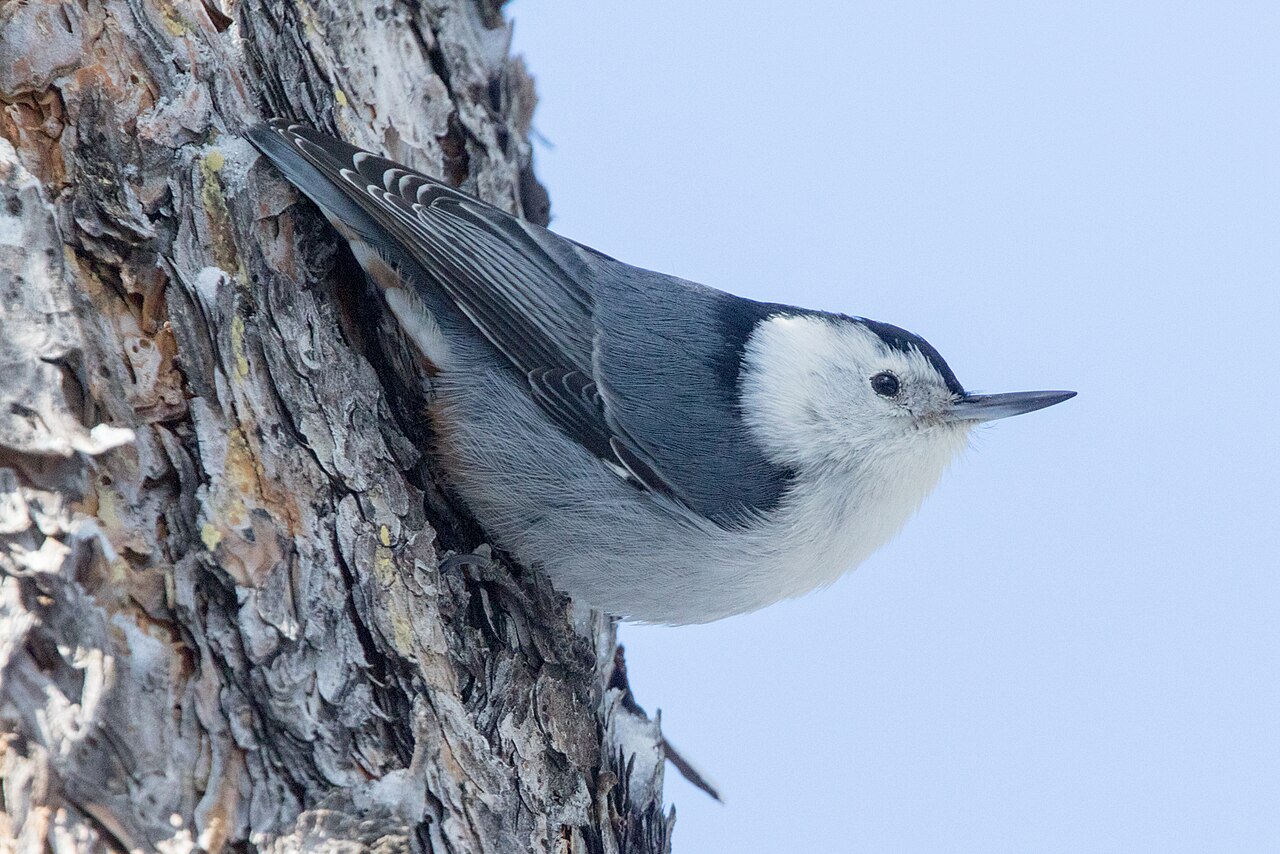
The largest nuthatch in the region and the only one common everywhere in the east: blue-grey above, white below, with a black cap running back over the nape like a hood. It stays all year within the same few hectares of woodland. At a feeder it stands out by taking a single seed and flying off with it at once.
Voice
All year round it gives a nasal, tooting yank-yank-yank, as though someone were blowing a tin horn; lower and slower in the east than in the west. The song is a rapid, monotone series of eight to twelve identical, slightly braying notes, wer-wer-wer-wer, delivered from a high branch in late winter. Feeding pairs keep in touch with a soft, short ip audible only at close range. When alarmed the nasal call is drawn out into a sustained bleating, which often gives away an owl or a squirrel.
Recording: Richard E. Webster — CC BY-NC-SA 4.0 · Portal, Arizona, United States · xeno-canto
Identification
Blue-grey upperparts, clean white underparts with a rusty wash around the legs, and a wholly white face in which the dark eye stands alone against the white. Crown and nape are glossy black on the male and greyer on the female, though the difference is not always visible in the field. The body is squat, the tail short and broad, there seems to be no neck at all, and the straight bill is long for a songbird. In flight it is short and undulating, with white corners in the black tail. Juveniles resemble their parents, with a duller cap.
Confusion species
Red-breasted Nuthatch (Sitta canadensis) is much smaller, has a black eye stripe cutting across the white face and rusty underparts. Brown-headed Nuthatch (Sitta pusilla) of the southern pinewoods and Pygmy Nuthatch (Sitta pygmaea) of the west wear a cap that reaches down below the eye, so that the face is marked rather than white. Brown Creeper only climbs upwards, props itself on its tail, and is streaked brown. Black-capped Chickadee also has a black cap, but carries a black throat patch with it.
Habitat
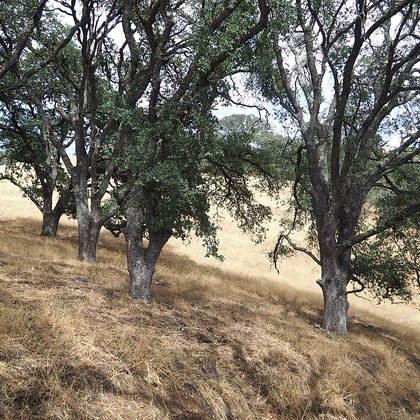
Mature deciduous woodland with heavy trunks and dead wood — oak, beech, maple, hickory — and in the west pine, juniper and montane conifer forest. What it needs is rough bark to search and a cavity to roost in; young coppice and dense scrub supply neither. On the edge of towns it holds on as long as old trees are left standing: a park with thick oaks is enough. In the Midwest it follows the riverside woods far out into the prairie.
Where the bird is most often found, arranged by the USNVC — the vegetation classification of the United States and Canada — and CMECS for sea and coast.




Range and movements
Resident from southern Canada to Florida and Texas, and in the west through the mountains into the highlands of Mexico; it does not migrate and winters where it spent the summer. Only in hard winters do northern birds shift irregularly a little southward. On the Great Plains it is absent wherever trees are absent, so that eastern and western birds are separated by a broad empty belt. East, west and Mexico differ so clearly in call and song that there are good grounds for recognising more than one species; for now they are kept together.
- Resident
- Breeding (summer)
- Winter
- Passage
- dark = core range, pale = thinly spread
Where and when to look
Watch for birds facing downwards: in the east, anything walking head-first down a trunk is this species. Outside the breeding season it travels with the roving parties of chickadees and titmice, so once you hear such a flock, simply wait for the nasal tooting to join in. At a feeder in wooded country it is one of the regulars, especially for sunflower seed in the shell and pieces of walnut.
Conservation
Common and increasing, listed as Least Concern (LC), with a population of about ten million birds; since 1966 it has grown by more than one per cent a year. The species benefits from eastern woodland growing older now that less land is farmed. Where dead and dying trees are tidied away it does disappear, because without cavities there is neither a roost nor a nest.
Scientific name
Sitta carolinensis | Latham, 1790
Latham described the species in 1790 as Sitta carolinensis, in the same genus it still stands in, so author and year carry no parentheses. The genus Sitta was introduced by Linnaeus in 1758 and goes back to Greek sittē, the name Aristotle used for a bird that climbed tree trunks. carolinensis means 'of Carolina'. Latham gave the locality as 'America, Jamaica', which cannot be right, since no nuthatch occurs on Jamaica; South Carolina was later accepted, after the plate Catesby made there in 1731.