All species › Passerines › New World warblers › Golden-crowned Warbler
Golden-crowned Warbler | Basileuterus culicivorus
Goudhaanzanger | Reinita coronidorada
The Golden-crowned Warbler is a warbler of the tropical forest understorey, with an orange-yellow crown stripe between two black bands and plain yellow underparts. Its range runs from northeastern Mexico to northern Argentina; north of the Rio Grande it has been recorded only as a vagrant.

Voice
The song is a series of four to six high, thin notes that swell and rise at the end, see see see seeee, usually given from dense shrubbery without the bird showing itself. The call is a sharp, dry tsip, repeated in short runs as a pair keeps contact; a rattling alarm is also given. Both partners call; the song comes almost entirely from the male.
Recording: Rosa Elena Albornoz — CC0 · Cecilio Acosta (near Caracas), Guaicaipuro, Miranda, Venezuela · xeno-canto
Identification
The upperparts are grey-green without wing bars, the underparts plain yellow all the way to the undertail coverts. The head pattern settles it: an orange-yellow to golden stripe runs down the centre of the crown, bordered on each side by a broad black band, with a pale supercilium and a dark eyestripe below that. The ear coverts are grey. The legs are flesh-coloured. Immatures are duller and browner and largely lack the crown pattern, but keep the eyestripe. The sexes are alike.
Confusion species
Within this window Rufous-capped Warbler (Basileuterus rufifrons) comes closest: it has a rufous rather than striped crown, a long white supercilium and a white belly instead of yellow underparts. Nashville Warbler has a grey head with a complete white eyering and no crown pattern at all. Orange-crowned Warbler (Leiothlypis celata) is plain olive with faint streaking and lacks the black crown bands. The combination of a striped crown, no wing bars and wholly yellow underparts is unmistakable within North America.
Habitat
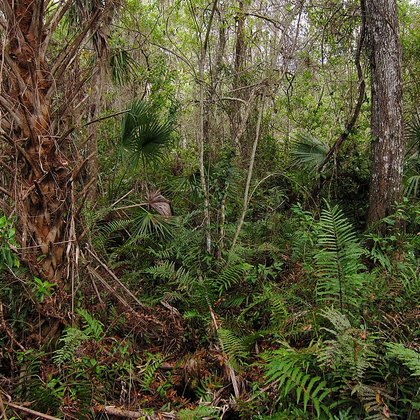
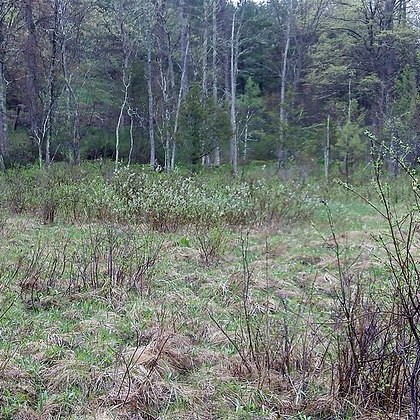
Understorey and low shrub layer of humid evergreen forest, semi-deciduous forest and old second growth, from the lowlands to about 2000 metres in the mountains. It usually stays within the lowest two metres, among dense vines and shrubs, and rarely enters the canopy. In northeastern Mexico this means cloud forest and densely vegetated ravines on the slopes; the bare plateau top it avoids. The few birds that reached Texas were in dense thickets of riverine forest along the Rio Grande.
Where the bird is most often found, arranged by the USNVC — the vegetation classification of the United States and Canada — and CMECS for sea and coast.


Range and movements
The range begins in northeastern Mexico in Tamaulipas, Nuevo León and San Luis Potosí and runs along the slopes of both coasts south through Central America and the Andes to northern Argentina and Uruguay. The species is resident and moves at most up and down the slopes; true migration is absent. North of the Rio Grande there are a handful of records, almost all in winter and in the Lower Rio Grande Valley of southern Texas. Because this is a resident bird, such records have stayed scarce.
- Resident
- Breeding (summer)
- Winter
- Passage
- dark = core range, pale = thinly spread
Where and when to look
Look for it in northeastern Mexico by sound: the rising, swelling series gives it away before the eye does, since it stays in the dense understorey. Follow the voice until you have a view of a gap in the shrub layer, then watch the crown — against the light the black and yellow head pattern still shows while the yellow underparts wash out.
Conservation
The species is spread over a very large range and is found commonly through much of it; it has therefore not been separately assessed for the Red List. It tolerates old second growth and forest edge reasonably well, which makes it less sensitive to fragmentation than species tied strictly to mature forest. In northeastern Mexico, at the northern limit of the range, cloud forest has been much reduced by farming and grazing, and the species has disappeared locally there.
Scientific name
Basileuterus culicivorus | (Deppe, 1830)
Wilhelm Deppe described the species in 1830 as Sylvia culicivora, from material taken in Mexico; the type came from Jalapa in Veracruz. Because it was later placed in another genus, author and year stand in parentheses. The epithet culicivorus is formed from Latin culex 'gnat' and -vorus 'eating', hence 'gnat-eater'. The genus Basileuterus was introduced by Cabanis in 1831, from Greek basileuteros 'more kingly', after the coloured crown stripe, which the English and Dutch names also name.