All species › Passerines › New World warblers › Canada Warbler
Canada Warbler | Cardellina canadensis
Canadese zanger | Reinita canadiense
The Canada Warbler is a blue-grey warbler with yellow underparts, yellow spectacles and a necklace of black streaks across the breast. It breeds in the moist shrub layer of mixed forest from southeastern Yukon to the Appalachians, and then makes one of the longest migrations in the family, to northwestern South America.

Voice
The song opens with a sharp isolated chip and runs on into a rapid, irregular burst of notes that falls into no fixed pattern, roughly chip — chewee-chee-deechee-choo. No two phrases are the same; the uneven rhythm separates it from the even series of most relatives. In the early morning the male sings a faster and more variable type than during the day. The call is a low, flat chup.
Recording: Sue Riffe — CC BY-NC-SA 4.0 · Tawas Point State Park, Iosco County, Michigan, United States · xeno-canto
Identification
The male is blue-grey above without wing bars and bright yellow from chin to belly, with white undertail coverts. Across the breast stands a row of black streaks that meets as a necklace; black streaks also mark the forehead. A white eyering runs round the eye and turns yellow towards the bill, forming a spectacle. The legs are flesh-coloured. Female and immature share the pattern, but the necklace is grey and faint and the head greyer. There is never white in the tail.
Confusion species
Magnolia Warbler also has yellow underparts with black streaking, but two white wing bars, a black back pattern and a white band across the tail. Nashville Warbler lacks the necklace and has a complete white eyering with a yellow throat. A female Mourning Warbler is olive without streaking and without yellow spectacles. Three marks together settle Canada Warbler: no wing bars, no white in the tail, and yellow spectacles on a grey head.
Habitat
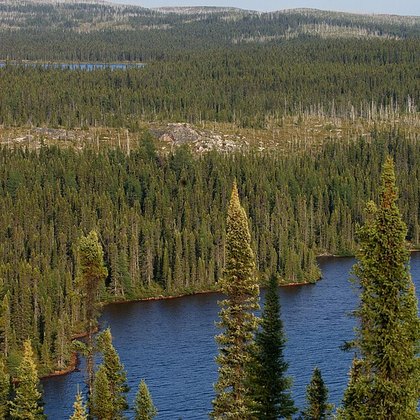
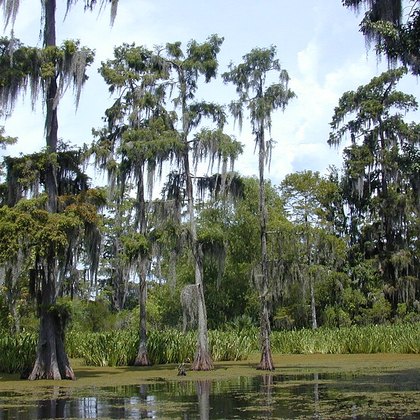
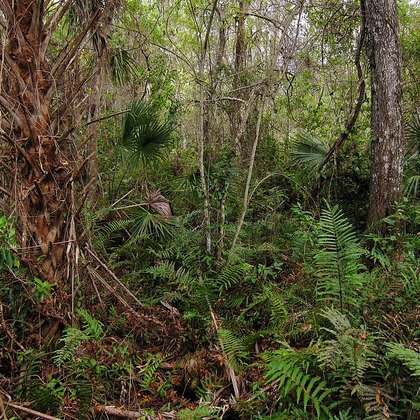
Moist mixed and deciduous forest with a dense, mossy shrub layer, usually near water: forested wetland, alder and willow thickets along streams, and wet hollows with fallen trunks. In the northwest of the range it uses aspen forest, in the south the rhododendron slopes of the southern Appalachians. The nest sits on or just above the ground, in moss, an upturned root mass or a stream bank. In winter it occupies humid montane forest of the Andes, roughly between 1000 and 2000 metres, where it joins mixed flocks.
Where the bird is most often found, arranged by the USNVC — the vegetation classification of the United States and Canada — and CMECS for sea and coast.



Range and movements
Well over four fifths of the breeding population is in Canada, from southeastern Yukon and northeastern British Columbia east through the boreal forest to Nova Scotia. In the United States it breeds in northern Minnesota, Wisconsin, Michigan, New York and New England, and further south in a narrow band along the Appalachians to northern Georgia. Migration passes over the eastern United States, the Gulf coast and Central America. It winters on the northern and western flank of the Andes, from Venezuela and Colombia to northwestern Bolivia; within the guide area only Colombia and Venezuela remain of that.
- Breeding (summer)
- Winter
- Passage
- dark = core range, pale = thinly spread
Where and when to look
The best chance is passage in the second half of May, when the necklace is at its clearest and the bird still sings. It stays low, in the shrub layer beneath the warbler flock, and flicks its wings constantly — so search below eye level rather than in the crown. In autumn the yellow spectacles on an otherwise grey head still identify it when the necklace has all but gone.
Conservation
Partners in Flight puts the world population at about 3 million birds and records a decline of some 62 per cent between 1970 and 2014; the continental concern score is 14 out of 20 and the species is on the Yellow Watch List. In Canada it is listed as threatened under the federal species act. The causes given are loss of the dense shrub layer through logging and through deer browsing, drainage of forested wetland, and deforestation in the Andean region where it winters. If the present rate continued, half of the remaining population would again be lost within fifty years.
Scientific name
Cardellina canadensis | (Linnaeus, 1766)
Linnaeus described the species in 1766 as Muscicapa canadensis, from material taken in Canada; because it was later placed in another genus, author and year stand in parentheses. The epithet canadensis means 'from Canada', which the English and Dutch names also refer to. The genus Cardellina was introduced in 1850 by Charles Lucien Bonaparte, from the Italian dialect word cardella for the European Goldfinch; the name thus means something like 'little goldfinch'.