All species › Passerines › New World warblers › Wilson's Warbler
Wilson's Warbler | Cardellina pusilla
Wilsons zanger | Reinita de Wilson
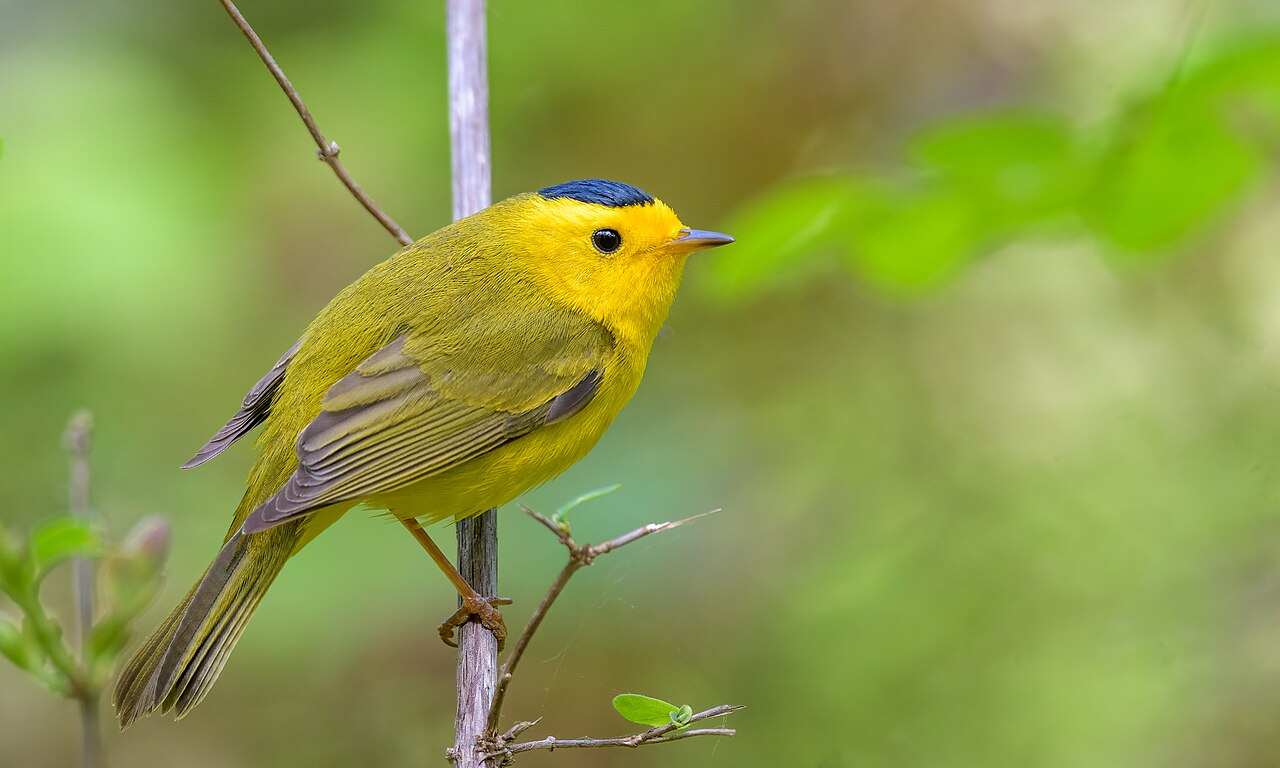
Wilson's Warbler is one of the smallest American warblers: olive-green above, yellow below, and in the male with a round black cap on the crown. It breeds in willow and alder thickets from Alaska to Newfoundland and south through the western mountains, and winters from Mexico to Panama.
Voice
The song is a rapid, chattering series of ten to fifteen short notes that drops in pitch and grows louder towards the end, chi-chi-chi-chet-chet-chet. In the west the series is usually faster and drier than in the east. The call is a flat, slightly husky chimp, with a nasal quality that differs from the clear chip of most relatives. The male sings from a low shrub branch, rarely more than a couple of metres up.
Recording: Andrew McCafferty — CC BY-NC-SA 4.0 · Aylard Farm, Sooke, Capital Regional District, British Columbia, Canada · xeno-canto
Identification
A small, short-winged warbler with a thin bill and a proportionately long, narrow tail, which it often holds up and jerks in short movements. The upperparts are olive-green, the underparts and face clear yellow; wing bars are absent and there is no white in the tail. The male wears a sharply bordered, glossy black cap on the forecrown. In the female that cap is small, dull and mixed with olive, or absent altogether; the large dark eye then stands out on an unmarked yellow face. Western birds are brighter yellow than eastern ones.
Confusion species
Yellow Warbler is fuller in build, has yellow spots in the tail and, in the male, chestnut breast streaks; the crown is never black. A female Hooded Warbler is larger and has large white tail spots, which show at once when the tail is spread. Orange-crowned Warbler is duller olive, with faint breast streaking and a broken eye-ring. For a female Wilson's the combination settles it: no wing bars, no white or yellow in the tail, and a plain yellow face with a dark eye.
Habitat
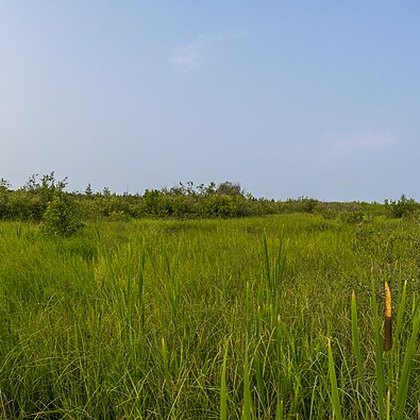
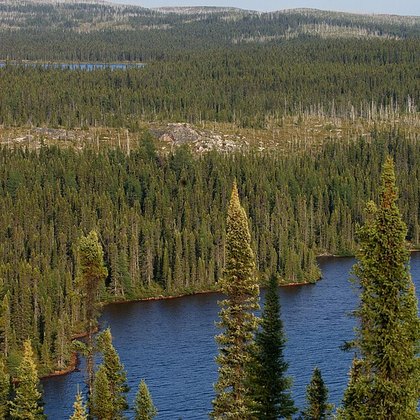
Breeds in dense thickets of willow, alder and birch along streams, in bogs, wet clearings and damp mountain meadows, in the west up to above 3000 metres. It avoids closed forest and high canopy; the nest sits on the ground in a small hollow at the foot of a shrub. On migration it also uses drier scrub, orchards and gardens. In winter it occupies everything from lowland scrub and riparian woodland to cloud forest and coffee plantations, usually in the low vegetation.
Where the bird is most often found, arranged by the USNVC — the vegetation classification of the United States and Canada — and CMECS for sea and coast.





Range and movements
The breeding range runs from western and central Alaska across boreal Canada to Newfoundland and Nova Scotia, and in the west south along the Cascades, the Sierra Nevada and the Rocky Mountains to southern California and northern New Mexico. In the eastern United States breeding is limited to northern Minnesota, northern Michigan, northern New York and New England. Migration is broad-front and across the whole width of the continent; it winters from northwestern Mexico and the Gulf slope south to Panama, with the largest numbers on the Mexican west slope and in the mountains of Central America.
- Resident
- Breeding (summer)
- Winter
- Passage
- dark = core range, pale = thinly spread
Where and when to look
It seldom sits still: in the shrub layer it hops from leaf to leaf picking off insects, with a great deal of tail movement. Look for that movement in low scrub rather than for a perched bird. In spring the male's black cap shows against the yellow face at a distance; in autumn the husky chimp helps pick it out of a mixed warbler flock.
Conservation
Partners in Flight puts the world population at about 81 million birds, which makes it one of the most numerous American warblers; the IUCN lists it as Least Concern (LC). Even so, numbers fell by roughly 60 per cent between 1966 and 2019, nearly two per cent a year, and the Continental Concern Score is 10 out of 20. Loss of riparian thicket through water abstraction, grazing and river regulation counts as the main cause, together with the loss of lowland and montane forest in the winter range; locally brood parasitism by Brown-headed Cowbird adds to it. The western coastal form chryseola has declined most sharply.
Scientific name
Cardellina pusilla | (Wilson, 1811)
Alexander Wilson described the species in 1811 as Muscicapa pusilla, from material taken in southern New Jersey; because it was later placed in another genus, author and year stand in parentheses. The epithet pusilla is Latin for 'very small'. The English and Dutch names honour Wilson himself, after whom the species long stood in the genus Wilsonia. The current genus Cardellina was introduced in 1850 by Charles Lucien Bonaparte, from the Italian dialect word cardella for the European Goldfinch.