All species › Passerines › New World warblers › Rufous-capped Warbler
Rufous-capped Warbler | Basileuterus rufifrons
Roodkapzanger | Reinita coronirrufa
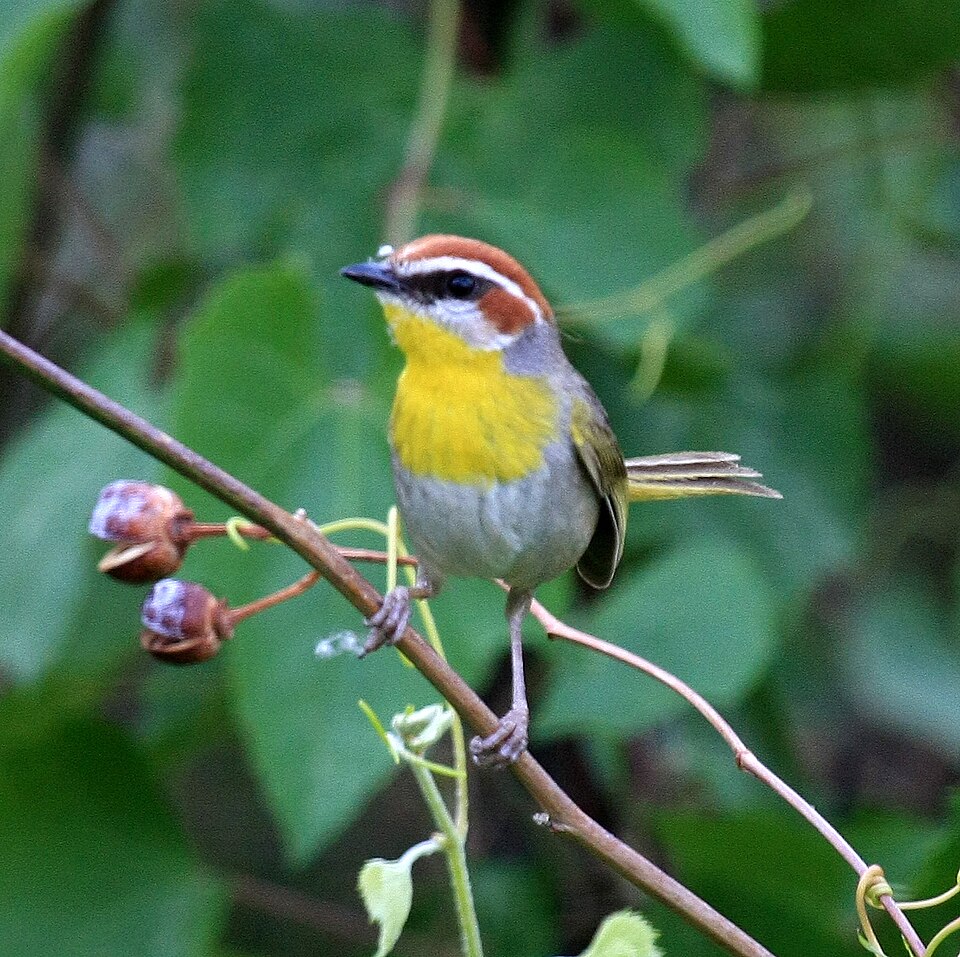
The Rufous-capped Warbler is a long-tailed warbler of dense scrub and canyon bottoms in Mexico and Guatemala. It moves wren-like low in the vegetation, holding its tail steeply cocked. In the United States it is an irregular presence in the canyons of southeastern Arizona and on the Edwards Plateau in Texas, where nesting attempts have occasionally been recorded.
Voice
The song is an accelerating series of dry chip notes on roughly one pitch, running into a rattle at the end and sometimes closing with a few accented notes. Song use varies by season, by time of day and from year to year. The call is a soft, staccato chek, often in short series as a pair keeps contact in dense cover. Despite the family name, none of the New World warblers actually warbles.
Recording: Manuel Grosselet — CC BY-NC-SA 4.0 · Tlalixtac de Cabrera, Santo Domingo Tomaltepec, Oaxaca, Mexico · xeno-canto
Identification
The crown is rufous, with a broad white eyebrow, a dark eyeline and a white stripe below the cheek. Throat and breast are yellow, the belly white, and the upperparts dull olive to olive-grey, without wingbars and without white in the tail. The tail is long and is often held at an upward angle and flicked in short jerks. The bird forages in low scrub and on the ground for insects and spiders and rarely takes anything on the wing.
Confusion species
Fan-tailed Warbler is larger, has a grey head with a yellow crown patch and white teardrops around the eye, and white tips to the tail. Golden-crowned Warbler has an orange-brown crown with black lateral stripes and no white eyebrow. Young warblers with a brownish crown lack the crisp white-dark-white head pattern. The absence of wingbars and tail spots, combined with the cocked tail, separates the species from all Setophaga warblers in the same area.
Habitat
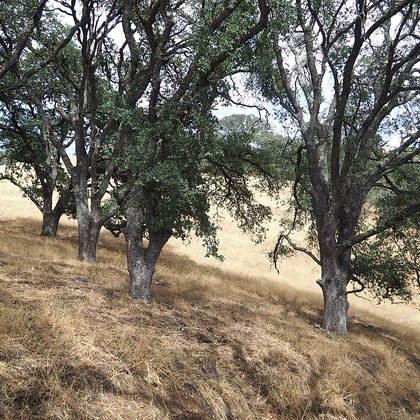
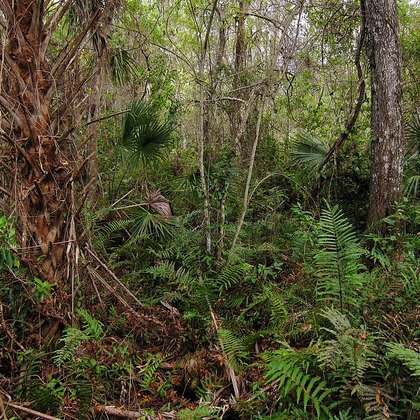
Dry to semi-humid scrub, thorn forest and open oak woodland of foothills and highlands, often on slopes with dense undergrowth. In Arizona and Texas it occupies canyon bottoms with oaks, dense shrubs and a permanent or seasonal watercourse. It stays almost entirely within the lowest two metres and seldom enters the canopy. Grassland and closed tall forest without an understorey are avoided.
Where the bird is most often found, arranged by the USNVC — the vegetation classification of the United States and Canada — and CMECS for sea and coast.



Range and movements
The range covers most of Mexico, from southern Sonora and southwestern Chihuahua on the Pacific side and Nuevo León and Tamaulipas on the Gulf side south to Chiapas, and on into Guatemala; populations further south in Central America are now often treated as a separate species. The species is resident. In the United States it involves small numbers in a few canyons of southeastern Arizona, where birds have at times been present for years on end and have bred, and scattered records in southern and central Texas.
- Resident
- Breeding (summer)
- Winter
- Passage
- dark = core range, pale = thinly spread
Where and when to look
In Arizona, Florida Canyon and a few neighbouring canyons of the Santa Rita Mountains give the best chance; go early in the morning and listen for the accelerating rattle from dense shrubs along the dry bed. Waiting pays better than searching: the bird works a fixed route through the scrub and comes into the open of its own accord. The cocked tail shows the moment it moves, even when the colours are lost in shade.
Conservation
The IUCN lists the species as Least Concern (LC), but that assessment still covers the broad sense, including the more southerly relatives now treated as a separate species; in that broad sense the population was put at about two million birds. It holds out in secondary scrub and neglected field margins, so conversion of forest to smallholder farming does not at once lead to its disappearance. In the United States the numbers involved are so small that they depend largely on settlement from Mexico.
Scientific name
Basileuterus rufifrons | (Swainson, 1838)
William Swainson described the species in 1838 as Setophaga rufifrons; because it was later placed in Basileuterus, author and year stand in parentheses. The species name is from Latin rufus 'reddish' and frons 'forehead'. The genus Basileuterus derives from Greek basileuteros 'more kingly', after the coloured crown of many species in the genus. The specimen described came from Mexico, later restricted to a locality in Veracruz.